Introduction
When a chicken becomes sick or weak, one of the most useful things a beginner can do is give her a quiet, clean, easy-to-monitor place to rest.
You don’t need an expensive veterinary cage.
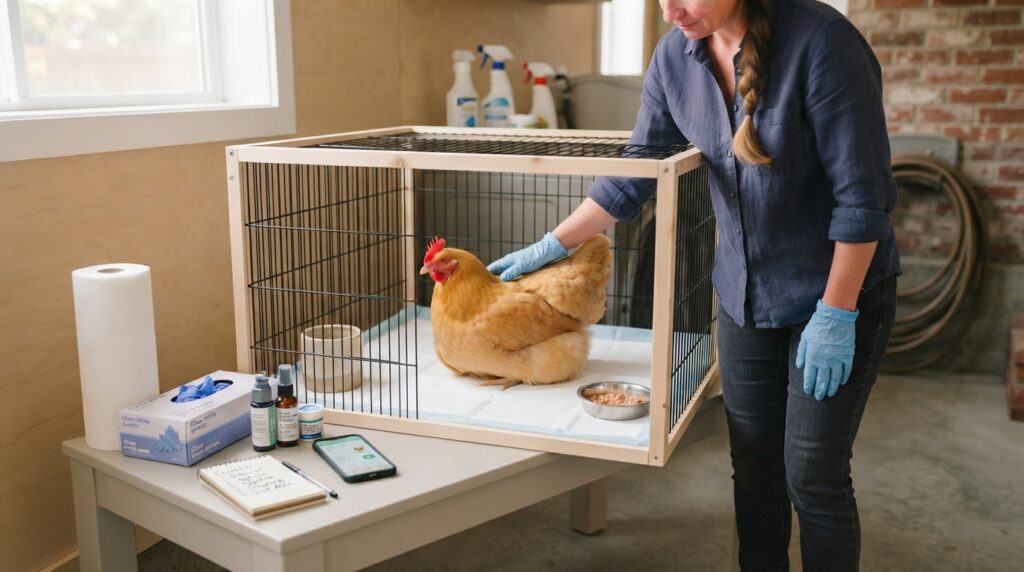
A simple hospital crate can be made from a clean pet carrier, sturdy plastic storage container with appropriate ventilation, or another secure enclosure that gives the chicken enough room to stand, turn around, and access food and water safely.
The purpose is simple:
Reduce stress, prevent bullying, make observation easier, and give you a controlled place to monitor food, water, droppings, and behavior.
It is not meant to diagnose or cure the underlying problem.
Birds can hide illness, and a chicken that looks only mildly unwell can sometimes deteriorate quickly. Veterinary guidance also recommends minimizing stress and avoiding restraint that interferes with breathing.
Here’s how to create a practical hospital crate without turning your backyard into a mini veterinary clinic. 🩺
1. Choose the Right Container 📦
The easiest option is usually a secure, well-ventilated pet carrier or small animal enclosure.
It should be:
- Large enough for the chicken to stand normally
- Large enough for her to turn around
- Easy to clean
- Well ventilated
- Secure enough to prevent escape
- Easy for you to access
- Protected from other chickens
Avoid using a tiny box where the chicken cannot move comfortably.
At the same time, you don’t necessarily need a huge enclosure.
A smaller, controlled space can make it easier to monitor a sick bird and prevent her from wasting energy wandering around.
A useful rule
Think:
Safe + clean + calm + observable.
Not:
Fancy + complicated + full of equipment.
2. Put It Somewhere Quiet 🤫
Location matters almost as much as the crate itself.
Place the hospital crate somewhere:
- Quiet
- Dry
- Out of direct weather
- Away from predators
- Away from household chemicals
- Away from excessive noise
- Away from curious children and pets
- Easy for you to check regularly
A sick chicken generally benefits from reduced activity and stress.
Avoid putting her directly in the middle of the household where people constantly walk past the crate.
But don’t hide her so completely that you forget to check her.
The ideal location is quiet but convenient to monitor.
3. Make the Floor Safe 🧻
A sick chicken may be weaker than normal.
That means the floor shouldn’t be slippery.
Cover the bottom with an absorbent, non-slip material such as:
- Clean paper towels
- Plain disposable paper
- Another clean, absorbent liner that can be replaced easily
Paper towels are particularly useful because they allow you to see droppings clearly.
That’s helpful when you’re trying to determine whether the bird is eating, drinking, and producing normal waste.
Change the liner regularly
Don’t allow wet droppings to accumulate.
A dirty enclosure increases contamination and makes it harder to monitor what’s happening.
USDA APHIS emphasizes cleaning and sanitation as important parts of poultry biosecurity.
4. Skip the Perch if She Is Weak 🪵
A healthy chicken may happily sleep on a perch.
A weak chicken may not be able to.
If she is having trouble standing, balance problems, or weakness, a perch can create an unnecessary fall risk.
For a sick or weak bird, a stable floor-level setup is often more practical.
You can reassess the setup as she improves.
The goal isn’t to make the crate look like a normal coop.
The goal is to make it safe for the chicken you actually have in front of you.
5. Give Her Easy Access to Water 💧
Water should be easy to reach without requiring the chicken to walk far or climb.
Use a stable container that is:
- Easy to access
- Difficult to tip over
- Appropriate for the bird’s size
- Easy to clean
Place it where the chicken can reach it comfortably.
Avoid positioning water where the bird could easily knock it over and soak the bedding.
Wet bedding creates a mess and can make maintaining a clean recovery space more difficult.
Important
Do not force water into a weak chicken’s mouth unless a veterinarian has specifically instructed you how to do it.
Trying to syringe water without appropriate technique can create a risk of aspiration.
If the bird isn’t drinking, that is useful information to give your veterinarian.
6. Make Food Easy to Reach 🍽️
Use the chicken’s normal appropriate feed unless a veterinarian has recommended something different.
Put the feeder close enough that the chicken doesn’t need to walk across the crate to reach it.
A sick chicken may have limited energy.
You want her to be able to:
wake up → reach food → eat → reach water → rest.
Don’t suddenly introduce a complicated diet because the chicken is sick.
And don’t assume that treats are a substitute for a balanced poultry diet.
If appetite is poor, record how much she appears to eat and tell the veterinarian.
Changes in food and water consumption are important observations when evaluating sick poultry.
7. Consider Temperature Carefully 🌡️
Temperature is one area where beginners can accidentally cause problems.
A sick bird may need a comfortable environment, but more heat is not automatically better.
Birds with respiratory difficulty can be particularly vulnerable to stress during handling and environmental changes. Veterinary guidance emphasizes minimizing stress and monitoring breathing closely.
If the chicken is cold, weak, or unable to maintain normal body temperature, ask a veterinarian about appropriate supportive warmth.
If supplemental heat is recommended, provide it so the bird can move away from the heat source.
Watch the chicken, not just the thermometer.
Signs that the setup may be too warm can include:
- Open-mouth breathing
- Excessive panting
- Moving away from the heat source
If breathing becomes labored, don’t assume the answer is simply “more heat.”
Difficulty breathing warrants prompt veterinary attention.
8. Keep the Air Fresh Without Creating a Draft 🌬️
The crate needs ventilation.
Don’t completely cover it with blankets or towels.
A cover can help reduce visual stimulation and drafts, but it should never block ventilation.
Think of the setup as:
protected from direct drafts + still receiving fresh air.
This becomes particularly important if the chicken has respiratory symptoms.
A stuffy, poorly ventilated enclosure isn’t an appropriate hospital environment.
9. Keep the Crate Away From the Main Flock 🐔↔️🐔
If you suspect illness, separating the chicken can protect her from bullying and can also reduce potential disease transmission.
USDA APHIS recommends isolating sick birds and using biosecurity practices such as clean equipment, dedicated footwear, and hand hygiene.
This doesn’t mean you should assume every sick chicken has a contagious disease.
It means that until you know what’s happening, unnecessary contact between a sick bird and healthy birds is best avoided.
Don’t allow healthy chickens to share:
- Food containers
- Water containers
- Bedding
- Crates
- Cleaning tools
Clean your hands after handling the sick bird, particularly before returning to the healthy flock.
10. Create a Simple “Hospital Station” 🩺
You don’t need dozens of supplies.
A useful beginner station might contain:
- Clean hospital crate
- Disposable floor liners
- Appropriate poultry feed
- Clean water container
- Paper towels
- Disposable gloves
- Hand sanitizer or access to handwashing
- Cleaning supplies
- Notebook or phone for observations
- Kitchen scale if you already have one and know how to safely weigh the bird
Keep the supplies organized in one place.
That way, you’re not searching for everything while trying to handle a weak chicken.
11. Make Observation the Main Tool 🔎
A hospital crate is valuable because it makes changes easier to see.
Instead of watching a sick chicken disappear into a flock of ten birds, you can observe one bird directly.
Check:
Behavior
Is she alert?
Appetite
Is she eating?
Water
Is she drinking?
Breathing
Does she breathe comfortably?
Droppings
What do they look like?
Movement
Can she stand and walk normally?
Posture
Is she sitting normally or appearing weak?
Appearance
Are her eyes, nostrils, comb, feathers, and vent changing?
These observations can be much more useful to a veterinarian than simply saying:
“She looks sick.”
Bird health guidance specifically recommends observing behavior, appetite, respiratory effort, posture, droppings, and other changes.
12. Use the Crate to Track Progress 📱
Your phone can become a surprisingly useful chicken-health tool.
Take a photo when you first set up the crate.
Then record:
Time: 8:00 AM
Eating: Yes/No
Drinking: Yes/No
Droppings: Normal/Changed
Activity: Alert/Quiet/Weak
Breathing: Normal/Abnormal
Notes: Anything new
Repeat later in the day.
This gives you a timeline.
If you need veterinary care, you can provide specific information about what changed and when.
Photos and videos can also document posture, breathing, walking, droppings, or other visible changes.
13. Don’t Keep Handling Her Just to Check 👐
This is an easy mistake.
You want to help, so you repeatedly pick up the chicken to inspect her.
But frequent handling can increase stress.
For many observations, watching from outside the crate is better than repeatedly picking her up.
If you do need to handle her, prepare everything first so the interaction is as short and calm as possible.
Merck Veterinary Manual advises keeping birds calm and avoiding restraint that compresses the chest because thoracic compression can interfere with breathing.
Never hold a chicken upside down simply because it seems convenient.
14. Clean the Hospital Crate Separately 🧼
Treat the hospital crate as a separate piece of equipment.
Don’t move it back into the flock area while it is still contaminated.
After use:
- Remove bedding and organic material.
- Clean the enclosure thoroughly.
- Wash food and water containers.
- Disinfect appropriate surfaces using a product according to its label.
- Allow surfaces to dry appropriately.
- Wash your hands after cleaning.
Cleaning must come before effective disinfection because organic material can interfere with disinfectants. USDA APHIS specifically recommends thorough cleaning and sanitation as part of poultry biosecurity.
15. Know When the Crate Is Not Enough 🚨
A hospital crate is supportive care.
It is not an emergency treatment center.
Don’t spend hours arranging bedding while a chicken is experiencing a serious emergency.
Urgent veterinary attention is appropriate for signs such as:
- Severe breathing difficulty
- Collapse
- Extreme weakness
- Seizures
- Serious neurological signs
- Open fractures
- Significant trauma
- Active heavy bleeding
- Inability to stand
Merck’s backyard poultry guidance specifically identifies extreme respiratory difficulty, weakness, seizures or other neurological signs, acute hemorrhage, head trauma, and open fractures as situations requiring emergency care before a routine examination.
If several birds become sick or deaths occur unexpectedly, contact a veterinarian or appropriate animal-health authority rather than treating the problem as an individual chicken issue. USDA APHIS also advises reporting concerning illness signs through veterinary or animal-health channels.
A Simple 10-Minute Hospital Crate Setup 🐔⏱️
If you need to prepare one quickly, use this checklist.
Minute 1–2: Choose the location
Pick a quiet, secure, temperature-appropriate area away from the flock.
Minute 3–4: Prepare the crate
Clean it and add a non-slip, absorbent liner.
Minute 5: Add water
Place stable, easy-to-reach fresh water inside.
Minute 6: Add feed
Place the normal appropriate feed where the chicken can reach it easily.
Minute 7: Check safety
Make sure there are no sharp edges, loose strings, unstable objects, or escape routes.
Minute 8: Reduce stimulation
Keep the area calm and avoid unnecessary handling.
Minute 9: Observe
Watch breathing, posture, alertness, and movement before disturbing the chicken.
Minute 10: Start your record
Write down the time, symptoms, appetite, drinking, droppings, and anything unusual.
That’s it.
Simple is often better.
The Hospital Crate Mindset 🏥🐔
Think of a hospital crate as having four jobs:
1. Protect
Keep the chicken safe from predators, injury, and flock bullying.
2. Rest
Give her a calm environment where she doesn’t have to compete with other birds.
3. Observe
Make eating, drinking, droppings, breathing, and behavior easier to monitor.
4. Transport
If veterinary care is needed, the crate may make it easier to move the chicken safely.
It is not supposed to replace diagnosis or treatment.
Final Thoughts 🌱
A sick chicken doesn’t need a complicated hospital room.
She needs a clean, secure, quiet, well-ventilated space with easy access to food and water and as little unnecessary stress as possible.
The best hospital crate is therefore not the most expensive one.
It’s the one that lets you safely answer the important questions:
Is she eating? Is she drinking? Is she breathing normally? Can she stand? Are her droppings changing? Is she getting better or worse?
Keep the setup simple, maintain good hygiene, and observe carefully.
And remember: if the chicken has severe breathing difficulty, collapse, major weakness, neurological signs, serious trauma, or other emergency symptoms, don’t let crate preparation delay veterinary care.
A hospital crate is a supportive-care tool, not a substitute for a veterinarian. 🐔❤️