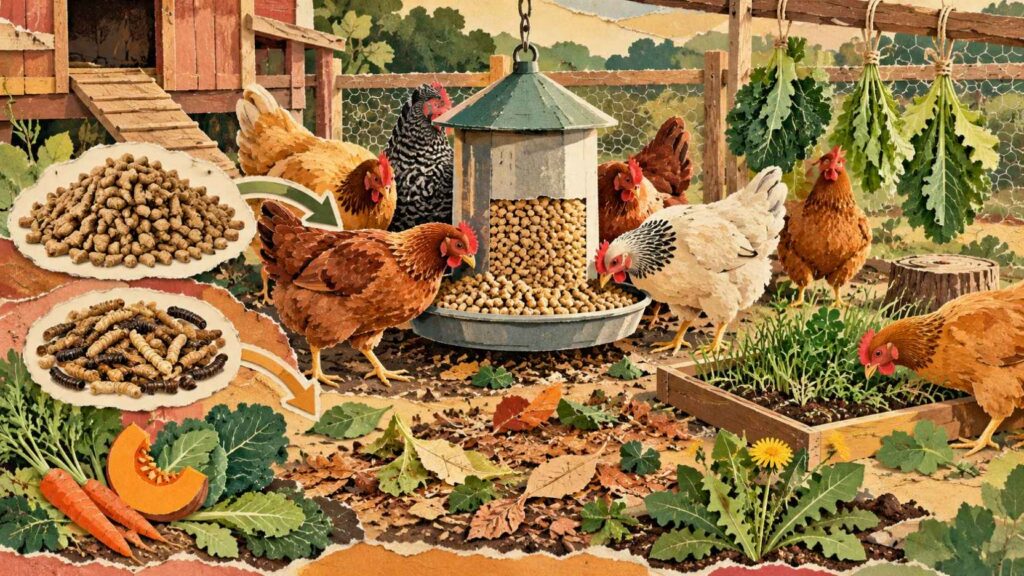
If your chickens spend most of their time inside a secure run, it is easy to wonder whether they are missing something that free-ranging birds naturally find in grass, weeds, worms, beetles, and other insects. 🐔 New keepers often worry that an enclosed flock needs regular mealworms, vegetables, or garden greens to compensate for not roaming across pasture. The reassuring answer is that chickens do not need bugs and greens to meet their basic nutritional requirements when they are eating an appropriate complete feed.
That does not make insects, grass, leafy plants, or other forage pointless, because these foods can provide variety and encourage natural scratching, pecking, and searching behavior. 🌱 The important distinction is between nutrition and enrichment: complete feed should supply the carefully balanced nutrients the bird depends on, while forage can make daily life more interesting. For owners researching feeding chickens without free ranging, understanding that difference prevents both unnecessary worry and accidental overfeeding.
Do Chickens Actually Need To Eat Bugs To Stay Healthy?
Chickens are naturally omnivorous and will enthusiastically chase insects, scratch through soil, pick at vegetation, and investigate almost anything that looks edible. 🪱 Watching this behavior can make insects appear essential, but enthusiasm does not necessarily equal nutritional necessity. A correctly formulated ration for laying hens is designed to provide appropriate amounts of protein, amino acids, energy, vitamins, and minerals without requiring the owner to supply worms or insects separately.
That means a hen living in a well-managed enclosed run does not become deficient simply because she cannot hunt grasshoppers every afternoon. Bugs can contribute protein and provide excellent behavioral enrichment, but they remain an optional addition rather than a mandatory dietary category when complete feed is doing its job. The same principle applies to mealworms, black soldier fly larvae, crickets, and many other commercial insect treats.
Complete Feed Vs. Natural Foraging: What Does Each Provide?
Think of complete layer feed as the nutritional foundation and forage as the optional landscaping around it. 🌾 Formulated feed is designed so that hens consuming it as their principal diet receive a predictable nutritional balance, including the calcium needed for eggshell formation. Natural forage, by comparison, changes with the season, location, soil, available insects, vegetation, weather, and what the birds happen to find.
A free-ranging chicken might find protein-rich insects one day and spend another afternoon eating mostly grass tips and seeds, so pasture cannot guarantee the same consistency as formulated feed. Foraging remains valuable because it encourages movement, exploration, scratching, and food-seeking behavior, but pasture access should complement rather than replace complete feed. This distinction is especially important when building a reliable chicken diet for egg laying, where nutritional consistency matters more than whether the food appears natural.
Seven Simple Ways To Provide Foraging Opportunities Inside A Run
Owners of enclosed chickens can recreate much of the behavioral value of free ranging without turning the run into an uncontrolled buffet. 🌿 The objective is not to manufacture an entire alternative diet but to give birds safe opportunities to scratch, peck, search, and investigate. Even simple changes in how enrichment is presented can keep chickens occupied while allowing their regular feeder to remain the nutritional center of the system.
| Foraging idea | Practical use | Feeding role |
|---|---|---|
| Hanging leafy greens | Encourages pecking and movement | Occasional enrichment |
| Clean grass or sod tray | Provides scratching and vegetation | Enrichment |
| Leaf litter | Encourages searching and scratching | Mostly behavioral |
| Small insect portion | Useful for training or recall | Treat |
| Safe garden weeds | Adds variety when correctly identified | Occasional extra |
| Vegetable trimmings | Makes use of suitable kitchen produce | Treat |
| Deep scratching material | Encourages natural exploration | Behavioral enrichment |
Rotate these activities instead of providing every option every day. 🔄 Chickens often stay more interested when an enrichment item appears occasionally, and rotation also reduces the chance that extras start replacing substantial amounts of their regular ration. Always make sure plants are correctly identified, food is fresh rather than moldy, and anything collected outdoors has not been contaminated with pesticides or other chemicals.
Are Mealworms, Black Soldier Fly Larvae, And Garden Bugs Necessary?
Mealworms and black soldier fly larvae are popular because chickens love them and because both can contain substantial amounts of protein and fat. 🐛 They are useful for calling birds into the coop, rewarding handling, encouraging movement, or simply providing occasional enrichment, but they are not complete layer rations. A nutrient-rich food can still be nutritionally incomplete when compared with a diet formulated to provide everything the bird needs in appropriate proportions.
Garden insects can also be perfectly normal additions when chickens encounter them naturally, but intentionally collecting random bugs requires more caution. Avoid insects from locations treated with pesticides and do not deliberately feed insects that could have contacted chemicals, spoiled material, or other contaminants. When buying dried larvae or mealworms, treat them as supplemental foods rather than something that must appear on the daily menu.
What About Greens For Chickens?
Leafy greens can be enjoyable for confined chickens because they create something to pull, peck, and investigate. 🥬 Suitable vegetables and safe garden plants can provide dietary variety, but a hen does not need a daily salad when her complete ration already supplies the nutrients required for maintenance and production. Greens work best as an enrichment category rather than as a large replacement for layer pellets or crumbles.
The word “natural” can sometimes mislead owners into assuming unlimited plant foods must automatically improve the diet. Chickens have finite appetites, so large quantities of low-energy or nutritionally unbalanced extras can reduce how much complete feed they consume during the day. Keep greens for chickens supplemental, monitor whether regular feed intake changes, and remove leftovers before they become spoiled or moldy.
Can Too Many Greens And Treats Reduce Egg Production?
The biggest nutritional risk is not usually one piece of lettuce or a handful of mealworms; it is dietary displacement. 🍽️ If treats, insects, scratch grains, kitchen scraps, and greens collectively become a large part of daily intake, the hens may eat less of the ration that was formulated to deliver balanced protein, energy, vitamins, minerals, and calcium. A practical beginner guideline is to keep treats and extras to roughly 10% or less of the overall diet, leaving complete feed as the overwhelming majority.
Egg production can change for many reasons, including age, molt, daylight, broodiness, stress, temperature, illness, and nutrition, so do not blame one treat immediately when laying slows. 🥚 However, if hens spend the day waiting for snacks while their feeder remains unusually full, the feeding routine deserves attention. The recurring question that works well here is: “How much complete feed did this replace?”
Do Free-Range Chickens Lay More Nutritious Eggs?
Diet can influence certain characteristics of eggs, but “free range” by itself does not guarantee that every egg will be nutritionally superior. 🌞 What a chicken actually consumes matters more than the label describing where she walks, because two free-ranging flocks may have completely different vegetation, insect availability, supplemental feeds, and seasonal conditions. Enclosed hens eating a carefully formulated diet can still produce high-quality eggs without routine access to pasture.
Yolk color is especially easy to misinterpret because a darker orange yolk looks richer and is often marketed as evidence of a healthier egg. Pigments called carotenoids in foods such as grasses, leafy plants, corn, and some other ingredients can deepen yolk color, but a darker yolk does not automatically prove that the entire egg is more nutritious. 🎨 Use egg appearance as one observation about the flock, not as a nutritional scorecard.
Feed-First Foraging Chart
The simplest way to manage an enclosed flock is to separate what is essential, what is optional, and what should stay limited. 🧭 This prevents owners from accidentally turning enrichment foods into major dietary components just because the birds enjoy them. It also makes purchasing decisions easier because you know which products truly belong in the daily feeding system.
| Category | Examples | Role in the flock |
|---|---|---|
| Essential foundation | Appropriate complete layer feed | Main source of balanced nutrition |
| Essential | Fresh clean water | Available continuously |
| Optional forage | Safe grass, weeds, leafy greens | Variety and enrichment |
| Optional insects | Mealworms, black soldier fly larvae | Treat, training, enrichment |
| Occasional extras | Suitable vegetable scraps | Small supplemental portions |
| Limit | Scratch grains, large treat portions | Can displace complete feed |
| Avoid | Moldy food, pesticide-contaminated forage, spoiled scraps | Unnecessary health risk |
For laying hens, calcium availability also deserves separate attention because eggshell production creates substantial calcium demand. Many flock systems provide an appropriate layer ration and make a calcium source such as oyster shell available separately so laying hens can consume additional calcium as needed. Avoid randomly adding large amounts of supplements to complete feed, because more of a nutrient is not automatically better.
What Actually Matters For Chickens That Don’t Free Range?
If your hens live happily in a secure run, you do not need to imitate every mouthful a free-ranging chicken might discover outside. 🐓 Prioritize appropriate complete feed, constant access to clean water, suitable calcium management for laying hens, adequate space, cleanliness, ventilation, and opportunities for natural behavior. Bugs, greens, forage trays, and vegetables can then be layered on top as enrichment rather than treated as missing nutritional requirements.
So, do chickens need bugs and greens if they don’t free range? Not necessarily for nutrition when they are receiving a properly formulated complete diet, but those foods can still make an enclosed environment more stimulating and enjoyable. 🌿 Think feed first, forage second: provide the balanced ration the body needs, then use safe insects and greens in modest amounts to give the chicken something interesting to do.