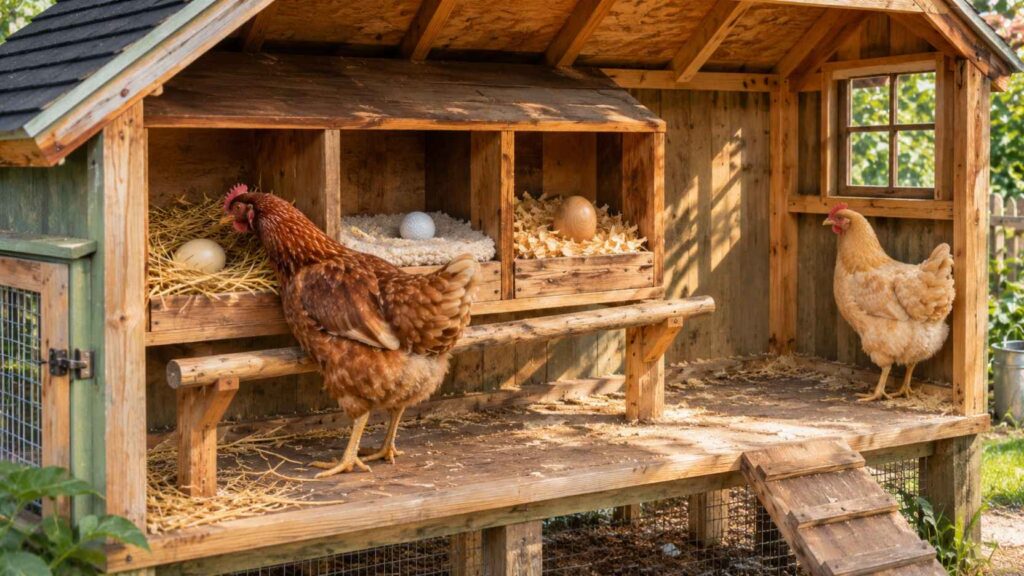
You placed ceramic eggs, wooden eggs, or even golf balls inside your chicken nesting boxes, expecting your hens to understand where their real eggs belong. 🥚 Instead, you keep finding eggs on the coop floor, beneath the roosts, or hidden somewhere in the run. If fake eggs are not working for your chickens, the problem may have more to do with the nesting environment than the decoys themselves.
Fake eggs are meant to encourage nesting behavior, but they cannot make an uncomfortable or inaccessible nesting box appealing. Some hens respond quickly to nesting cues, while others continue using familiar laying spots despite having several decoys available. 🐔 Before spending money on another imitation egg, examine what your chickens experience when they actually need to lay.
Why Do Chicken Keepers Put Fake Eggs in Nesting Boxes? 🥚
Fake eggs serve as visual nesting cues, suggesting that a particular location is already being used for laying. Chickens naturally investigate suitable nesting spaces, and the presence of eggs can help make a location more attractive. This is why backyard keepers commonly place imitation eggs inside nesting boxes before pullets begin producing their first eggs.
However, decoys do not train chickens through a guaranteed learning process. A hen still evaluates whether the nest feels sufficiently private, comfortable, accessible, and secure before settling down. Even a convincing ceramic egg cannot compensate for a nesting box exposed to constant disturbances.
Another important distinction is that fake eggs influence laying location, not egg production itself. They cannot make an immature pullet start laying or correct egg production changes associated with seasonal daylight, molting, nutrition, or illness. Their usefulness depends on whether a hen is already laying and simply choosing an undesirable location.
Golf Balls vs. Ceramic Eggs vs. Wooden Eggs
Not all fake nesting eggs look or feel identical, but there is no dependable evidence that one ordinary decoy material consistently works best for every backyard flock. 🪺 The practical differences involve durability, appearance, ease of cleaning, and whether the object remains suitable for repeated use. Choosing between them should therefore be a maintenance decision rather than a promise of better nesting behavior.
| Decoy Type | Advantages | Limitations |
|---|---|---|
| Golf balls | Inexpensive, durable, easy to find | Different shape and surface from real eggs |
| Ceramic eggs | Realistic shape, easy-to-clean surface | Can chip or break when dropped |
| Wooden eggs | Lightweight, durable, reusable | Some finishes and porous surfaces are harder to clean |
| Plastic eggs | Lightweight, inexpensive, washable | Hollow models may separate or crack |
Golf balls are a convenient starting option because many households already have them. Ceramic eggs resemble real eggs more closely, while wooden eggs offer a lightweight alternative that is unlikely to shatter during normal handling. If you already own any safe, intact decoy, changing the nesting conditions is generally more informative than immediately purchasing a different material.
Five Reasons Fake Eggs May Not Change Laying Habits
1. The Nesting Box Does Not Feel Private Enough
Hens generally prefer nesting areas that offer some separation from bright light, heavy activity, and frequent interruptions. ☀️ A box directly beside a busy doorway or facing strong sunlight may be less appealing than a sheltered corner of the coop. Try reducing unnecessary disturbances and providing a comfortably dim nesting space without eliminating ventilation.
2. The Bedding Feels Uncomfortable or Unstable
A hen needs enough suitable nesting material to settle into a comfortable laying position. Thin bedding, exposed hard flooring, dirty nesting pads, or materials that slide beneath her feet may discourage use. 🌾 Start with clean, dry pine shavings, straw, or an appropriate nesting pad, and check whether the material stays in place.
3. The Hen Already Has a Favorite Laying Spot
Chickens can develop location preferences, particularly after repeatedly laying successfully in the same corner. A fake egg in another box does not automatically erase that established habit. Observe where eggs repeatedly appear, then make the intended nesting boxes more attractive while safely discouraging access to the unwanted location.
4. The Nesting Boxes Are Difficult to Access
A nesting box may look perfectly positioned to its owner while remaining inconvenient for a particular hen. 🐔 High entrances, awkward jumps, slippery landing areas, or competition from other birds can discourage a pullet from entering. Check whether the hen can approach and enter comfortably, adding a stable access perch or step when necessary.
5. The Timing Is Working Against You
Many hens lay during the earlier part of the day, although individual laying times can vary. If birds are repeatedly released into areas with hidden nesting opportunities before using their designated boxes, they may continue choosing those locations. ⏰ For birds already accustomed to laying outside, providing access to comfortable coop nests during their usual laying period can help reveal whether timing contributes to the problem.
What Should You Change Before Buying Another Decoy?
Start by examining the nesting setup rather than changing every detail simultaneously. 🔎 A commonly recommended starting point is approximately one nesting box for every four to five hens, with at least two boxes useful even for a small flock. For standard-sized chickens, a box around 12 inches wide, deep, and tall is often suitable, although larger breeds may need additional room.
Next, watch your hens during their normal laying period without repeatedly disturbing them. Notice whether they investigate the boxes, enter briefly and leave, encounter another hen, or ignore the nesting area altogether. These observations can distinguish an accessibility problem from an unattractive nest or an established laying preference.
Then select one practical adjustment and monitor the results before making another. 🛠️ You might replace uncomfortable bedding, improve access, move a disruptive object, or prevent access to a favorite floor-laying corner without restricting the birds’ essentials. Keeping the decoy unchanged during this experiment makes it easier to identify whether the environmental adjustment helped.
The Seven-Day Nest-Training Observation Tracker 📋
A short tracking period can help you recognize patterns that are difficult to notice during ordinary egg collection. Record where eggs appear, which nesting boxes receive attention, and any changes you make to the setup. Seven days is an observation window rather than a guaranteed training deadline, especially when a flock contains newly laying pullets.
| Day | Observation or Action | What to Record |
|---|---|---|
| Day 1 | Inspect the existing nesting setup | Egg locations, bedding, access, disturbances |
| Day 2 | Observe hens during laying time | Which boxes they investigate or avoid |
| Day 3 | Make one targeted improvement | Exact adjustment and reason |
| Day 4 | Maintain the adjusted setup | Nest visits and floor eggs |
| Day 5 | Observe access and competition | Crowding, blocked entrances, interruptions |
| Day 6 | Continue the same routine | Whether nesting locations are changing |
| Day 7 | Compare observations | Improvement, no change, or remaining problems |
Avoid moving several boxes, replacing every decoy, and changing the bedding all on the same day. Such changes make it harder to understand which factor influenced the birds, even when the results initially look promising. 📊 Consistent observations provide more useful information than repeatedly guessing which nesting product might work.
What If Chickens Still Lay on the Floor?
If eggs continue appearing outside the boxes, investigate whether particular hens are responsible or whether the problem affects the entire flock. One hen repeatedly choosing the same floor corner suggests a different situation from several birds avoiding every available nesting box. Frequent crowding, dirty bedding, and disturbances deserve attention when multiple hens share the problem.
Check especially carefully with pullets that have only recently started laying. Young hens may initially produce eggs in unexpected places while they develop nesting routines, and early access to suitable boxes can make those routines easier to establish. 🐣 Avoid punishing or frightening birds for floor laying, since additional stress does not make a nesting location more inviting.
When Should You Stop Using Fake Eggs?
Fake eggs are useful only when they contribute something to the nesting routine. If your hens consistently use the designated boxes, you can try removing a decoy and observe whether their laying locations remain stable. ✅ There is no requirement to leave imitation eggs in every box indefinitely once the flock has established dependable habits.
If several weeks of observation show no meaningful improvement, reconsider whether decoys are addressing the actual problem. Persistent floor laying may require changes to nesting access, box location, bedding, competition, or the availability of alternative laying areas. Buying more fake eggs without investigating those factors simply repeats an unsuccessful experiment.
You should also remove decoys that become cracked, damaged, excessively dirty, or difficult to sanitize. 🧼 Keep nesting areas clean and collect real eggs regularly to reduce breakage and contamination. An imitation egg should never become another maintenance problem inside a box intended to protect freshly laid eggs.
The Better Solution Is Usually a Better Nest
When fake eggs are not working for chickens, the most productive response is not necessarily choosing a more realistic decoy. 🐓 Start with the fundamentals: comfortable bedding, reasonable privacy, easy access, enough nesting space, and an environment free from unnecessary disturbances. These conditions influence whether a hen wants to use a nest regardless of what imitation egg sits inside it.
Your goal is not to make every hen respond to the same object, but to create a nesting space they consistently prefer over the alternatives. Observe their behavior, change one factor at a time, and let actual egg locations guide your next decision. 🥚 Before buying another fake egg, find out why your hens are rejecting the nest you already provide.