You fill your chicken feeder in the morning, only to discover that a surprising amount of expensive feed has ended up scattered across the ground by afternoon. 🐔 Some hens scratch through the pellets, others flick feed out with their beaks, and a few seem determined to empty the entire container before eating anything. If you have already tried several feeder styles without solving the problem, the real issue may involve feeder design, height, placement, or feeding behavior rather than the chickens themselves.
Chickens wasting feed is a common frustration for backyard keepers because spilled pellets cost money, attract pests, and create additional cleanup. However, the best no-waste chicken feeder is not necessarily the most expensive model or the one promising the largest reduction in spillage. Understanding why your current feeder makes a mess can help you choose between hanging feeders, treadle systems, and covered bucket designs without wasting money on another unsuccessful purchase.
Why Do Chickens Scratch and Scatter Their Feed? 🐓
Chickens naturally scratch, peck, and investigate their surroundings while searching for food, making some feed scattering an expected part of their behavior. Unfortunately, shallow trays and containers placed directly on the ground allow birds to kick pellets into bedding or pull food over the edges. A feeder that gives chickens room to scratch inside it can encourage unnecessary waste, especially when several birds compete for the same opening.
Feed texture also matters because finely crushed material, dust, and larger pieces may separate inside certain containers. 🌾 Birds sometimes select preferred pieces and leave smaller particles behind, making the remaining feed appear less appealing. Overfilling a shallow feeding tray increases spillage because chickens can easily push food over the rim while eating.
Hanging vs. Treadle vs. Bucket Feeders: Which Wastes Less?
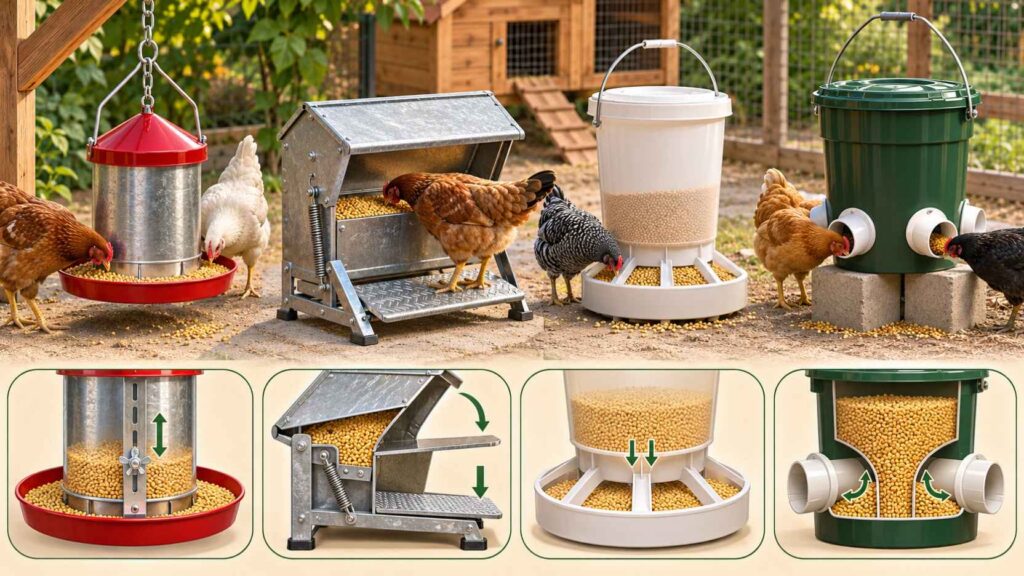
Hanging chicken feeders use suspended containers to keep feed above the ground, helping reduce scratching and bedding contamination. They are generally affordable, easy to adjust, and convenient for backyard flocks, although chickens can still scatter food when the tray sits too low or has an inadequate retaining lip. A properly adjusted hanging feeder is often a sensible first option before investing in more complicated equipment.
Treadle feeders open when chickens step onto a platform, while covered bucket or PVC-port feeders restrict access through smaller openings. 🔧 Treadle models may reduce pest access when closed, whereas port-style feeders can limit how much feed chickens pull outside the container. Neither design guarantees zero waste because opening size, bird behavior, feed flow, and accessibility determine how successfully each system performs.
Chicken Feeder Comparison Chart
| Feeder Type | Accessibility | Cleanup | Relative Cost | Potential Spill Points |
|---|---|---|---|---|
| Hanging feeder | Easy for most adult chickens | Easy | Low–Medium | Shallow tray, low hanging height |
| Treadle feeder | Training required; weight matters | Moderate | Medium–High | Open lid, feeding trough |
| Gravity bucket feeder | Generally easy | Easy–Moderate | Low–Medium | Feed outlets, tray edges |
| Covered PVC-port feeder | Depends on port dimensions | Moderate | Low–Medium for DIY | Port openings, feed buildup |
These comparisons describe common design characteristics rather than results from controlled side-by-side performance tests. A well-adjusted inexpensive feeder may waste less than a poorly positioned premium model, particularly when the birds are different sizes. The strongest choice is the one that minimizes spillage while allowing every chicken to eat comfortably.
How Feeder Height and Placement Affect Spillage 📏
Before buying another feeder, check whether its feeding edge sits at an appropriate height for your chickens. Poultry extension guidance commonly recommends positioning feeder lips around the birds’ back height, although the exact adjustment depends on feeder design and bird size. This arrangement helps prevent chickens from standing inside the feeding area or scratching large amounts of material onto the ground.
Location matters because uneven flooring can tilt containers, while outdoor rain can spoil exposed feed and create waste unrelated to chicken behavior. 🌧️ Place feeders on stable ground, protect the feed from moisture, and avoid positioning equipment beneath roosts where droppings may contaminate it. If several chickens crowd one feeding station, providing additional accessible feeding space may reduce competition and aggressive pecking around the tray.
Can a Covered PVC Feeder Keep Mice Out? 🐭
Covered PVC-port feeders can reduce exposed feed compared with open trays, but a covered feeder is not automatically mouse-proof. Mice can squeeze through small gaps, climb surfaces, and investigate openings that remain accessible overnight. A feeder may prevent chickens from scattering pellets while still providing rodents with a convenient source of food.
Treadle feeders offer another approach because their lids generally close when birds leave the pressure-operated platform. However, some rodents may exploit improperly adjusted mechanisms, and spilled feed underneath the equipment can still attract unwanted visitors. The most reliable prevention strategy combines secure feed storage, prompt spill cleanup, properly maintained equipment, and removing or closing accessible feed overnight when practical.
Which Feeders Work Best for Small Chicken Breeds?
Bantams and other small chicken breeds can struggle with feeders designed around the weight and body dimensions of standard laying hens. 🐥 Some treadle mechanisms require more pressure than lightweight birds can comfortably apply, making the feeder difficult or impossible to open. Before purchasing one, check the manufacturer’s minimum operating weight and confirm that your smallest chickens can activate it safely.
Hanging feeders with adjustable heights and appropriately sized covered ports may be more convenient for smaller flocks. However, openings must allow comfortable head movement without trapping birds or forcing them into awkward feeding positions. In mixed-size flocks, more than one feeding station may be necessary to accommodate different heights and prevent dominant chickens from monopolizing the food.
What to Check Before Buying Another Feeder 🔍
Start by identifying where the feed is actually going rather than assuming the container needs replacement. Check whether pellets are accumulating beneath the tray, whether birds are scratching inside the feeder, and whether feed becomes wet or contaminated before consumption. A simple adjustment to height, tray depth, feed-flow setting, or placement may solve the problem without buying anything.
Next, consider whether the proposed replacement matches your flock’s size, breed, feeding schedule, and available cleaning time. A large-capacity feeder is not automatically better if feed remains inside long enough to become stale or damp, and complicated mechanisms require maintenance. Compare accessibility, cleaning requirements, weather protection, and spill prevention before comparing advertising claims about supposedly waste-free designs.
How to Test Feed Waste Over Seven Days 📊
A simple seven-day comparison can help determine whether adjustments actually reduce feed waste instead of merely changing where the mess appears. For the first three days, use your normal setup and record how much feed you provide, how much remains, and how much spilled feed you can collect separately. Keep the same suitable feed available throughout the experiment, and never restrict access simply to produce better measurements.
On the fourth day, make one controlled improvement, such as raising the hanging feeder or adjusting the feed outlet, then observe the results through day seven. 📋 Record visible spillage, moisture exposure, feeder crowding, and whether all chickens continue eating normally. Because conditions can vary from day to day, consider the results a practical household comparison rather than proof that one feeder design is universally superior.
7-Day Chicken Feed Waste Observation Sheet
| Day | Feeder Setup | Feed Added | Spilled Feed | Observation |
|---|---|---|---|---|
| 1 | Original | Record weight | Record weight | Establish baseline |
| 2 | Original | Record weight | Record weight | Check scattering |
| 3 | Original | Record weight | Record weight | Review baseline |
| 4 | Adjusted | Record weight | Record weight | Make one change |
| 5 | Adjusted | Record weight | Record weight | Watch accessibility |
| 6 | Adjusted | Record weight | Record weight | Check consistency |
| 7 | Adjusted | Record weight | Record weight | Compare results |
Compare the collected spilled feed against the amount supplied during each observation period, while accounting for changes in feeder leftovers and flock size. Collect measurable waste from a clean catch tray where possible, because feed mixed with bedding, manure, or moisture cannot be accurately recovered or safely returned to the feeder. If the difference is small or inconsistent, extend the test before deciding that purchasing new equipment will save money.
The Best Feeder Is the One That Solves Your Flock’s Actual Problem ✅
There is no single feeder design that eliminates every source of chicken feed waste. Hanging feeders offer affordability and easy adjustment, treadle systems can limit access when closed, and covered PVC-port feeders may reduce scattering when properly sized. Each solution works best when paired with appropriate positioning, sufficient feeding space, and regular cleaning.
Before spending money on another supposedly miraculous feeder, inspect your existing equipment and observe how your chickens interact with it. 🐔 A better feeder should reduce wasted food without making it harder for birds to eat, particularly smaller or less dominant members of the flock. The goal is not perfectly spotless feeding equipment but a practical system that keeps feed accessible, minimizes contamination, and reduces unnecessary expenses.