
Introduction
You count your chickens in the morning, but one is missing. You check the nesting boxes, look behind the coop, and search the yard. There are no obvious feathers, no blood, and no clear sign of a struggle. So where did your chicken go?
Missing poultry can be stressful for backyard keepers, especially when the flock seemed safe the night before. A predator may be responsible, but that is not the only possibility. Chickens can hide, become trapped, escape through small openings, or be taken by an animal without leaving obvious evidence.
The best response is to investigate systematically instead of guessing. A careful search can help you find a missing bird, identify a potential entry point, and reduce the risk of another disappearance.
This guide explains what to check first, how to inspect your coop and run, and how to use the evidence you find to improve flock safety.
🔎 Step 1: Confirm That a Chicken Is Actually Missing
Before assuming a predator attack, check whether the bird is hiding somewhere nearby.
Chickens sometimes disappear from view because they are broody, frightened, resting in secluded spots, or seeking shelter. A hen may also choose an unexpected nesting location.
Start with these checks:
- Inspect nesting areas. Look inside nesting boxes, under raised coops, and behind stored equipment.
- Search nearby hiding places. Check shrubs, tall grass, sheds, woodpiles, and sheltered corners.
- Look for trapped birds. Check spaces between fencing, stacked materials, gates, and other places where a chicken could become stuck.
- Count the flock again. Identify the missing bird by its color, markings, age, and usual behavior so you do not mistake one bird for another.
- Check the last-seen location. Ask anyone who feeds or cares for the flock whether a gate was left open or a bird was seen outside the enclosure.
Search calmly and listen for clucking or distress calls. A frightened chicken may stay quiet and remain hidden even when you are nearby.
If the missing bird is a hen that regularly lays eggs, check unusual nesting places as well. A hidden nest may explain why she is absent from the usual nesting area, although it does not rule out other risks.
🦊 Step 2: Look for Evidence of a Predator
If the chicken is not nearby, inspect the area for clues. Avoid disturbing the scene more than necessary before documenting it.
Scattered feathers
Feathers may indicate a struggle, attempted capture, or normal molting. A concentrated patch of feathers in an exposed area is worth investigating, but feathers alone cannot identify the cause.
Chicken Coop with Hardware Cloth Buried 12 Inches
Fresh digging near the fence
A gap beneath the run may indicate that an animal dug its way in or tried to enter. Dogs and several wild mammals can dig, so look for additional evidence before naming a culprit.
Chicken Coop Ideas Australia: Designs, Plans and Predator-Proofing, Planting Season
Damaged mesh or disturbed latches
Bent wire, loose fasteners, a broken board, or a door that will not close properly may reveal a possible entry point. Check whether the damage is fresh or has been present for some time.
A Guide on How to Fox-Proof a Chicken Coop
Tracks or other animal signs
Footprints, droppings, disturbed soil, and repeated travel paths may help establish which animals visit the property. Track identification can be difficult, especially in soft or disturbed ground.
Remember that predators do not always leave obvious evidence. A fox or other animal may carry a chicken away, while a bird may escape without leaving much more than a few disturbed feathers.
🏡 Step 3: Inspect the Coop for Hidden Weak Spots
A chicken can disappear because a predator entered, but the animal may have used a weakness that was difficult to notice during an ordinary daily check.
Inspect the enclosure methodically rather than looking only at the obvious door.
Check these six areas
1. Doors and latches
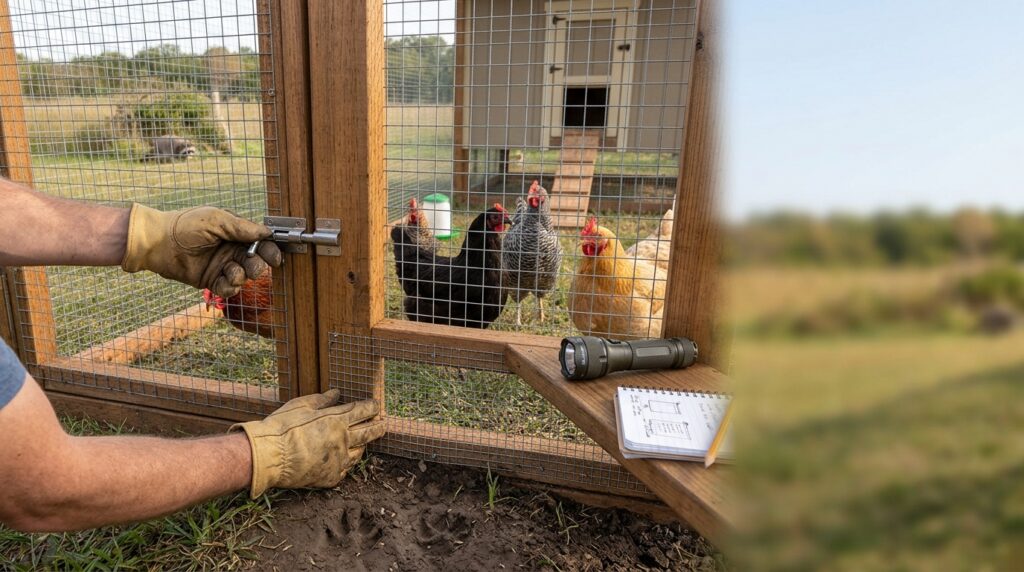
Close every door and test it from the outside. Look for loose hinges, gaps around the frame, and latches that can be lifted or pushed open. A door that appears closed may still leave enough room for an animal to squeeze through.
2. Wire mesh and fasteners
Examine the entire run, including corners and places where mesh meets wood. Look for holes, rusted sections, loose staples, and wire that has pulled away from its supports.
Ordinary chicken wire can help keep chickens contained, but it is not a reliable barrier against determined predators. Strong welded-wire mesh, securely attached to a sturdy frame, generally offers better protection.
3. The ground perimeter
Walk around the base of the enclosure and look for tunnels, gaps, loose soil, or places where the fence does not meet the ground. A buried wire barrier or outward-facing wire apron can help discourage digging when installed correctly.
4. The roof and overhead openings
Inspect roof panels, vents, and the tops of walls. Climbing predators may exploit gaps above the ground, while uncovered runs can leave birds vulnerable to aerial attacks.
5. Windows and ventilation openings
Ventilation is essential for poultry health, but openings should be covered with appropriately strong mesh. Do not seal a coop so tightly that it becomes poorly ventilated.
6. Nearby structures and objects
Branches, stacked lumber, bins, and equipment may provide climbing access or conceal gaps. Move objects away from vulnerable walls when practical, and keep the area clear enough to inspect easily.
Take photographs of any weakness before repairing it. This helps you compare the area during future inspections and track recurring problems.
🌙 Step 4: Reconstruct When the Chicken Went Missing
The timing of the disappearance can narrow your investigation, although it cannot identify a predator by itself.
- Missing after the flock was let out: Check gates, fence gaps, neighboring yards, shrubs, and places where a bird could have wandered.
- Missing after being left in the run during the day: Examine the perimeter, overhead protection, and any evidence of a chase or aerial attack.
- Missing after the flock was locked in overnight: Check doors, latches, mesh, roof openings, and signs of digging or climbing.
- Missing repeatedly from the same area: Look for a consistent weak point, a route under the fence, or a routine that leaves the flock exposed.
Write down the last time the bird was seen, who closed the coop, the weather conditions, and what you discovered. A simple record can reveal patterns that are difficult to remember after several incidents.
If you have a camera, review existing footage around the time the bird was last seen. Place cameras only where you have a lawful right to monitor, and do not trespass to investigate a suspected predator.
🐕 Step 5: Consider Other Explanations
Predation is a serious possibility, but it should not be the automatic conclusion.
- Escape: Chickens can squeeze through damaged fencing or slip through an open gate.
- Broodiness or hiding: A hen may remain in a concealed nesting spot for long periods.
- Accidental confinement: A bird may become trapped behind equipment or inside a structure.
- Illness or injury: A weak or injured chicken may isolate itself from the flock.
- Human access: An unsecured gate or an unfamiliar person entering the property may be relevant, but avoid making accusations without evidence.
If you find an injured bird, move it to a quiet, secure place and seek veterinary advice for serious wounds, breathing problems, weakness, or signs of shock. Puncture wounds can be difficult to assess from the surface.
🛡️ Step 6: Secure the Flock While You Investigate
You do not need to identify the exact predator before improving safety.
- Keep the remaining chickens in a secure enclosure while you inspect and repair damage.
- Close and test all doors and latches every evening.
- Repair gaps in mesh, walls, and the ground perimeter.
- Cover exposed runs with suitable overhead protection where aerial predators are a risk.
- Store feed securely and clean up spills that may attract wildlife.
- Check the coop daily, and perform a more thorough inspection after storms, damage, or suspected attacks.
If you use an automatic coop door, test its operation regularly and make sure all birds are safely inside before it closes. Automation can support a routine, but it cannot compensate for damaged walls, insecure mesh, or a faulty door.
Avoid poison or improvised traps. They can injure chickens, pets, children, and non-target wildlife. Follow local wildlife laws and contact the appropriate animal-control or wildlife authority if a persistent threat requires professional assistance.
Final Thoughts: Investigate First, Then Improve Your Coop 🐔
When a chicken disappears, it is natural to suspect a predator. But the most useful response is to search nearby hiding places, document the evidence, inspect the enclosure, and consider other explanations before reaching a conclusion.
A damaged latch, a gap under the fence, or an uncovered run may reveal a weakness even when the attacker remains unknown. Fixing those problems can protect the rest of the flock regardless of which animal was responsible.
Make flock counts and coop inspections part of your daily routine. A few consistent checks can help you spot problems early, improve security, and give your chickens a safer place to roost.




