
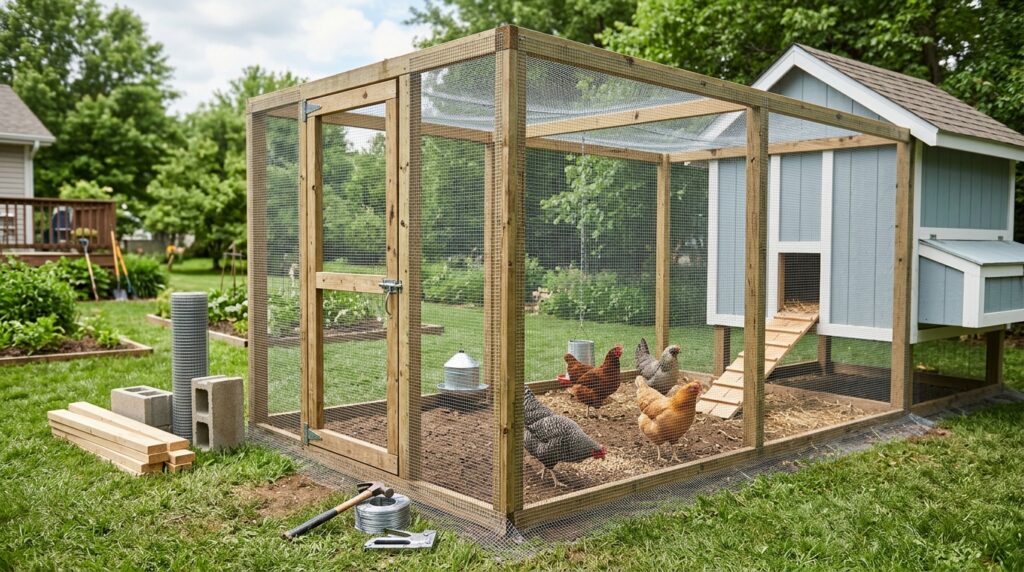
Introduction
Keeping backyard chickens safe does not have to mean buying an expensive prefabricated enclosure. With thoughtful planning, sturdy materials, and a few important design choices, you can build a chicken run that helps protect your flock without overspending.
The key is understanding that predators do not all attack in the same way. Dogs may push through weak panels, raccoons can reach through openings, and foxes may dig beneath an enclosure. Hawks and other aerial predators can also threaten chickens in an uncovered run.
No enclosure can guarantee complete protection, but a well-designed run can significantly reduce common risks.
This guide explains how to plan a budget-friendly chicken run, choose practical materials, avoid costly mistakes, and make security a priority without sacrificing ventilation or the chickens’ comfort.
1. Start With a Predator Risk Check 🔍
Before buying materials, identify the threats most likely to affect your property.
- Digging predators: Foxes, dogs, and other animals may dig under a fence.
- Climbing predators: Raccoons and some other animals can climb or reach through openings.
- Pushing and tearing: Dogs and larger animals may damage weak fencing.
- Aerial predators: Hawks and owls may threaten chickens in an exposed run.
- Small predators: Weasels, rats, and similar animals may exploit gaps that seem too small to matter.
Your location, local wildlife, neighboring pets, and the design of your existing coop all influence which protections matter most.
Walk around the planned run and look for gaps beneath gates, loose fence sections, low spots, overhanging branches, and places where a predator could gain access.
Budget tip: Spend first on the parts that prevent entry. Decorative trim, matching paint, and elaborate landscaping can wait.
2. Choose a Practical Size and Layout
A run should give chickens room to move, scratch, dust-bathe, forage, and avoid one another. Crowding can increase stress and create more competition around food, water, and resting areas.
Space needs depend on flock size, chicken breed, time spent inside the run, and access to other safe outdoor areas. As a practical starting point, many backyard guides suggest around 8–10 square feet per standard-sized chicken in an outdoor run, with more space beneficial when the birds spend most of their time there. Local animal-welfare guidance may recommend different amounts.
For example, four standard-sized chickens would need roughly 32–40 square feet using that starting range. This is not a universal minimum or a guarantee of adequate space in every setup.
Plan the layout before building. A simple rectangular run attached directly to the coop often uses materials more efficiently than a complex shape with many corners.
Leave enough room to open the gate, clean the enclosure, refill feeders, and inspect the fence line.
3. Choose the Right Fencing Materials
Not all wire fencing provides the same level of protection.
<text weight=”medium” size=”md”>Materials worth considering</text>
- Welded wire mesh: A sturdy option for the main enclosure when the wire gauge, opening size, and frame are appropriate for the predators in your area.
- Hardware cloth: Small-opening galvanized wire mesh that can help block raccoons, weasels, and other small predators from reaching through or squeezing into gaps. It is often more expensive than ordinary chicken wire, so prioritize it in vulnerable areas.
- Chicken wire: Useful for containing chickens, but generally not strong enough to serve as the only predator barrier.
- Wooden posts and framing: Support the mesh and provide attachment points. Sound, properly secured framing matters as much as the wire itself.
- Roofing mesh or sturdy netting: Can help deter aerial predators, but choose a system that will not sag dangerously or trap birds.
For a budget-conscious build, you can use stronger mesh in vulnerable lower sections, around openings, and near the coop, while choosing other suitable fencing for less exposed areas. The correct combination depends on the threats you need to deter.
Avoid assuming that a product is predator-proof just because its packaging uses that term. Check its strength, opening dimensions, corrosion resistance, and installation requirements.
4. Protect the Bottom of the Run From Digging
A fence that looks secure above ground can still have a vulnerable base.
One practical option is a wire apron, sometimes called an outward-facing predator apron. Attach sturdy mesh along the bottom of the fence and extend it horizontally outward, then secure it to the ground and cover it with soil, mulch, or suitable ground material.
A commonly used starting point is an apron extending roughly 12–24 inches outward, although the appropriate width and design depend on local predators and ground conditions.
Another option is a properly installed buried barrier. This can be effective, but it may require more digging and labor.
For either method:
- Secure the barrier firmly to the main fence.
- Overlap and fasten mesh joints so predators cannot exploit seams.
- Pay special attention to corners and the gate.
- Inspect for erosion, exposed wire, and new gaps after heavy rain.
Do not leave sharp wire ends exposed where chickens, pets, or people could be injured.
5. Add a Secure Roof or Overhead Cover ☀️
A roof can help protect chickens from aerial predators and prevent climbing animals from entering from above.
A framed wire-mesh roof is one option for a permanent run. Strong, properly tensioned netting may be suitable in some situations, but it is not equivalent to a rigid barrier against every predator.
If your budget is limited, prioritize a roof over the most vulnerable section first, such as the area immediately outside the coop. Expand the protected area when resources allow, while considering whether uncovered sections still leave the flock exposed.
The run also needs shade and weather protection. A partial solid roof can provide relief from sun and rain, but maintain ventilation and prevent water from pooling. Make sure roof supports can withstand local wind and weather conditions.
Never use flimsy coverings that could collapse onto the birds.
6. Build a Gate That Cannot Be Easily Opened
Gates are common weak points because they need to move and are used frequently.
Choose hinges and a latch suited to the weight of the gate. Close gaps around the frame, and make sure the gate reaches the ground or connects securely to the bottom barrier.
A simple latch may be sufficient in some settings, but raccoons are capable of manipulating certain fasteners. A secure, appropriately designed latch or two-step fastening system can reduce this risk.
Get into the habit of checking the gate every time you enter or leave. A strong fence offers little protection if the gate is left open overnight.
7. Estimate the Cost Before You Build 💰
The cost of a chicken run depends heavily on its size, the materials already available, local prices, and whether you can reuse sound framing.
Here is a practical way to budget without relying on misleading universal price estimates.
| Material | What to calculate |
|---|---|
| Posts and framing | Number of posts, rails, and braces needed |
| Main fencing | Total perimeter multiplied by fence height |
| Hardware cloth | Area needed for vulnerable sections and openings |
| Ground apron | Fence length plus the planned outward extension |
| Roof materials | Total covered area and required supports |
| Hinges and latches | Gate hardware and fasteners |
| Miscellaneous supplies | Staples, screws, wire ties, and repair materials |
Measure the enclosure and make a list before visiting the hardware store. Compare the cost per unit of usable mesh rather than choosing a roll based only on its price.
You may be able to save money by reusing sturdy posts, repurposing sound lumber, or building a straightforward rectangular enclosure. Avoid using rusted, damaged, or structurally weak materials simply because they are free.
Do not cut costs by leaving the bottom unsecured, using weak mesh as the only barrier, or skipping necessary roof protection. These shortcuts can leave the most important vulnerabilities untouched.
8. Common Budget Mistakes to Avoid
A low initial cost does not always mean a good long-term investment.
- Using chicken wire as the only defense: It may contain chickens but can fail against determined predators.
- Leaving gaps at the corners: Small openings can undermine an otherwise sturdy enclosure.
- Ignoring the ground: Digging animals may get underneath an unprotected fence.
- Forgetting overhead access: Climbing and aerial predators require different protections.
- Choosing weak gate hardware: A poorly secured entrance can become the easiest way in.
- Blocking ventilation: A tightly enclosed run still needs good airflow and suitable shade.
- Skipping maintenance: Loose fasteners, rust, storm damage, and soil erosion can create new entry points.
Build for the predators you actually face, then inspect the enclosure regularly. No single design works equally well for every yard.
9. A Simple Chicken Run Inspection Checklist
Before leaving your chickens unattended, check the following:
- The mesh is firmly attached to the frame.
- There are no visible gaps around corners or openings.
- The ground barrier is secure and intact.
- The gate closes fully and the latch holds.
- The roof or overhead protection has no holes or loose sections.
- Shade, ventilation, and drainage are adequate.
- Feed spills and other attractants are cleaned up.
- The coop itself is secure for nighttime.
Repeat the inspection after storms, landscaping work, or any sign of a predator attempt. Look for disturbed soil, bent wire, scratches, loose fasteners, and damaged vegetation near the fence.
Final Thoughts 🐣
Building a budget-friendly chicken run is about making smart choices, not buying the cheapest materials available.
Start by identifying local predator risks, choose appropriate fencing, secure the bottom and gate, and add overhead protection where needed. A simple design built carefully can be more useful than an elaborate enclosure with weak points.
If you cannot afford every upgrade at once, prioritize the most serious vulnerabilities and improve the run in stages. Keep the chickens’ space, ventilation, and comfort in mind throughout the process.
A secure chicken run is an ongoing project, not a one-time purchase. Regular inspections and prompt repairs help keep your flock safer as your backyard and its risks change.




