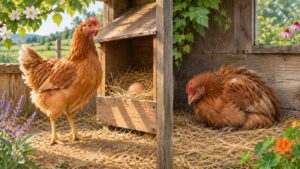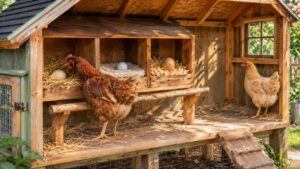
You expected your new hens to follow the flock into the coop at sunset, but instead they are sitting on a fence, huddling under the ramp, or preparing to sleep in the run. 🐔 When new chickens won’t sleep in the coop, repeatedly chasing them around after dark can turn bedtime into a stressful routine for both birds and owner. A better approach is to make the coop easy to enter, establish the same evening sequence, and gradually reduce your assistance as the newcomers learn where nighttime happens.
Some chickens understand the arrangement after one or two evenings, while others may need several nights of repetition. Seven nights is a useful training framework, not a guaranteed deadline, because temperament, previous housing, flock dynamics, coop design, and individual confidence all affect adjustment. The goal of this chicken bedtime routine is therefore not to force every bird onto an exact schedule, but to help you identify progress—and recognize when continued refusal suggests an underlying problem.
Why Do New Chickens Sleep Outside The Coop?
New chickens may know perfectly well that shelter exists without yet recognizing your particular coop as their sleeping location. 🌙 A bird moved from another property may have previously slept in a different style of building, used another entrance, or roosted in an entirely different place, so your ramp and doorway are unfamiliar landmarks. Finding the coop during daylight and confidently entering it as darkness approaches are two different behaviors.
Flock relationships can complicate the adjustment because established hens may already claim preferred roost positions or control access to the doorway. A newcomer that approaches the coop but repeatedly backs away may be reacting to another bird rather than forgetting where the building is. 👀 Watch the interaction carefully, because new chickens sleeping outside can sometimes be a social-access problem disguised as a training problem.
Before Night One: Make Sure The Coop Is Ready
Before training the chickens, inspect the sleeping area from the birds’ perspective. Roosts should be stable, reachable, appropriately sized for your birds, and arranged with enough usable space that newcomers are not forced onto the floor simply because every comfortable position is occupied. 🪵 The coop should also remain dry and ventilated while protecting chickens from nighttime weather and predators.
Check the entrance next, particularly if the coop uses a steep ramp, narrow automatic door, high threshold, or unfamiliar opening. Observe the flock around dusk and determine whether dominant hens stand in the doorway, chase newcomers off the roost, or repeatedly prevent them from settling. Fixing an accessibility problem before starting your seven-night routine can save you from spending a week trying to “train” behavior caused by the coop itself.
Nights 1–2: Help Your Chickens Find Their Sleeping Spot
During the first two evenings, begin before the yard becomes completely dark. Chickens do not see particularly well in darkness, so waiting until they are already confused and settled somewhere inappropriate makes the job unnecessarily difficult. 🌅 Calmly guide the newcomers toward the entrance while there is still enough natural light for them to walk up the ramp and explore the coop.
If a bird refuses to settle, gently placing it inside or onto an appropriate accessible roost can demonstrate where the night’s safe resting area is located. Avoid frantic chasing, grabbing at flying birds, or repeatedly frightening the entire flock, because the aim is to make the coop predictable rather than threatening. Once everyone is inside, account for every bird and secure the coop against predators before leaving them for the night.
Nights 3–5: Establish A Predictable Evening Routine
Now begin turning your assistance into a recognizable pattern. Shortly before sunset, use the same calm call, movement, or small food reward near the coop entrance so newcomers begin associating that sequence with returning home. 🍽️ Treats can be useful as a training tool, but keep the amount small so the reward does not replace meaningful consumption of the flock’s balanced feed.
Stand back enough to see what each newcomer actually does instead of automatically carrying everyone inside. Does one bird reach the doorway independently but hesitate, while another remains at the far end of the run waiting for you? Recording these differences matters because how to train chickens to go into the coop is less about repeating one action and more about reducing help as each bird demonstrates that it understands the routine.
Watch established birds during these middle nights as well. If the newcomers enter successfully and then immediately rush back outside after being pecked, the problem may involve roost competition or social pressure rather than failure to learn. 🐓 Giving birds adequate roosting options and observing the actual bedtime interactions can reveal much more than simply counting how many chickens eventually ended up inside.
Nights 6–7: Let Them Try Going Inside On Their Own
By nights six and seven, give the birds an opportunity to demonstrate the routine without immediate intervention. Begin your normal evening signal and then observe from a short distance as sunset approaches rather than standing directly beside the doorway. 🌇 A chicken that previously required carrying may suddenly follow the established hens, climb the ramp, and choose a roost without assistance.
Continue performing your final head count even when the flock appears to have mastered bedtime. Independence does not mean abandoning safety checks, because one hen could still be hiding in vegetation, perched somewhere unusual, injured, or accidentally separated from the flock. Reward successful routines calmly, secure the coop, and remember that the objective is reliable voluntary entry, not a perfect performance exactly seven nights after arrival.
What If Your Chickens Still Refuse After A Week?
If your chickens won’t roost at night after a week of consistent guidance, stop assuming they simply need more repetition and investigate the environment. Check for overcrowding, unstable or difficult-to-reach roosts, an intimidating ramp, a doorway bottleneck, dominant hens guarding access, or something inside the building that repeatedly frightens them. 🔍 Watch at actual bedtime, because an apparently peaceful coop at midday can look very different when every bird competes for a preferred nighttime position.
Also inspect for nighttime disturbances and parasites when behavior changes suddenly or birds seem specifically reluctant to remain on the roost. Certain mites hide in cracks around roosting areas during the day and feed on birds at night, while predator activity around the coop can also leave a flock restless or unwilling to settle. ⚠️ Persistent refusal accompanied by illness, weakness, breathing difficulty, injuries, heavy parasite loads, severe bullying, or other abnormal behavior deserves more than additional bedtime training.
Printable Seven-Night Chicken Bedtime Training Tracker
Use the tracker to separate actual progress from the feeling that you are doing the same thing every evening. 📋 One chicken might move from requiring complete assistance to entering independently on night four, while another still needs guidance on night seven, and writing this down makes that difference obvious. Also record unusual behavior so you can spot patterns such as one bird consistently being chased from a particular roost.
| Night | Independent Entry | Assistance Required | Roosting Location | Unusual Behavior |
|---|---|---|---|---|
| Night 1 | Yes / No | None / Guided / Carried | Record location | Note hesitation, bullying, hiding |
| Night 2 | Yes / No | None / Guided / Carried | Record location | Compare with Night 1 |
| Night 3 | Yes / No | None / Guided / Carried | Record location | Watch doorway interactions |
| Night 4 | Yes / No | None / Guided / Carried | Record location | Note progress or regression |
| Night 5 | Yes / No | None / Guided / Carried | Record location | Watch roost competition |
| Night 6 | Yes / No | None / Guided / Carried | Record location | Reduce unnecessary help |
| Night 7 | Yes / No | None / Guided / Carried | Record location | Decide whether troubleshooting is needed |
Do not treat the tracker like a test the chickens must pass by Night 7. Its purpose is to show whether assistance is gradually decreasing and whether the same obstacle repeatedly appears. If there is no improvement at all, your notes can help distinguish a learning problem from a coop, flock, or health problem.
Frequently Asked Questions About Chicken Bedtime
- How long does it take chickens to learn where to sleep? There is no universal number of nights, because some birds follow established flockmates almost immediately while others need repeated guidance as they adapt to a new environment. 🐔 Seven nights works well as an observation and training period, after which continued resistance deserves closer investigation rather than endless repetition.
- Will chickens eventually go into the coop by themselves? Many chickens develop a reliable sunset routine once they recognize the coop as their nighttime roosting location, especially when the environment is comfortable and predictable. Natural dusk cues help encourage roosting behavior, which is also why gradual training around sunset generally makes more sense than trying to teach the routine after complete darkness.
- Is it okay to carry chickens into the coop every night? Temporarily carrying a calm reluctant bird inside can be useful while establishing the location, but ideally your assistance should decrease rather than becoming permanent. 🤲 If you are still carrying the same healthy chicken every single evening with no progress, investigate why it chooses not to enter instead of assuming that carrying is the long-term solution.
- Do new chickens need older hens to teach them? Established birds can make the routine easier because newcomers may follow flockmates toward the coop at dusk, but older hens are not essential for learning the location. In some introductions, established hens can actually make bedtime harder by guarding desirable roosts or intimidating newcomers, so observe the flock rather than assuming experienced birds are always helpful teachers.
Make Bedtime Boring And Predictable
The best chicken bedtime routine should eventually feel uneventful: dusk approaches, the birds move toward shelter, they choose their roosts, you perform a head count, and the coop is secured. 🌙 Consistency helps chickens learn, while calm observation tells you when an individual still needs assistance. You are building a habit rather than winning a nightly chase around the yard.
If your new chickens need seven nights while another pair learned immediately, that difference alone does not mean anything is wrong. Give them a clear routine, reduce assistance as they improve, and investigate the environment if progress stops instead of simply carrying them indefinitely. 🐔 The practical rule is guide first, observe next, then troubleshoot if the birds continue telling you that something about bedtime does not work.