If you keep quail—whether for eggs, meat, or as ornamental birds—you have likely noticed how startlingly reactive they can be to unexpected sounds. Unlike chickens, quail have evolved as ground-dwelling prey birds with a nervous system wired for instant flight. Understanding their sensitivity to noise is not just about keeping them calm; it is about ensuring their survival, egg production, and overall well-being. This article dives deep into how quail respond to loud noises like barking dogs and predator calls, compares their stress physiology to chickens, and provides actionable management strategies you can implement today.
The Evolutionary Roots of Noise Sensitivity in Quail
Quail are prey animals at the bottom of the food chain. In the wild, their primary defense is not fighting back but freezing, crouching, or explosive flight—often straight upward into cover. Their auditory system is exquisitely tuned to detect subtle sounds of approaching predators, from the rustle of a snake to the footfall of a fox. This evolutionary pressure means that any sudden or loud noise triggers an immediate adrenaline surge, even in domesticated quail that have never seen a predator.
“A quail’s heart rate can double within 0.2 seconds of hearing a sharp noise. This is not a behavioral quirk—it is a hardwired survival reflex that remains fully intact regardless of how many generations the bird has been captive-bred.” — Dr. Melissa K. Ramsey, Avian Stress Physiology Lab, UC Davis
When a dog barks near a quail pen, the bird perceives it not as a nuisance but as a potential life-threatening event. The resulting stress cascade can last anywhere from 30 minutes to several hours, depending on the intensity of the sound and the bird’s individual temperament.
How Quail React to Barking Dogs and Predator Sounds
Let us break down the behavioral and physiological responses to two common noise categories: domestic noises (dogs, machinery, children) and predator vocalizations.
Response to Dog Barks
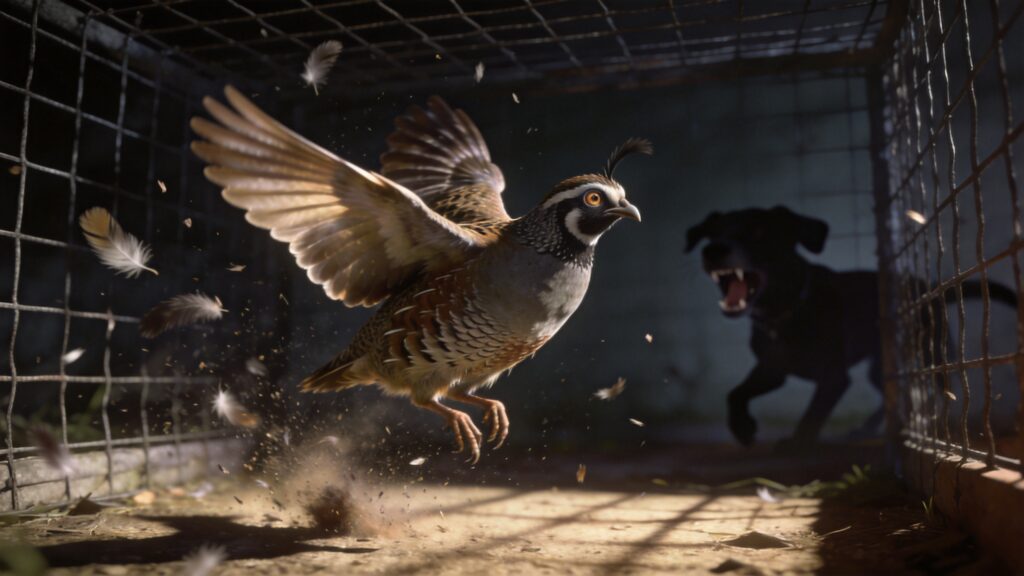
Dogs are perceived as canine predators, and quail do not distinguish between a friendly Labrador and a wild coyote. A sudden bark at close range (within 30 feet) typically causes:
- Immediate “flush” response: birds fly vertically into the pen ceiling, often injuring their heads or breaking blood feathers.
- Prolonged crouching: after the initial flight, quail may remain motionless on the ground for 20–40 minutes, refusing to eat or drink.
- Egg-laying disruption: hens that are frightened during laying hours may experience egg binding or drop soft-shelled eggs for 2–3 days afterward.
- Chronic fear conditioning: if barking occurs repeatedly at the same time each day, quail begin anticipatory stress—their cortisol levels rise before the bark even happens.
Response to Predator Sounds
Recorded hawk screams, owl hoots, or raccoon chittering produce an even more intense reaction because these sounds are biologically relevant. The quail’s brain has specialized neural circuits that process predator calls differently from non-threatening sounds. Typical reactions include:
- Immediate freezing for up to 10 minutes—a last-ditch camouflage tactic.
- Alarm calling by dominant males, which spreads panic through the flock.
- Refusal to move from sheltered areas for hours, even after the sound stops.
- Reduced fertility in breeding males, as stress hormones suppress testosterone production.
Quail vs. Chickens: A Side-by-Side Stress Comparison
Many new quail keepers assume quail and chickens have similar stress thresholds. This is a dangerous misconception. The table below highlights key differences that matter for day-to-day management.
| Factor | Quail | Chickens |
|---|---|---|
| Baseline heart rate (bpm) | 320–400 | 240–300 |
| Heart rate increase after loud noise | +80–120% within 0.2 sec | +30–50% within 1–2 sec |
| Cortisol peak duration | 90–180 minutes | 30–60 minutes |
| Time to resume normal feeding after startle | 25–45 minutes | 5–10 minutes |
| Egg production impact from single loud event | 2–4 days disruption | 0–1 day disruption |
| Likelihood of injury from flush response | High (ceiling collisions, broken blood feathers) | Low (chickens typically run, not fly upward) |
| Suitability for urban/suburban backyards | Low—unless carefully managed | Moderate to high |
The data is clear: quail are substantially more vulnerable to noise-induced stress than chickens. This means you cannot simply apply chicken management practices to quail and expect the same outcomes. A barking dog that a chicken flock ignores within minutes can send a quail flock into a production tailspin for days.
Why the Difference Matters for Your Flock
The practical implication is that noise management is not optional for quail keepers—it is a core husbandry requirement. If you live in a neighborhood with dogs, children, traffic, or construction, you must actively design your quail environment to buffer sound. Otherwise, you risk chronic stress, which manifests as:
- Feather picking and cannibalism (stress-induced behaviors)
- Immune suppression leading to respiratory infections
- Drastic drop in egg production (can fall by 50% or more within a week)
- Increased mortality from heart failure in extreme cases
Environmental Management: Building a Sound-Buffer Zone
Reducing noise exposure starts with strategic pen placement and construction. Here are five actionable steps you can implement this weekend.
1. Choose a “Quiet Zone” Location
Place your quail pen as far as possible from:
- Dog kennels or dog runs
- Garage doors, air conditioning units, and heat pumps
- Children’s play areas
- Street-facing property lines (especially with traffic noise)
Ideally, the pen should be at least 50 feet from any regular noise source. If you cannot achieve this distance, you must rely on sound-dampening materials.
2. Use Solid Walls for Sound Dampening
Wire mesh pens offer zero noise reduction. Quail benefit enormously from having at least three solid sides on their enclosure. Suitable materials include:
- Plywood or OSB (1/2 inch or thicker)—blocks high-frequency sounds like bird alarms and dog barks.
- Insulated metal panels—excellent for both sound and temperature regulation.
- Straw bales stacked against the outside of the pen—a low-cost option that also provides thermal mass.
3. Create a “Sound Ceiling”
Quail are most startled by sounds coming from above (predator calls, overhead aircraft, tree branches hitting the roof). A solid roof material, even if just a tarpaulin stretched tight, can reduce overhead noise by 10–15 dB. For permanent setups, use corrugated polycarbonate with a foam underlayment to deaden rain noise and animal footsteps.
4. Install a White Noise or Masking System
Continuous, low-level background noise helps quail habituate to sudden sounds by raising their auditory threshold. Options include:
- A small fan or air circulator running 24/7 inside the pen area (provides both ventilation and masking noise).
- A white noise machine placed outside the pen, near the most common noise source.
- A gentle water feature (a small fountain or drip system) within 10 feet of the pen—the sound of running water is calming to many prey birds.
5. Maintain Visual Barriers
Quail that cannot see a noise source are 50–70% less stressed than those that can. If a dog is barking from a neighboring yard, block the quail’s line of sight with:
- 6-foot-tall privacy fence slats
- Dense shrubbery (holly, arborvitae, or bamboo)
- Opaque tarps or shade cloth
Desensitization Techniques: Teaching Quail to Tolerate Noise
While environmental management reduces noise exposure, you can also actively train your quail to be less reactive. Desensitization works best when started with young birds (3–6 weeks old) but can be adapted for adult flocks with patience.
“Desensitization is not about making quail unafraid—it is about shifting their fear response from panic to cautious alertness. The goal is a bird that flattens its feathers and stays still for a few seconds, rather than one that explodes into the ceiling.” — Avian Behavior Lab, University of Georgia Extension
Step-by-Step Noise Desensitization Protocol
- Start with low intensity. Play a recording of a dog bark at very low volume (barely audible to you) for 10 minutes twice a day. Observe the quail—if they show signs of stress (crouching, alarm calls, refusing food), reduce the volume further.
- Pair noise with positive reinforcement. Offer a preferred treat (mealworms, chopped greens) immediately after the noise plays. Over time, the quail begin associating the sound with a reward rather than danger.
- Gradually increase volume. Over 2–3 weeks, raise the volume in small increments (3–5 dB per session). Stop at any point where the quail show panic behaviors—then dial back two steps and proceed more slowly.
- Introduce real-world sounds. Once the quail tolerate recordings at a moderate level, expose them to the actual source (e.g., a calm, leashed dog standing 100 feet away, with the owner ensuring no barking). Gradually decrease the distance over multiple sessions.
- Maintain with periodic exposure. Desensitization is not permanent. If you stop exposure for 2–3 weeks, the birds may revert to baseline fear. Schedule at least one “noise practice” session per week.
Important Caution for Adult Quail
Adult quail that have already experienced a traumatic noise event (e.g., a dog barking directly at the pen) are much harder to desensitize. In these cases, focus primarily on environmental management (solid walls, visual barriers, white noise) rather than forced exposure, which can worsen their fear. Consider replacing the most reactive individuals with young, unexposed birds if the flock’s stress level is affecting overall production.
Case Example: Managing Quail Near a Dog-Running Property
Let me share a practical scenario. A quail keeper in suburban Oregon had a 20-bird flock in a back garden adjacent to a neighbor’s husky that barked at the fence line 4–6 times daily. Initial conditions: 40-bird mortality in three months, egg production at 15%, and several birds with chronic bald spots from feather picking. After implementing the following changes, production recovered to 65% within 5 weeks:
- Moved the pen to the opposite side of the property (70 feet from the fence).
- Built a solid plywood wall on the side facing the dog, with 2-inch foam insulation sandwiched inside.
- Installed a white noise fan on the roof of the pen, directed outward toward the dog.
- Planted a row of fast-growing bamboo along the fence to block visual contact.
- Desensitized the flock using a recording of the husky’s bark at low volume during evening feeding time for 10 days.
Key Takeaways for Quail Keepers
- Quail are 3–4 times more noise-sensitive than chickens, both in immediate reaction and duration of stress.
- Dog barks and predator sounds trigger primal fear circuits that cannot be reasoned or trained away—only managed.
- Environmental buffers (solid walls, distance, white noise, visual barriers) are the most effective first-line intervention.
- Desensitization is possible but requires slow, positive reinforcement and is most successful in young birds.
- If you have dogs, never allow them access to the quail pen area, even if they are “gentle.” A single bark at close range can cause lasting trauma.
Conclusion
Quail are exquisitely sensitive to noise—far more than most backyard poultry keepers realize. A barking dog or a hawk scream is not a minor annoyance to them; it is a physiological crisis that can disrupt egg laying, trigger injuries, and suppress immunity. The good news is that with thoughtful pen design, sound masking, and gradual desensitization, you can create an environment where your quail feel safe enough to thrive. Treat noise management as seriously as you do feeding and watering, and your flock will reward you with robust health and consistent production.