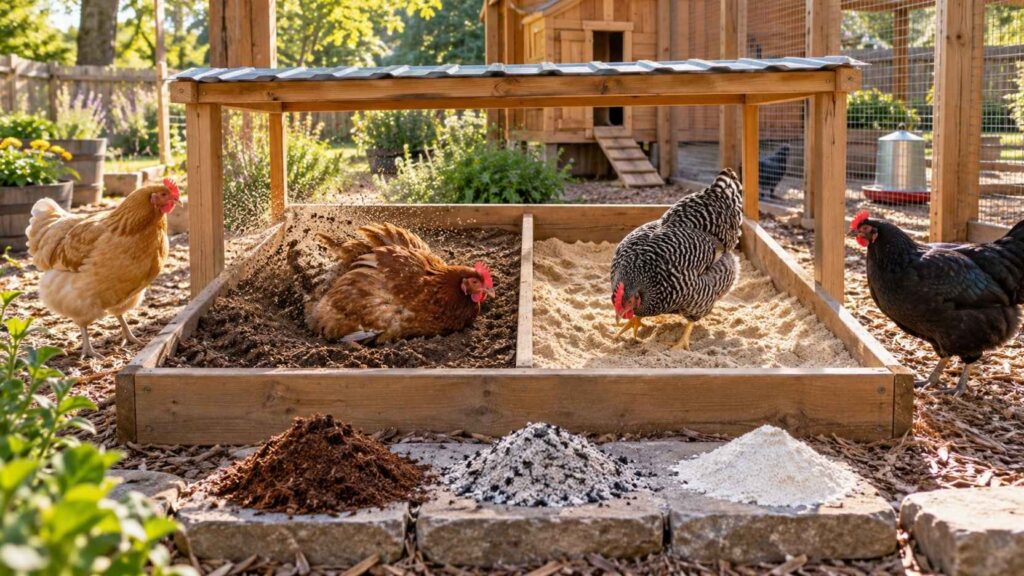
A chicken dust bath does not need to look like an elaborate recipe from social media. 🐔 Chickens mainly need access to a dry, loose, friable material they can scratch into, settle their bodies into, and work through their feathers while performing their normal dust-bathing behavior. For many backyard flocks, clean soil or suitable sand already provides everything necessary for that basic job.
The confusion begins when keepers start adding wood ash, peat moss, diatomaceous earth, herbs, and other ingredients because each supposedly makes the bath “better.” Some additions may be usable under certain conditions, but they are not automatically necessary, and the finest powders can create an unnecessary airborne-dust issue. The best chicken dust bath ingredients are therefore not the most complicated ones—they are the materials chickens can use comfortably while you can keep the area dry, clean, and low-risk.
What Ingredients Does A Chicken Dust Bath Actually Need?
Start with function rather than ingredients: chickens need material loose enough to move through their feathers instead of hard-packed ground, wet mud, or compacted bedding. During dust bathing, a bird crouches, scratches, rolls, and flicks material through its plumage, making the physical characteristics of the substrate more important than creating a particular homemade blend. 🌿 A sheltered patch of naturally loose soil may therefore work just as well operationally as a purpose-built container.
Research supports keeping the discussion focused on substrate rather than additives. A published meta-analysis of chicken substrate-preference studies found that birds dust-bathed more on sand and peat moss than on wood-based and several other tested materials, although the peat evidence came from fewer studies and should be interpreted more cautiously. For a beginner, that points toward a straightforward starting principle: choose something dry, loose, reasonably clean, and easy for the birds to manipulate.
Is Plain Garden Dirt Enough For Chickens?
Yes, plain dirt can be enough when the soil is appropriate. 🌱 Many chickens create their own bathing spots by scratching shallow depressions beneath shrubs, coop edges, porches, or other sheltered areas where soil stays dry and powdery. You do not need to interrupt a perfectly functional natural dust bath merely because an online recipe includes four additional ingredients.
The important question is what is in that soil and whether it remains usable. Avoid locations contaminated by spilled fuel, pesticides, herbicides, treated-wood debris, moldy organic waste, excessive manure, sharp objects, or other materials you would not want repeatedly worked through feathers and around eyes and nostrils. If your ground turns into compacted clay or mud after rain, a covered container of clean soil or sand gives chickens a more reliable option.
Sand Vs. Soil: Which Makes A Better Dust Bath?
The dirt vs. sand for chickens debate does not require one universal winner. Soil is inexpensive and natural, but its performance depends heavily on local texture and weather; sandy soil may remain beautifully loose while heavy clay can become hard when dry and sticky when wet. 🏡 Sand can provide more predictable drainage and consistency, especially inside a covered dust-bath box where you want material that stays workable.
Sand also has meaningful behavioral evidence behind it. In the published meta-analysis, chickens dust-bathed substantially more in sand than in wood and the collection of other tested substrates, and sand was one of the strongest overall options in the preference data. That does not prove every backyard chicken needs commercial sand, but it makes clean, suitable sand an excellent simple option when your native soil does not work well.
Should You Add Wood Ash To A Chicken Dust Bath?
Wood ash appears frequently in backyard dust-bath recipes because generations of keepers have mixed fireplace or stove ash into bathing areas. 🔥 However, traditional use is not the same thing as necessity, and ash is an extremely fine material that can create more airborne particles when birds vigorously flap and roll. A dust bath works perfectly well without ash, so beginners do not need to add it simply because a recipe says they should.
There is another reason to avoid treating ash like harmless dirt: wood ash is alkaline and can be caustic, particularly in concentrated amounts, and agricultural guidance for handling it recommends protection from skin, eye, and inhalation exposure. Never use ash from burned garbage, pressure-treated or painted wood, charcoal products containing additives, or unknown materials. If you already have a successful soil-or-sand bath, adding ash offers little reason to complicate the system.
Is Diatomaceous Earth Safe For Chicken Dust Baths?
This is where backyard recommendations become genuinely contradictory. Some poultry sources describe mixing food-grade diatomaceous earth, or DE, into sand for ectoparasite management, while other poultry specialists recommend simply using sand because chickens and people can inhale the extremely fine dust. That disagreement is important because it means DE should not be presented to beginners as an essential ingredient in every chicken dust bath.
“Food grade” also does not mean “safe to inhale without concern.” DE dust can irritate the nose and respiratory passages, and while food-grade material contains far less crystalline silica than pool or filter-grade DE, it is still an airborne powder. For a routine recreational dust bath, the simplest conservative choice is leave DE out and provide clean soil or sand instead.
What About Peat Moss, Compost, And Other Materials?
Peat moss deserves mention because chickens showed substantial dust-bathing preference for it in controlled studies. The same meta-analysis found dust bathing on peat and sand was similar, while both performed better than wood and the miscellaneous substrate group; however, only a small subset of included studies tested peat. 🪶 Peat is therefore an optional material rather than evidence that every dust bath should contain it.
Compost deserves more caution because “compost” can describe everything from clean, fully matured material to damp mixtures containing mold, manure, food residues, or substances unsuitable for repeated contact. Do not assume garden compost is automatically a best chicken dust bath material simply because it is organic or inexpensive. If experimenting with any alternative material, prioritize dryness, cleanliness, low dustiness, and freedom from contaminants instead of trying to maximize the number of ingredients.
Do Homemade Dust Baths Prevent Mites And Lice?
Dust bathing is an important natural grooming behavior, but a dust-bath box should not become your entire parasite-management program. Chickens can use substrate to work material through their feathers and remove excess feather lipids, yet a hen happily dust bathing can still develop mites or lice. 🔎 Regularly inspect birds around the vent, under the wings, along feather bases, and in areas where you notice irritation or feather damage.
If parasites are actually present, identify the pest before deciding what treatment is appropriate rather than continually adding powders to the bathing area. Poultry guidance commonly emphasizes inspecting birds regularly because infestations are easier to address before they become severe, and approved treatment options vary by parasite and product. Persistent or serious infestations warrant advice from a poultry veterinarian or knowledgeable local extension professional.
The Simplest Dust Bath Recipe For Beginners
A beginner dust bath can be remarkably uncomplicated: use clean, dry native soil, suitable clean sand, or a mixture of the two in a protected area deep and wide enough for a hen to crouch, roll, and flap comfortably. 🪣 Put it somewhere sheltered from rain, remove manure or wet clumps when you see them, and replenish material as chickens kick it outside the container. If several birds compete for one tiny spot, create a larger bathing area rather than solving the crowding problem with additional ingredients.
You do not need ash, DE, herbs, insecticides, or a long shopping list to provide meaningful enrichment. Your birds are telling you whether the setup works when they dig shallow hollows, lie on their sides, flick substrate upward, spread their wings, and repeatedly return to the site. In practical backyard poultry care, simple, dry, accessible, and maintainable usually beats complicated.
Chicken Dust Bath Ingredient Safety Guide
| Material | Main Consideration | Beginner Guidance |
|---|---|---|
| Clean, dry soil 🌱 | Natural and inexpensive, but quality varies by location | Excellent starting option |
| Suitable clean sand 🏖️ | Loose, consistent, and drains well | Excellent option |
| Soil + sand | Combines natural soil with improved texture | Simple practical mix |
| Peat moss | Preferred in some behavioral research | Optional, not required |
| Wood ash | Very fine, alkaline, and potentially irritating | Unnecessary; use caution |
| Diatomaceous earth | Fine inhalable particles; guidance differs | Avoid routine addition |
| Compost | Quality and contamination vary substantially | Use caution or skip it |
| Random powders/additives | May increase dust without improving the bath | Usually unnecessary |
The decision is easier when you stop asking, “What can I add?” and start asking, “What does the chicken need this material to do?” ✅ A good substrate needs to remain loose enough for dust bathing, dry enough not to cake, clean enough for repeated contact, and manageable enough that you will actually maintain it. Everything beyond those requirements should earn its place rather than being included automatically.
That makes the answer to what goes in a chicken dust bath refreshingly simple: dirt or sand may be all you need. Chickens do not require a complicated homemade cocktail, and the existence of an ingredient in dozens of online recipes does not prove that it improves the bathing area. Give the flock a dependable place to perform the behavior naturally, then spend your management effort on keeping it dry, checking the birds, and replacing contaminated material. 🐔