
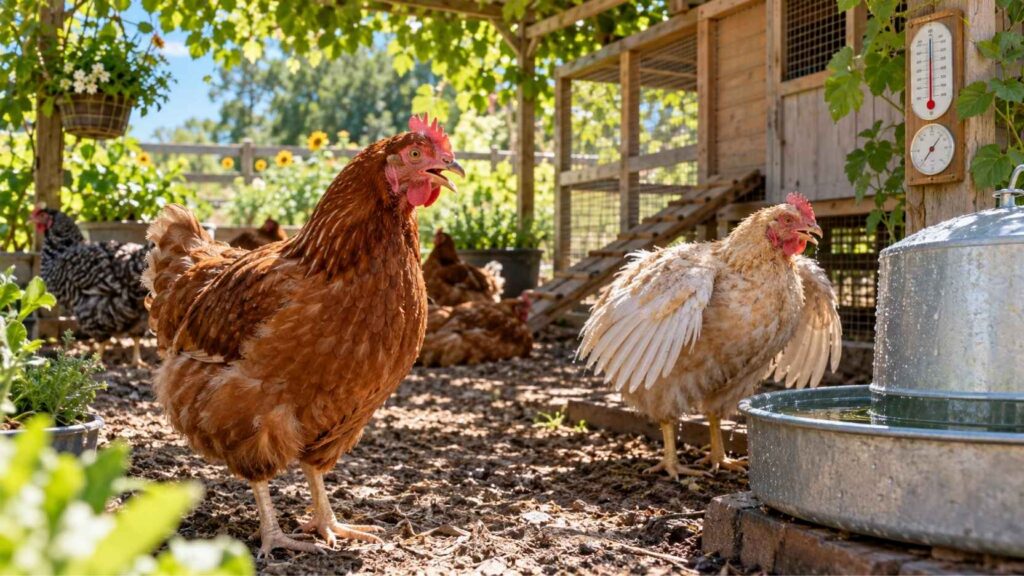
Seeing a chicken standing with her beak open and breathing rapidly can be alarming, especially when you have never watched your flock through a hot summer before. 🐔 The reassuring part is that chicken panting in hot weather can be a normal cooling response, because chickens cannot sweat the way people do and instead use evaporation from their respiratory system to release excess heat. The important question is not simply, “Why is my chicken panting?” but whether the bird is coping successfully or beginning to show additional signs of heat stress.
That distinction matters because light panting and dangerous heat stress can initially look similar from across the yard. A hen that remains alert, walks normally, drinks, responds to flockmates, and settles when conditions improve is very different from one panting heavily while holding her wings away from her body, crouching, becoming weak, or struggling to remain upright. 🌡️ Instead of treating every open beak as an emergency, use the bird’s whole behavior plus its environment to decide what needs to happen next.
Is Panting Normal For Chickens When It’s Hot?
Chickens release body heat through several mechanisms, including unfeathered areas such as their combs, wattles, legs, and the skin beneath their wings. As environmental temperatures rise, evaporative cooling becomes increasingly important, which is why an otherwise healthy chicken may begin breathing with her mouth open on a warm afternoon. 💨 Short periods of relatively light panting can therefore be part of normal hot-weather temperature regulation rather than evidence that something is immediately wrong.
Panting still deserves attention because it tells you that the bird is actively working to lose heat and water is being lost through that process. Heat problems can become more serious as temperature, humidity, direct sunlight, poor ventilation, and prolonged exposure combine, and individual birds can tolerate those conditions differently. Think of light panting as an early environmental signal: check the flock and make cooling resources available rather than either panicking or ignoring it.
Look At The Whole Chicken, Not Just The Open Beak
A lightly panting hen that remains upright, curious, responsive, and willing to move between the feeder, waterer, and shade is usually less concerning than a bird whose entire posture has changed. 👀 Chickens trying to release additional heat may hold their wings slightly away from their bodies, but increasingly exaggerated wing spreading combined with heavy panting, crouching, or inactivity deserves closer monitoring. Watch several birds if possible because widespread panting can also tell you that the environment itself needs improvement, even before individual hens become severely affected.
More concerning signs of heat stress in chickens include increasingly forceful panting, prolonged wing spreading, lethargy, weakness, lying or crouching abnormally, reduced responsiveness, pale-looking combs or wattles, staggering, or collapse. A bird showing several of these signs should not merely be observed from a distance while you wait for the afternoon to cool. 🚨 Heavy panting plus abnormal behavior indicates that the chicken may be losing its ability to compensate for the heat and needs immediate cooling assistance.
The 5-Minute Heat Check: Shade, Water, Airflow, Humidity, Behavior
Start with shade because direct sunlight can make conditions around the bird considerably harsher than the general weather reading suggests. 🌳 Make sure every chicken can actually enter a shaded location without dominant flock members blocking access, and remember that shade moves as the sun crosses the sky. A run that was shaded at 10 a.m. may be completely exposed during the hottest part of the afternoon.
Then check water, airflow, humidity, and behavior rather than staring only at the thermometer. Fresh cool water should remain accessible, the coop and run should allow warm air to escape, and high humidity deserves extra attention because panting relies partly on evaporation, which becomes less effective when the surrounding air already contains substantial moisture. Finally, watch what the chicken does after these conditions improve: a bird that settles is telling you something very different from a bird whose open-mouth breathing becomes progressively harder.
What To Do When Your Chicken Starts Panting
For mild hot-weather panting, begin with basic environmental management rather than complicated treatments. 💧 Provide plentiful fresh water, increase access to shade, open safe ventilation points, and improve air circulation while maintaining predator security. Outdoor-rated fans can help in suitable installations, but electrical equipment around coops should always be protected from moisture, dust, curious birds, and unsafe wiring.
During prolonged hot weather, check water more often because chickens usually drink more while trying to regulate body temperature. Poultry electrolyte products may sometimes be used according to their labeled instructions during significant heat stress, but they are not a substitute for water, shade, airflow, and cooling, and stronger homemade mixtures are not automatically better. 🧊 The goal is to reduce the environmental heat load early enough that mild panting never has the opportunity to progress into exhaustion.
Normal → Watch Closely → Act Now Heat-Stress Card
| Level | What You May See | What To Do |
|---|---|---|
| Normal cooling ✅ | Light open-mouth panting during warm weather; bird remains alert, upright, mobile, responsive, and interested in water | Confirm fresh water, shade, and ventilation; continue observing |
| Watch closely ⚠️ | Faster or more persistent panting, wings held away from the body, less activity, prolonged resting, several flock members visibly uncomfortable | Improve shade and airflow immediately, refresh water, reduce unnecessary handling, and recheck birds frequently |
| Act now 🚨 | Heavy or labored panting with lethargy, abnormal crouching or lying down, weakness, staggering, poor responsiveness, pale comb/wattles, or collapse | Move the bird to a cooler environment and begin active cooling; seek veterinary help if severe signs persist or the bird does not recover promptly |
Use the card as a progression guide rather than a diagnostic test, because birds do not always move neatly through three predictable stages. One chicken may tolerate a hot afternoon relatively well while another from the same flock becomes distressed sooner due to breed, age, feathering, body condition, health status, or where she happens to be sitting. The safest habit is to react to meaningful changes in behavior instead of waiting until a particular box can be perfectly checked.
Also compare the affected chicken with the rest of the flock. 🐓 If every bird is panting, spreading its wings, and crowding around the waterer, your immediate problem is probably the flock’s hot environment, whereas one chicken struggling severely while her flockmates appear comfortable deserves closer individual evaluation. That comparison can help you recognize when chicken open mouth breathing may have another cause besides ordinary summer heat.
When Panting Becomes An Emergency
A chicken that becomes weak, unresponsive, unable to stand normally, or severely distressed needs prompt intervention rather than another hour of observation. Move the bird away from direct heat into a cooler, well-ventilated location and offer accessible fresh water without forcing water down its throat. 🆘 Active cooling with cool rather than ice-cold water can be appropriate for severe heat stress, while avoiding anything that obstructs the nostrils or causes additional handling stress.
If the chicken does not begin recovering after the heat source has been removed and cooling measures have started, contact a poultry-experienced veterinarian or other qualified animal-health professional. The same applies when severe panting occurs without hot environmental conditions, particularly when accompanied by coughing, wheezing, nasal discharge, facial swelling, unusual sounds, repeated neck stretching, or other signs that suggest the breathing problem may not simply be temperature related. Heat stress is an important possibility, but “open beak” should never become an automatic diagnosis for every respiratory problem.
Why Temperature Alone Doesn’t Tell The Whole Story
It is tempting to search for one number that tells you exactly when chickens will start experiencing heat stress, but real backyard conditions are more complicated. 🌡️ Temperature interacts with humidity, airflow, direct sunlight, shade, breed, feather type, body size, age, acclimation, housing design, stocking density, and access to water, so two hens experiencing the same thermometer reading may respond differently. Heavy-bodied or heavily feathered birds may also have different heat-management needs from lighter breeds with larger combs and less insulating feathering.
Humidity is particularly important because panting cools the bird partly by evaporating moisture from the respiratory tract. When the air is already humid, that evaporation becomes less efficient, meaning a warm, muggy day can be harder on the flock than the thermometer alone suggests. 💦 This is why behavior is often your best early-warning system: the chickens themselves can reveal when the combination of environmental conditions has become uncomfortable.
Don’t Wait For Panting Before Improving Summer Conditions
The best heat-stress strategy begins before a chicken reaches the point of heavy panting. Provide dependable shade during the hottest part of the day, maintain multiple accessible drinking points where appropriate, keep water fresh, and make sure coop ventilation removes accumulated hot air instead of trapping it around roosts and nest boxes. 🌿 Checking conditions at bird height can also be more useful than relying only on a weather app because the temperature inside a sunny enclosed run can differ substantially from the reported outdoor temperature.
Avoid unnecessary chasing, catching, transportation, or stressful flock-management jobs during the hottest part of extreme days when those tasks can reasonably be moved to cooler hours. Feed intake can decrease during hot conditions, so maintaining an appropriate complete ration and monitoring normal eating and drinking patterns gives you another way to notice when the flock is struggling. Prevention turns summer management from an emergency response into a predictable part of your daily chicken-care system.
What Should You Do When You See A Panting Chicken?
First, do not panic at the sight of an open beak—but do not walk away without checking the conditions either. 🐔 Look at shade, water, airflow, humidity, and the chicken’s overall behavior, then determine whether you are seeing light cooling behavior, worsening discomfort, or obvious physical distress. A bright, mobile bird panting briefly on a warm afternoon belongs in a very different category from a hen lying down, panting forcefully, and struggling to respond.
The practical rule is simple: light panting means check the environment, heavier panting means improve it immediately, and heavy panting plus weakness or abnormal behavior means act now. 🌞 Learning that progression lets you respond early without treating every summer breath as a crisis, while still recognizing the birds that genuinely need help. Once you stop judging heat stress by the open beak alone and start watching the whole chicken, summer flock care becomes much easier to understand.




