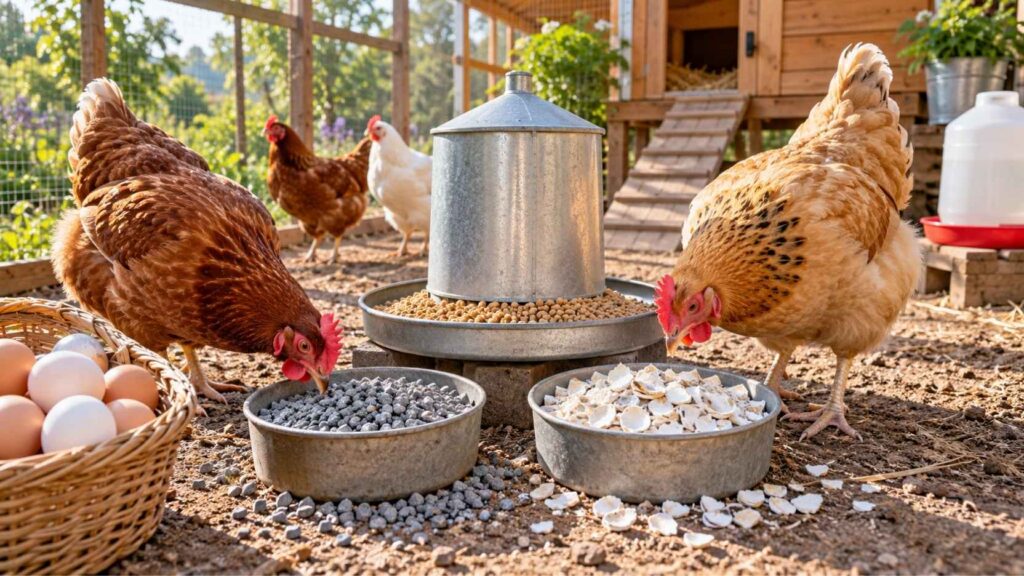
Walk into almost any feed store and you may find two bags of small, crushed-looking material sitting near the chicken feed: poultry grit and oyster shell. 🐔 Because chickens peck at both and keepers often place both in small containers beside the feeder, beginners understandably assume they perform roughly the same job. They do not—grit helps chickens process food, while oyster shell supplies supplemental calcium primarily for laying hens.
Understanding that difference prevents one of the most common backyard-flock feeding mistakes. A chicken can have plenty of oyster shell and still lack appropriate digestive grit, while a hen can have unlimited granite grit without receiving meaningful supplemental calcium from it. Think of them as two completely different tools that happen to look similar.
The 10-Second Answer: Grit And Oyster Shell Are Not The Same Thing
If you remember only one sentence from this guide, make it “Grit = digestion; oyster shell = calcium.” Grit is usually made from hard, insoluble stone that chickens retain in their muscular gizzard to help grind food, while oyster shell is a calcium-rich material that gradually breaks down during digestion. 🪨 Their purposes are different enough that one should never automatically be substituted for the other.
Both are commonly offered free-choice in separate containers, allowing birds to consume what they need rather than forcing a fixed amount into every meal. This approach is particularly useful in mixed flocks because laying hens may seek additional calcium while roosters, chicks, and nonlaying birds generally do not need the same supplemental calcium intake. Your regular feed remains the nutritional foundation; these products serve specific supporting roles.
| Grit | Oyster Shell | |
|---|---|---|
| Main job | Helps grind food | Provides supplemental calcium |
| Most useful for | Birds eating foods that require grinding | Primarily actively laying hens |
| Material | Hard, insoluble stone | Calcium-rich shell material |
| Does it dissolve? | Remains in the gizzard relatively longer | Gradually breaks down |
| How to offer | Separate container | Separate container |
| Can one replace the other? | No | No |
What Chicken Grit Actually Does
Chickens do not chew food with teeth the way people do. Food eventually reaches the gizzard, a powerful muscular organ that uses swallowed grit to mechanically crush and grind tougher food particles before digestion continues. ⚙️ Proper poultry grit therefore functions almost like the grinding surface of a tiny internal food processor.
Hard insoluble materials such as appropriately sized granite are commonly used because they remain useful in the gizzard longer than softer materials. The bird gradually loses or passes pieces and replaces them by consuming more grit when available. Size matters too, which is why chick grit is smaller than grit intended for mature chickens.
What Oyster Shell Actually Does
Oyster shell has a completely different purpose: it provides a concentrated source of calcium, an important mineral for eggshell formation. 🥚 A laying hen repeatedly moves significant amounts of calcium into the shells she produces, which is why many backyard keepers provide oyster shell separately even when hens are eating a formulated layer ration. Birds can then consume supplemental calcium according to their individual demand.
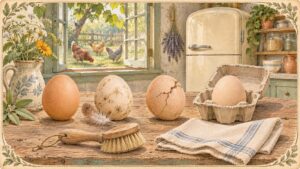
However, an unusual eggshell does not automatically prove that a hen needs more oyster shell. Shell quality can also be influenced by factors including age, heat stress, temporary reproductive disturbances, overall nutrition, and certain illnesses. 🔍 Treat oyster shell as part of a sound feeding system, not as a guaranteed cure for every thin, rough, misshapen, or unusual egg.
Why Oyster Shell Cannot Replace Chicken Grit
This is where the visual similarity causes trouble. Oyster shell may feel hard in your hand, but it is not the same durable insoluble material as proper poultry grit, and it gradually dissolves as a calcium source. Feeding oyster shell therefore does not reliably provide the long-lasting grinding material chickens need in the gizzard.
Likewise, granite grit cannot replace oyster shell because rock is not being offered as a usable calcium supplement. 🪨 A hen could have excellent access to digestive grit and still need an appropriate calcium source within her overall diet. The safest mental shortcut remains simple: one grinds food; the other contributes calcium.
Which Chickens Need Oyster Shell?
Actively laying hens are the primary birds for which free-choice oyster shell is commonly provided. Pullets that have not begun laying generally do not need supplemental oyster shell simply because they will eventually become layers, and chicks should receive feed formulated specifically for their growth stage instead. 🐥 Introducing large amounts of extra calcium before birds need it is not a substitute for age-appropriate nutrition.
Roosters and other nonlaying adult chickens also do not have the eggshell-production demand that laying hens have. In a mixed flock, one practical system is to feed an appropriate flock ration and provide calcium separately where laying hens can take it free-choice, rather than forcing every bird to consume a high-calcium supplement. The exact base ration should still match your flock’s ages and production stages.
Should Chickens Have Grit All The Time?
Whether chickens need supplemental grit depends partly on what they eat and what they can access naturally. Birds eating only commercially prepared crumble or pellets may need little additional grinding because the ingredients have already been processed, while chickens consuming whole grains, vegetation, insects, kitchen-safe treats, or forage have more reason to need appropriate grit. 🌿 Free-ranging birds may locate small stones naturally, but you cannot always know whether they are finding suitable material.
For that reason, many keepers simply provide correctly sized insoluble poultry grit free-choice whenever birds consume foods beyond a finely processed complete ration. It is inexpensive, stores easily, and the flock can take what it needs without you trying to calculate an exact daily dose. Avoid assuming playground sand, oyster shell, random gravel, or every stone in the yard automatically performs the same job as properly sized poultry grit.
The Easiest Beginner Setup
A simple feeding station removes most of the confusion: complete feed → grit → oyster shell → clean water. 🌾 Keep the main ration in its feeder, offer grit separately when appropriate, provide oyster shell separately for laying hens, and maintain fresh drinking water at all times. Labeling the supplement containers can also prevent family members or new flock keepers from mixing them together.
You generally do not need to dump handfuls of grit or oyster shell into the primary feeder simply because the birds have access to them. Free-choice containers make it easier for chickens with different needs to regulate their own intake while preserving the nutritional formulation of the main feed. Keep the containers dry, protected from manure and excessive litter, and refill them as needed rather than according to an arbitrary daily amount.
What To Observe First → When To Worry
If you are evaluating whether your supplement setup is working, begin with observation rather than immediately adding more products. 👀 Check whether birds are eating their complete feed normally, whether grit and oyster shell remain available, whether eggshell changes affect one bird or many, and whether unusual eggs appear repeatedly rather than once. Also consider age, weather, molt, diet changes, and stress before assuming calcium is the only explanation.
Persistent soft-shelled eggs, repeated abnormal shells across several birds, appetite changes, lethargy, weight loss, or other signs of illness deserve more investigation than simply adding extra oyster shell. A qualified poultry veterinarian or knowledgeable agricultural professional can help when flock problems continue despite an appropriate feeding system. Supplements work best when they support good management rather than replace diagnosis.
One-Page Grit Vs Oyster Shell Guide
GRIT 🪨
- Job: Helps the gizzard grind food.
- Who may need it: Chickens eating whole grains, treats, forage, grass, insects, and other foods requiring grinding.
- Best setup: Appropriate size for the bird, offered free-choice in a separate container.
- Remember: Grit is not a calcium supplement.
OYSTER SHELL 🥚
- Job: Provides supplemental calcium for eggshell production.
- Who commonly uses it: Actively laying hens.
- Best setup: Offer free-choice separately from the main ration.
- Remember: Oyster shell is not digestive grit.
The easiest way to remember oyster shell vs grit for chickens is to stop thinking of them as competing supplements. Grit belongs to the digestion system, while oyster shell belongs to the laying-hen calcium system, and each should be used for the job it was meant to perform. 🐔 Once that distinction is clear, one of the most confusing parts of beginner chicken feeding becomes surprisingly simple.