
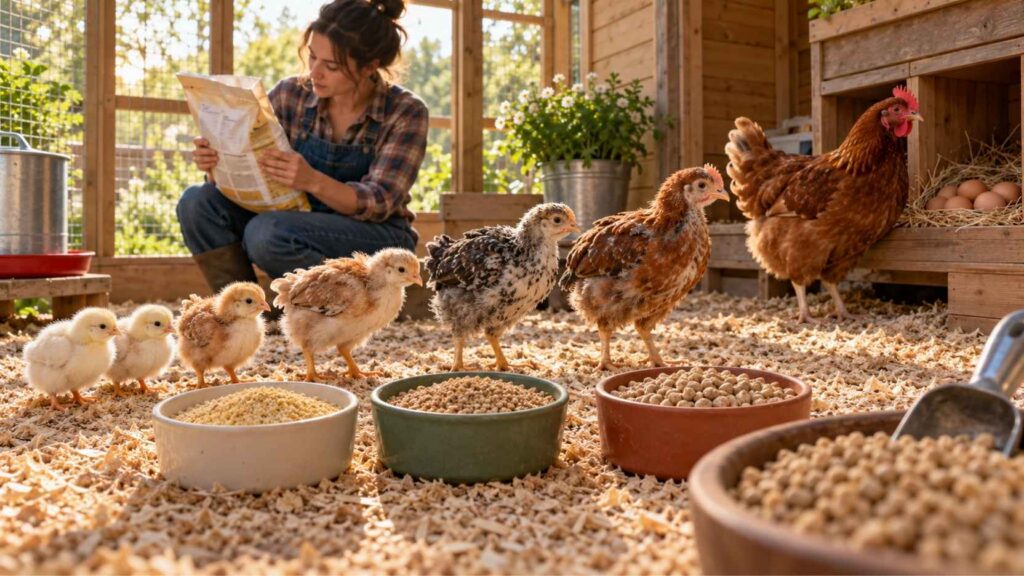
Walk into a feed store and the chicken aisle can make raising pullets seem more complicated than it needs to be: starter, starter/grower, grower, developer, all-flock, and layer feed may all be sitting within a few feet of each other. 🐥 That naturally creates the beginner question, “Do chickens actually need grower feed, or can I simply keep feeding starter until they begin laying?” The answer is that chickens need nutrition appropriate for their stage of growth, but that does not always require purchasing a separate bag with the word “Grower” printed across it.
Some feeding programs divide development into several distinct rations, while other commercial products intentionally combine starter and grower stages into one formula. That is why two experienced chicken keepers can describe completely different feeding routines and both be following reasonable programs. 🌾 Instead of memorizing product names, learn to read the intended age or life stage, protein level, calcium level, and feeding instructions on the actual bag.
Why Some Chicken Owners Never Buy A Bag Called “Grower”
A keeper using a dedicated feeding program might start chicks on starter, change to grower after the early growth period, and eventually transition pullets to layer feed when appropriate. Another keeper may purchase a product labeled starter/grower that is specifically formulated to remain the flock’s complete ration through much or all of the pre-laying period. 🐔 The second keeper has technically never purchased “grower feed,” yet the birds have still been receiving a ration designed for growing chickens.
This explains much of the disagreement you will see among backyard flock owners. Product lines are not standardized around one universal naming system, so “Starter,” “Grower,” and “Starter/Grower” can represent different feeding programs depending on the manufacturer. The label’s feeding directions therefore tell you more than another chicken owner’s statement that they always—or never—use grower feed.
Starter Vs Starter/Grower Vs Grower: What Actually Changes?
Chick starter is formulated for young birds experiencing rapid early development and commonly provides relatively high protein compared with later-stage layer diets. A grower or developer ration is designed for older immature birds that are still building their bodies but have not entered regular egg production. 🌱 Exact protein percentages and recommended ages vary by product, so there is no single number that describes every starter or grower formula on the market.
A combined starter/grower chicken feed removes one transition by creating a ration intended to cover a broader period. That convenience can be particularly attractive for someone raising six backyard pullets rather than hundreds of production birds, because partially used bags and unnecessary feed changes become less of a problem. The important point is not whether the bag uses one word or two—it is whether the feed is complete and formulated for birds of that age and purpose.
The Feed Bag Matters More Than The Product Name
Turn the bag over before making feeding decisions. 🔍 Look for the species and class of poultry it is intended for, the recommended ages or production stage, guaranteed nutrient analysis, and instructions describing when another ration should replace it. Those details answer “Do chickens need grower feed?” much more reliably than the marketing name on the front.
Pay particular attention to calcium, because the requirements of a growing pullet and an actively laying hen are substantially different. Layer rations contain considerably more calcium to support eggshell production, while immature pullets do not need a layer-level calcium ration simply because they are getting closer to adulthood. 🥚 This is one reason you should not solve a missing grower-feed problem by automatically moving young birds straight onto layer feed.
If Your Store Only Sells Starter/Grower, What Should You Do?
If the starter/grower product specifically states that it is a complete feed for chickens through the age range your birds currently occupy, you generally do not need to hunt down another product solely because it lacks a separate “grower” stage. Feed it according to the manufacturer’s directions while keeping clean water continuously available. 💧 When the birds approach the next life stage, reread the label and determine when that particular feeding program recommends changing rations.
This is especially useful in small towns or farm stores where only a few poultry formulas are stocked. A well-formulated starter/grower is not an inferior shortcut simply because another company sells starter and grower separately. Think of these products as different routes toward the same goal: appropriately balanced nutrition while the pullet develops.
If Your Starter Bag Runs Out At 8, 10, Or 12 Weeks
Do not switch feeds purely because you reached the bottom of the bag. 📅 First check what the existing product was designed to feed and compare that with the birds’ current age, because some starters are intended only for early chicks while other starter/grower products continue much longer. If your birds have reached the manufacturer’s transition point, move to the appropriate next-stage ration rather than automatically buying another identical bag.
Conversely, you do not need to panic because your chicks turned a particular age yesterday and still have several pounds of an appropriate complete ration remaining. Feeding programs have planned transition ranges rather than a biological switch that flips at midnight on one exact birthday. What matters most is following a sensible life-stage feeding program consistently, not making every change on an artificially precise calendar date.
Can Chickens Stay On Starter Feed?
The answer depends on what “starter” means on your particular bag. If it is actually labeled starter/grower and its instructions cover the pullet’s current age, continuing that ration may be exactly what the manufacturer intended. ✅ If it is a dedicated chick starter intended only for an earlier growth stage, use the label’s transition instructions rather than assuming the same feed should continue indefinitely.
Keeping older pullets on a richer starter longer than necessary may also be needlessly expensive even when it does not create an immediate visible problem. Grower programs are designed to match changing nutritional needs as rapid chick growth slows and the bird moves toward maturity. The goal is therefore not finding one feed that chickens can merely survive on, but choosing the ration designed for their present stage.
What To Observe First: Age, Purpose, Protein And Calcium
Start with age and purpose because a six-week-old future laying hen, a meat bird, and an adult laying hen do not belong on identical feeding programs. Then compare protein and calcium while remembering that percentages should be interpreted within a complete ration rather than treated as isolated targets. 📋 More protein or more calcium is not automatically better simply because those nutrients are important.
Also determine whether you are raising standard laying pullets, dual-purpose birds, meat birds, or a mixed-age flock, because those situations can require different strategies. Never assume a bag intended for broilers, gamebirds, turkeys, ducks, or adult layers is automatically interchangeable with a pullet ration. Reading who the feed was formulated for prevents more mistakes than obsessing over whether the largest word says Starter or Grower.
When To Worry About The Wrong Life-Stage Ration
The most common beginner mistake is not failing to perform a perfect starter-to-grower transition; it is feeding a ration that clearly belongs to the wrong class of bird. ⚠️ Moving immature pullets onto high-calcium layer feed too early is particularly unnecessary because that added calcium is intended for birds producing shells. Likewise, repeatedly diluting a complete grower ration with large amounts of treats, scratch, or kitchen scraps can undermine the nutritional balance you were trying to achieve.
If birds are growing poorly, losing weight, behaving abnormally, developing persistent digestive problems, or showing other signs of illness, do not assume switching feed names will solve everything. Nutrition is only one part of flock health, and persistent problems deserve a broader evaluation and veterinary guidance when appropriate. Your feeding routine should create a stable nutritional baseline that makes unusual changes easier to recognize.
“Do I Need Grower Feed?” Decision Tree
Does your current bag say it is appropriate for your chickens’ present age? ➜ Yes: Keep following its directions. ➜ No: Move to the next appropriate complete ration.
Does the bag say Starter/Grower and cover the entire pre-laying period? ➜ Yes: You probably do not need a separate bag labeled Grower. ➜ No: Follow the manufacturer’s recommended transition to grower or developer feed.
Are your pullets not laying yet? ➜ Avoid automatically switching to layer feed simply because grower is unavailable. ➜ Look for an appropriate starter/grower, grower, developer, or other complete ration specifically labeled for growing chickens.
Are the birds beginning the laying stage and reaching the transition described by your feed program? ➜ Prepare to move to the appropriate layer ration. 🥚 ➜ Make the change according to the feed instructions rather than relying only on one universal age.
The Simplest Feeding Route For A Small Backyard Flock
For many small-flock owners, the easiest system is one appropriate complete starter or starter/grower ration during early development, an appropriate grower stage if the chosen feed program requires it, and layer feed when the pullets reach the laying stage specified by that program. 🐓 Keep treats modest so they do not replace meaningful amounts of complete ration, provide constant access to clean water, and avoid unnecessary supplements that duplicate what the formulated feed already provides. Simplicity works well when the underlying feed is appropriate.
So, do chickens really need grower feed? They need the nutrients supplied by an appropriate growing-bird ration, but they do not necessarily need a separate product literally named “Grower” if their starter/grower formula already covers that stage. 🌾 The easiest rule to remember is: feed the life stage, not the biggest word on the front of the bag.




