Introduction
Egg laying is a normal part of a hen’s reproductive cycle, but sometimes an egg can become difficult or impossible to pass through the reproductive tract. Backyard keepers often call this egg binding.
It is important because a hen that is struggling to lay an egg may become seriously ill. However, not every hen that spends extra time in the nest box is egg-bound. Similar signs can occur with other reproductive, digestive, or systemic problems.
The safest approach is to recognize the warning signs early, avoid risky home treatments, and know when veterinary care is needed.
What Is Egg Binding? 🥚
Egg binding generally refers to a situation in which an egg is retained in the reproductive tract and the hen cannot pass it normally.
The problem may involve an egg that is unusually large, malformed, damaged, or otherwise difficult to pass. In some cases, problems with the reproductive tract or the hen’s general health may contribute.
Egg binding can become an emergency when the hen becomes weak, distressed, unable to pass the egg, or develops other serious symptoms.
Warning Signs to Watch For 👀
A potentially egg-bound hen may show several changes, including:
- Repeatedly visiting or remaining in the nest box
- Straining
- Restlessness
- Reduced appetite
- Reduced activity
- Weakness
- A hunched or unusual posture
- Tail pumping or repeated contractions
- Changes in droppings
- A swollen or uncomfortable-looking abdomen
- Difficulty walking normally
These signs are not specific to egg binding.
A hen with a reproductive tract infection, prolapse, internal laying, egg yolk peritonitis, intestinal problems, or another illness may look similar.
That is why the hen’s overall condition matters.
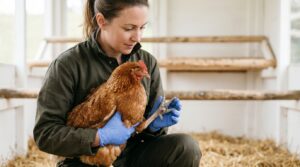
Check the Hen Without Causing Injury
If you suspect a problem, handle the hen calmly and gently.
Look for obvious external abnormalities, particularly around the vent.
A prolapsed oviduct or vent tissue is an important finding that requires prompt veterinary attention.
Do not repeatedly squeeze the abdomen or attempt to force an egg out.
The reproductive tract is delicate, and aggressive manipulation can cause injury, bleeding, or other complications.
When Is It an Emergency? 🚨
Treat the situation as urgent when the hen is clearly deteriorating.
Seek veterinary care promptly if she:
- Becomes extremely weak or unable to stand
- Has difficulty breathing
- Collapses
- Has significant bleeding
- Has a prolapse
- Shows severe abdominal swelling or pain
- Cannot pass droppings and appears seriously ill
- Repeatedly strains without producing an egg
- Stops eating and becomes increasingly lethargic
- Has symptoms that are rapidly worsening
A hen that is weak, distressed, or deteriorating should not be left for hours while multiple home treatments are attempted.
The sooner a seriously ill bird is evaluated, the more options may be available.
What About a Warm Bath? 🛁
Warm bathing is commonly recommended online as a treatment for egg binding.
However, it should not be treated as a guaranteed cure.
A warm, quiet environment may help reduce stress, but it cannot remove an obstruction caused by every possible reproductive problem.
If a hen is already weak, struggling to breathe, collapsing, or otherwise seriously ill, bathing her may delay professional treatment and can create additional stress.
When in doubt, veterinary assessment is safer than repeatedly attempting home remedies.
Don’t Try to Pull the Egg Out ⚠️
This is one of the most important rules.
Do not insert fingers, tools, or other objects into the vent to retrieve an egg.
Do not intentionally break an egg inside the hen.
Sharp shell fragments or manipulation of the reproductive tract can cause serious injury, bleeding, infection, or other complications.
What appears to be a simple retained egg may actually be another reproductive disorder.
Why Can Egg Binding Happen?
There isn’t always one simple cause.
Potential contributing factors can include:
- An unusually large or malformed egg
- Reproductive tract abnormalities
- Problems affecting normal egg formation or movement
- Poor overall health
- Nutritional problems
- Excessive reproductive activity
- Stress or other environmental factors
A hen’s age and reproductive history can also influence the likelihood of reproductive disorders.
Importantly, one episode of egg retention does not necessarily reveal the underlying cause.
If a hen repeatedly has laying difficulties, veterinary evaluation can help determine whether there is a larger reproductive problem.
Prevention Starts With Good Nutrition 🌱
Good flock management cannot prevent every case, but it supports normal health.
Provide a balanced layer diet appropriate for laying hens and ensure access to clean drinking water.
Calcium is particularly important for eggshell formation, but giving large amounts of supplements without considering the hen’s complete diet is not necessarily better.
Avoid relying on random supplements as a substitute for a balanced feed.
Also monitor body condition and general health rather than focusing only on egg production.
Know Your Hen’s Normal Behavior
One of the best tools for detecting problems is knowing what your hens normally look like.
Pay attention to:
- Appetite
- Activity
- Droppings
- Egg production
- Walking
- Breathing
- Nest-box behavior
- Appearance around the vent
A hen that suddenly becomes quiet, withdrawn, or unusually inactive deserves closer observation.
Because chickens can hide illness, behavioral changes can be important early clues.
Don’t Assume Every Missing Egg Means Egg Binding
Egg production naturally changes.
A hen may stop laying because of:
- Age
- Molting
- Seasonal changes
- Reduced daylight
- Stress
- Illness
- Nutritional problems
Therefore, one day without an egg does not automatically mean a hen is egg-bound.
Look at the whole picture.
Is she eating? Is she active? Is she passing normal droppings? Is she repeatedly straining? Does she appear painful or weak?
Those details are much more informative than egg production alone.
Keep a Simple Emergency Plan 📋
Every backyard poultry keeper should know where to seek veterinary help before an emergency occurs.
Keep a note with:
- Your regular veterinarian or poultry-capable clinic
- After-hours contact information if available
- Basic flock records
- Recent medications or treatments
- Important observations about the affected hen
If you need veterinary advice, being able to describe when the symptoms started and how they changed can be extremely useful.
Final Thoughts ❤️
Egg binding can be serious, but recognizing one symptom alone does not prove that a hen is egg-bound.
Watch for persistent straining, unusual nest-box behavior, weakness, changes in droppings, abdominal abnormalities, prolapse, or rapid deterioration.
Most importantly, never try to force an egg out or break it inside the hen.
A warm, quiet environment may reduce stress, but home care should never delay veterinary attention when a hen is seriously ill.
For backyard chicken keepers, the most valuable skill isn’t knowing every treatment on the internet. It’s knowing what is normal for your hen, recognizing when something is wrong, and getting professional help before a potentially manageable problem becomes an emergency. 🐔💛