
Having a sick chicken is stressful enough.
Having a sick chicken when you have to leave for work can make the situation feel impossible.
You may spend your morning thinking:
Will she eat? Will she drink? Will the other chickens bother her? What if she gets worse while I’m gone?
The reality is that you cannot monitor a chicken every minute of the day. What you can do is create a safe, quiet setup before leaving, recognize when a chicken needs urgent veterinary attention, and make a simple plan for checking her when you return.
Because chickens often hide illness until they are quite sick, even small changes in behavior, appetite, drinking, droppings, posture, or activity deserve attention.
Here’s how to handle a sick chicken when your work schedule doesn’t stop. 🌿
🏠 First, Decide Whether She Can Safely Be Left Alone
This is the most important step.
Not every sick chicken is appropriate for a “leave her in a quiet crate and go to work” situation.
A chicken showing extreme weakness, severe breathing difficulty, seizures or other neurological signs, major bleeding, an open fracture, or other obvious emergency signs needs prompt veterinary attention rather than simply being left alone for the workday.
A bird that is weak, unresponsive, lying on the bottom, or struggling significantly to breathe should be treated as an emergency.
If you’re unsure, contact a veterinarian or poultry-health professional before leaving.
The question isn’t:
“Can I make her comfortable until I get home?”
The better question is:
“Is this bird stable enough that waiting several hours is reasonably safe?”
You cannot answer that perfectly at home, but recognizing obvious red flags can prevent dangerous delays.
🐔 Isolate Her Before You Leave
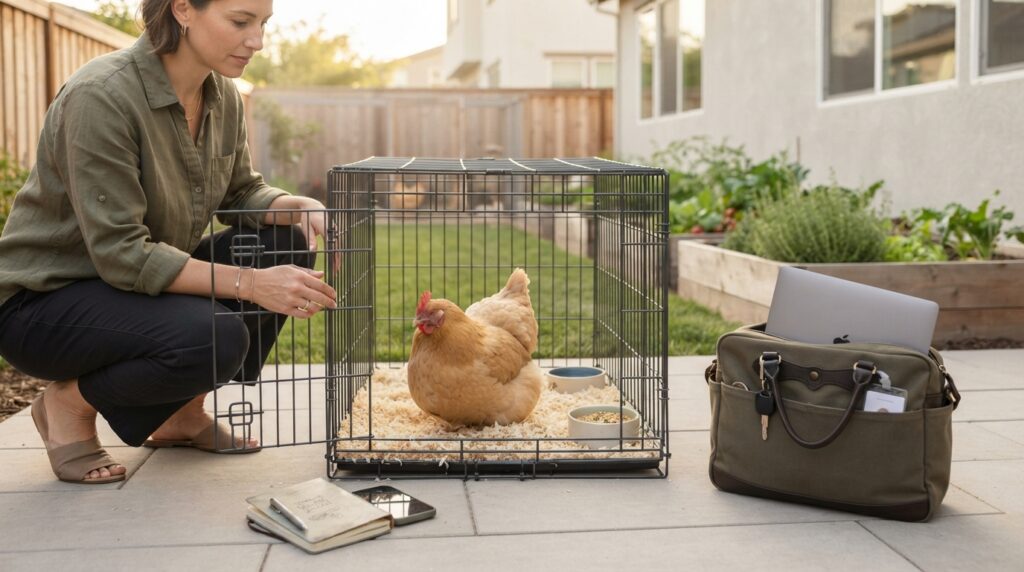
If the chicken is sick, injured, being bullied, or unable to compete normally for food and water, a separate recovery area may be appropriate.
A simple hospital crate can be useful because it allows you to monitor:
- Food intake
- Water intake
- Droppings
- Activity
- Posture
- Breathing
- General condition
Isolation also helps prevent healthy flock members from pecking or harassing a weak bird.
However, isolation is not automatically a treatment. It is a way to provide a controlled environment while you determine what is happening and seek appropriate care.
For suspected infectious disease, separating the sick bird and strengthening biosecurity practices can help reduce the risk of disease spreading through the flock.
🧺 Make the Recovery Area Boring
When you’re going to work, boring is good.
You want a setup that is:
Quiet + secure + easy to clean + easy to monitor
A simple recovery space may include:
- A secure crate or small enclosure
- Clean, dry bedding
- Easy access to water
- Appropriate chicken feed
- Good ventilation
- Protection from drafts and extreme temperatures
- Enough space for the bird to move comfortably
Avoid unnecessary perches if the chicken is weak or having difficulty balancing. A bird that repeatedly falls from a perch can injure itself.
The goal is to reduce unnecessary activity and stress.
Sick birds benefit from quiet rest, and supportive care can include appropriate warmth, hydration, nutrition, and a calm environment.
🌡️ Be Careful With Heat
A common instinct is to make a sick chicken very warm.
That can be dangerous if taken too far.
A sick bird may benefit from a somewhat warmer environment because maintaining body temperature uses energy. However, overheating is also a problem. Veterinary guidance for sick birds emphasizes warmth without overheating.
If using supplemental heat, make sure the chicken can move away from the heat source.
Watch for signs that the bird is too warm, such as panting or holding its wings away from the body.
And never create a setup where a heat lamp can fall onto bedding or ignite surrounding material.
If you’re going to be away for many hours, fire safety matters just as much as keeping the bird warm.
💧 Make Water Extremely Easy to Reach
A sick chicken may drink less than usual.
That makes water access particularly important.
Put clean water within easy reach so the bird doesn’t need to walk across the enclosure to find it.
If the chicken is weak, don’t assume that placing a drinker several feet away is good enough.
You want the bird to be able to reach it without climbing, jumping, or struggling.
Check that the container:
- Is stable
- Cannot easily tip over
- Is clean
- Is low enough to reach
- Is positioned where droppings are unlikely to contaminate it
Sick birds can become dehydrated when they drink less than normal, so hydration is an important part of supportive care.
Don’t force water before work
If you aren’t trained to safely administer fluids, don’t experiment with syringes immediately before leaving for work.
Birds can aspirate liquids if they are given improperly.
If your veterinarian has shown you exactly how to administer a prescribed treatment, follow those instructions.
Otherwise, focus on making clean water easily accessible and getting professional guidance when necessary.
🍽️ Keep Food Within Easy Reach
The same principle applies to food.
A weak chicken shouldn’t have to compete with six other birds to reach the feeder.
In a recovery enclosure, place appropriate feed close enough that the bird can reach it comfortably.
Avoid suddenly changing the entire diet unless there is a specific reason to do so.
For routine feeding, chickens should receive a nutritionally complete diet appropriate for their age and type rather than relying heavily on treats or scratch.
If a veterinarian has recommended a particular diet or feeding method, follow that plan.
👀 Do a Five-Minute Check Before Work
You don’t need a complicated medical examination every morning.
Instead, develop a consistent routine.
Before leaving, ask:
1. Is she alert?
Does she respond when you approach?
2. Is she standing normally?
Or is she unable to stand, repeatedly falling, or remaining collapsed?
3. Is she breathing normally?
Look for obvious respiratory effort, open-mouth breathing, or pronounced tail movement associated with breathing.
4. Is she drinking?
Check the water level and observe her when possible.
5. Is she eating?
Don’t assume an untouched feeder means she hasn’t eaten, but note obvious changes.
6. What do the droppings look like?
Changes can provide useful information, especially when tracked over time.
7. Is she worse than yesterday?
This may be the most important question.
A chicken that looks exactly the same may still need veterinary care.
A chicken that is clearly deteriorating needs faster action.
📱 Take a Quick Photo or Note
If you’re worried about the chicken, document what you see.
You can record:
Morning
- Activity: low
- Food: some interest
- Water: drinking
- Droppings: observed
- Breathing: no obvious difficulty
- Weight: ___, if routinely monitored
A quick photograph can also help you compare posture or physical changes later.
This is especially useful because memory is unreliable when you’re stressed.
It also gives your veterinarian a clearer timeline.
🧼 Think About Biosecurity Before Leaving
If the chicken may have an infectious illness, your routine matters beyond the sick bird.
Disease can move between birds through contaminated hands, clothing, shoes, equipment, feed, and other materials. USDA recommends practical biosecurity measures such as limiting unnecessary access, maintaining clean clothing and footwear, cleaning equipment, washing hands, and protecting birds from wildlife.
If you care for healthy chickens and a sick chicken separately, try to avoid carrying contamination from the sick bird back to the healthy flock.
A simple routine can be:
Healthy birds → sick bird → clean up
rather than moving repeatedly between groups.
Follow local veterinary or animal-health guidance if a contagious disease is suspected.
⏰ Create a “Before Work / After Work” Routine
You don’t need to spend an hour with the chicken every morning.
A practical routine might look like this:
Before work ☀️
5–10 minutes
- Observe the chicken
- Check breathing and posture
- Check water
- Check food
- Check droppings
- Clean obvious contamination
- Confirm the enclosure is secure
- Give prescribed medication if directed by your veterinarian
After work 🌙
10–15 minutes
- Reassess activity
- Check water and food
- Observe droppings
- Check for new symptoms
- Compare with the morning
- Clean the recovery area as needed
- Contact your veterinarian if the condition has deteriorated
The exact amount of monitoring depends on how sick the bird is.
A mildly affected chicken and a severely weak chicken should not be treated as if they require the same level of supervision.
🩺 Know When Work Has to Become the Secondary Problem
Sometimes the answer isn’t a better hospital crate.
Sometimes the answer is veterinary care.
A chicken with severe respiratory distress, major bleeding, neurological symptoms, an open fracture, extreme weakness, or collapse should not simply be placed in a crate until you finish your shift.
This is where having a backup plan helps.
If possible, know in advance:
- Which veterinarian treats poultry
- Who can transport the chicken if you’re at work
- Which emergency clinic accepts birds
- Who can check the chicken during your shift
- Where your carrier or transport crate is kept
You don’t want to search for all of this while standing beside a rapidly deteriorating bird.
🧑💻 What If Nobody Can Check Her During the Day?
This is one of the hardest situations.
If nobody is available, your goal is to make the environment as safe and stable as reasonably possible without pretending that home care can replace veterinary treatment.
Before leaving:
✔ Secure the enclosure
✔ Provide clean water
✔ Provide appropriate food
✔ Remove hazards
✔ Keep the environment calm
✔ Maintain appropriate temperature
✔ Make sure the bird cannot fall from a height
✔ Follow veterinary instructions for prescribed treatment
✔ Keep the sick bird separated when appropriate
Then reassess as soon as you return.
If the bird’s condition is unstable or worsening, the answer may be arranging veterinary care rather than simply improving the setup.
🚫 Avoid the Internet Diagnosis Trap
When you’re rushing to work, it can be tempting to search:
“Chicken fluffed up not eating what disease?”
Five minutes later, you have twelve possible diseases and absolutely no idea which one your chicken actually has.
Symptoms overlap.
Lethargy, reduced appetite, abnormal droppings, respiratory signs, weight loss, and weakness can have multiple possible causes.
Use reliable veterinary information to recognize warning signs, but don’t treat a symptom search as a diagnosis.
And don’t start random medications simply because someone online says they worked for their chicken.
Treatment depends on the cause, and medication decisions for poultry can have additional considerations when eggs or meat enter the food chain.
📝 Keep a Simple Sick-Chicken Log
For chickens that need monitoring over several days, a simple log can be incredibly useful.
| Check | Morning | Evening |
|---|---|---|
| Alertness | ✓ / ✗ | ✓ / ✗ |
| Standing normally | ✓ / ✗ | ✓ / ✗ |
| Eating | ✓ / ✗ | ✓ / ✗ |
| Drinking | ✓ / ✗ | ✓ / ✗ |
| Droppings | Normal / Changed | Normal / Changed |
| Breathing | Normal / Abnormal | Normal / Abnormal |
| New symptoms | — | — |
If you routinely weigh the bird, record the weight too.
The purpose isn’t to turn your chicken into a laboratory experiment.
It’s simply to make changes easier to recognize.
❤️ Your Job Is to Build a Safe Plan, Not Watch Every Second
Having to work doesn’t make you a bad chicken keeper.
You have responsibilities outside the coop.
The important thing is recognizing when a chicken can reasonably be supported in a quiet recovery area and when the situation has crossed into something that needs professional attention.
A good workday plan is simple:
Observe → stabilize the environment → provide easy access to food and water → isolate when appropriate → document changes → seek veterinary care when needed → reassess after work.
And remember: chickens can hide illness surprisingly well. A bird that suddenly looks very sick may have been unwell for longer than it appeared.
🌿 Final Thoughts
A sick chicken doesn’t necessarily mean you have to cancel your entire day.
But it does mean you need a realistic plan.
Set up a secure recovery space. Keep food and water accessible. Reduce stress and hazards. Practice good biosecurity. Record important changes. And most importantly, learn to recognize when “wait until I get home” is no longer an appropriate plan.
Your goal isn’t to provide constant surveillance.
It’s to make the hours you’re away as safe as possible while getting veterinary help when the bird’s condition requires it. 🐔❤️
A calm, prepared routine is much more useful than panic — especially when the clock says you need to leave for work.




