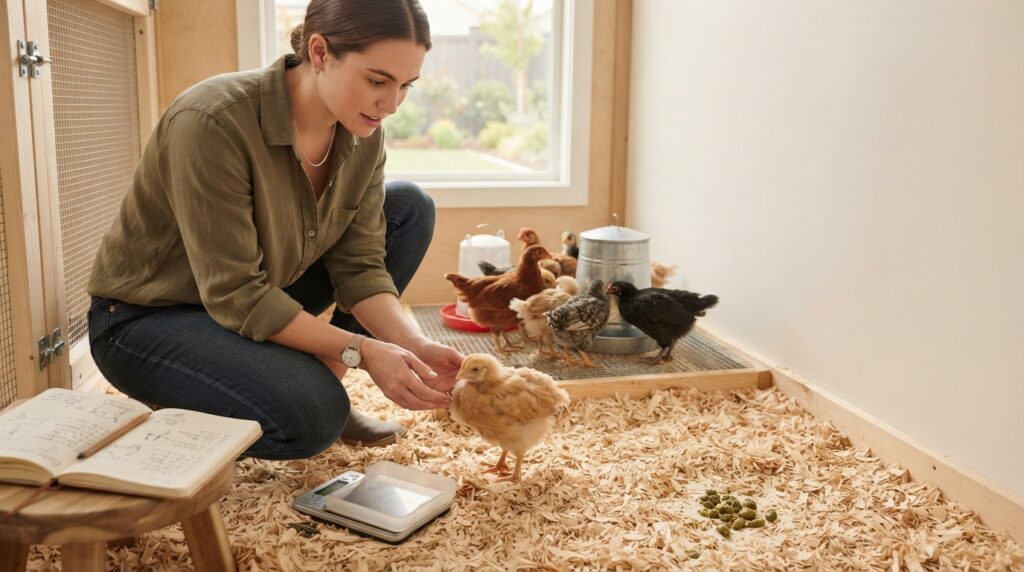
Coccidiosis is one of those chicken health problems that beginners should learn to recognize early.
It is caused by microscopic protozoan parasites, mainly Eimeria species, that multiply inside the chicken’s intestinal tissues. Different Eimeria species affect different parts of the intestine, and some can cause significant intestinal damage, bleeding, dehydration, weight loss, and even death.
The tricky part?
A chicken doesn’t start by announcing:
“I have coccidiosis.” 😅
Instead, the first clues may be subtle.
A chick may become quieter. Feed consumption may decrease. Growth may slow. Droppings may change. Then the bird may become weak, lose weight, develop severe diarrhea, or show blood in the feces.
Recognizing the early pattern matters because coccidiosis can progress over a relatively short period. In chickens, clinical disease is particularly common in young birds, and backyard poultry are often affected when environmental contamination becomes high.
Here’s what beginner chicken keepers should know.
🦠 What Exactly Is Coccidiosis?
Coccidiosis is a gastrointestinal disease caused by coccidia, microscopic protozoan parasites.
In chickens, the important organisms belong primarily to the genus Eimeria.
The parasites reproduce inside intestinal cells. As their numbers increase, they can damage the intestinal lining.
That damage is responsible for many of the signs you see.
The life cycle also explains why the environment matters so much.
Infected birds shed coccidia oocysts in their droppings. Under favorable conditions involving moisture, oxygen, and suitable temperatures, these oocysts become infective. Chickens can then ingest them from contaminated litter, soil, feed, water, equipment, or other surfaces.
So coccidiosis isn’t simply a problem with one chicken.
It can become a flock-management problem.
🐥 Which Chickens Are Most at Risk?
Young chickens are particularly susceptible.
In backyard poultry, coccidiosis most often occurs in birds roughly 1–4 months old, although susceptibility depends on factors including the bird, the Eimeria species involved, environmental exposure, and management.
Very young chicks are not immediately susceptible to infection in the same way older chicks are. Merck notes that chickens generally become susceptible after approximately 10–14 days of age.
Older chickens can still carry and shed coccidia, and clinical disease can occur under the right circumstances.
That’s why seeing an older bird around healthy chicks isn’t automatically harmless.
👀 Early Sign #1: A Chick Becomes Noticeably Quiet
One of the earliest things you may notice is a behavioral change.
A normally active chick may:
- Sit more often
- Move less
- Stay away from the group
- Appear tired
- Spend more time resting
- Show less interest in exploring
This is not specific to coccidiosis.
Many chicken illnesses can cause lethargy.
But if reduced activity appears alongside digestive changes, reduced appetite, weight loss, or abnormal droppings, it becomes more important.
Think of the change as a clue rather than a diagnosis.
🍽️ Early Sign #2: Reduced Appetite
A chicken with intestinal disease may eat less.
You may notice that a bird that normally rushes toward the feeder suddenly hangs back.
Or the bird may peck at food but consume noticeably less.
Reduced feed consumption is a recognized sign of coccidiosis in poultry.
The problem is that eating less can create a cycle:
Intestinal damage → reduced appetite → reduced nutrient intake → weakness and weight loss
That’s one reason early observation matters.
Don’t simply assume a quiet chick is “being picky.”
💧 Early Sign #3: Drinking Changes
Watch the waterer as well as the feeder.
A sick bird may change its drinking behavior, and severe intestinal disease can lead to dehydration.
Don’t try to diagnose coccidiosis simply from increased or decreased drinking, however.
Water consumption can change for many reasons, including temperature, diet, illness, and access to water.
Instead, look at drinking together with the rest of the picture.
💩 Early Sign #4: Droppings Look Different
This is one of the biggest clues beginners notice.
Coccidiosis can cause:
- Diarrhea
- Watery feces
- Mucoid feces
- Bloody feces in some infections
Severe disease can cause substantial intestinal damage and hemorrhage.
But here’s an important beginner warning:
Not every abnormal dropping means coccidiosis.
Chicken droppings naturally vary.
Diet, stress, heat, intestinal contents, and other diseases can change their appearance.
So don’t diagnose a chicken from one unusual dropping.
Instead, look for persistent or significant changes combined with other signs.
🩸 What About Bloody Droppings?
Blood in the droppings deserves attention.
Some Eimeria infections, particularly infections involving the ceca, can produce significant intestinal hemorrhage. Eimeria tenella is one of the more pathogenic species in chickens and can cause hemorrhagic lesions in the ceca.
But seeing red in a dropping doesn’t automatically prove that the chicken has coccidiosis.
The appearance of chicken feces can be confusing, and other conditions can produce abnormal droppings.
If you see repeated bloody droppings, especially with weakness, reduced appetite, weight loss, or multiple affected birds, contact a veterinarian promptly.
⚖️ Early Sign #5: Weight Loss or Poor Growth
Weight can tell you something that feathers sometimes hide.
A chick that isn’t growing normally or is losing weight deserves closer attention.
Merck lists rapid weight loss and decreased growth among signs associated with coccidiosis.
For young birds, regular weighing can be particularly useful.
You don’t need an elaborate system.
A simple record might look like:
| Day | Chick A | Chick B | Chick C |
|---|---|---|---|
| Monday | 280 g | 295 g | 300 g |
| Wednesday | 285 g | 298 g | 302 g |
| Friday | 270 g | 305 g | 308 g |
The numbers above are only an example of record-keeping, not target weights.
The important thing is noticing the direction of change.
A bird falling behind its flockmates can be easier to identify when you have actual records.
🪶 Early Sign #6: Ruffled Feathers
A sick chicken may sit with its feathers puffed or ruffled.
Merck lists ruffled feathers among clinical signs associated with coccidiosis.
Again, this is not diagnostic by itself.
A chicken may fluff its feathers because of cold, stress, pain, or many other illnesses.
But:
Ruffled feathers + lethargy + reduced appetite + abnormal droppings
is much more concerning than ruffled feathers alone.
🐔 Early Sign #7: Several Chickens Start Looking “Off”
This is particularly important for flock keepers.
If several young chickens begin showing similar digestive or behavioral changes around the same time, don’t treat each bird as an unrelated problem.
Coccidia are shed through feces and can contaminate litter, soil, feed, water, equipment, footwear, and other surfaces.
Moist, heavily contaminated litter creates an environment in which coccidial exposure can become a significant problem.
Multiple affected birds should prompt you to examine the environment as well as the chickens.
🌧️ Why Wet Litter Matters
One of the most useful beginner lessons is this:
Coccidiosis isn’t just about the chicken. It’s also about the environment.
Coccidia oocysts need appropriate environmental conditions to become infective.
Moisture is particularly important.
Wet bedding around drinkers, poorly drained ground, overcrowding, and heavy fecal contamination can increase exposure pressure.
Take a walk around the chicken area.
Look for:
- Wet litter
- Leaking drinkers
- Muddy ground
- Droppings accumulating around feeders
- Crowding
- Poor drainage
- Damp corners
- Dirty equipment
You don’t need a perfectly sterile coop.
The practical goal is to reduce excessive fecal contamination and keep the birds’ environment as dry and manageable as possible.
🔬 Can You Confirm Coccidiosis at Home?
Not reliably.
Clinical signs can make coccidiosis a possibility, but confirmation may require examination of feces for oocysts and, in some cases, examination of intestinal tissues after death.
A fecal examination may help detect coccidia.
However, simply finding oocysts does not always mean that coccidiosis is the cause of every symptom. Coccidia can be present in poultry environments, and clinical disease depends on factors such as parasite species, exposure level, bird susceptibility, and other conditions.
That’s why a veterinarian may consider the whole clinical picture, not just one laboratory result.
🚨 When Early Signs Become an Emergency
Coccidiosis can become severe.
Contact a veterinarian promptly if you see:
🔴 Significant weakness
🔴 Severe or persistent diarrhea
🔴 Repeated bloody droppings
🔴 Rapid weight loss
🔴 Dehydration
🔴 A bird that cannot stand normally
🔴 Multiple birds becoming sick
🔴 Unexpected deaths
🔴 Rapid deterioration
Severe coccidiosis can result in high morbidity and mortality in affected flocks.
Don’t wait for every classic symptom to appear.
💊 Don’t Automatically Reach for a Coccidiosis Medication
This is where internet advice can become dangerous.
If someone says:
“That’s definitely coccidiosis. Give this medication.”
you still don’t know whether your chicken actually has coccidiosis, which Eimeria species may be involved, whether another disease is present, or whether the product and dose are appropriate for your particular birds.
Anticoccidial drugs are used in poultry, but approved products, dosing instructions, withdrawal requirements, and permitted uses vary by product and jurisdiction. Resistance to anticoccidial drugs is also an established concern.
For chickens producing eggs or meat for people, medication decisions are particularly important because food-animal withdrawal requirements may apply.
Use veterinary guidance and follow the product label and local regulations.
🧹 What Beginners Can Do Immediately
While seeking appropriate veterinary advice, there are several sensible management steps.
1. Reduce unnecessary stress
Keep affected birds somewhere calm and protected.
2. Make clean water available
A weak bird should not have to compete with stronger flock members.
3. Make appropriate feed easy to reach
Don’t force a sick bird to fight for access to the feeder.
4. Keep bedding dry
Address wet areas, particularly around drinkers.
5. Reduce overcrowding
Crowding increases fecal contamination and makes disease management more difficult.
6. Clean contaminated equipment
Pay particular attention to feeders and drinkers.
7. Monitor the entire flock
Don’t watch only the sickest chicken.
Good management and sanitation can reduce parasite loads and reinfection pressure, although ordinary cleaning alone cannot eliminate all coccidia from a poultry environment.
📝 Create a Simple Coccidiosis Watch List
If you’re worried about young chickens, keep a daily checklist.
Morning ☀️
☐ Everyone active?
☐ Everyone eating?
☐ Water available and clean?
☐ Any unusual droppings?
☐ Any blood or excessive mucus?
☐ Anyone sitting alone?
☐ Any bird losing weight?
Evening 🌙
☐ Same birds still active?
☐ Any new sick birds?
☐ Feed consumption normal?
☐ Water consumption normal?
☐ Bedding dry?
☐ Any new abnormal droppings?
This takes only a few minutes.
But those few minutes can help you notice a pattern before the problem becomes much harder to manage.
🐥 Remember: Coccidiosis Is Not the Only Explanation
This may be the most important lesson in the entire article.
A chicken with diarrhea is not automatically suffering from coccidiosis.
Other diseases, parasites, dietary problems, environmental stressors, and intestinal disorders can cause similar signs.
That’s why the most useful beginner skill isn’t memorizing one disease.
It’s learning to recognize:
Something has changed.
Then:
Document it.
Then:
Investigate it.
Then:
Get appropriate help when needed.
That approach is much safer than trying to match every symptom to an internet diagnosis.
🌿 Final Thoughts
Coccidiosis can be a serious problem in chickens, particularly young birds, but early recognition gives you a valuable advantage.
Watch for the combination of reduced appetite, lethargy, weight loss or poor growth, ruffled feathers, and abnormal diarrhea or feces. Bloody droppings can occur with some serious Eimeria infections and should never be casually dismissed.
At the same time, don’t assume that every unusual dropping is coccidiosis.
Look at the whole chicken.
Then look at the flock.
Then look at the environment. 🐔🌱
Dry, well-managed housing, sensible stocking density, clean feeding and watering areas, appropriate prevention programs, and early attention to sick birds all have an important role in reducing the impact of coccidiosis.
The beginner goal isn’t to become an overnight poultry diagnostician.
It’s to become good at noticing when “something isn’t right” and responding before a small warning sign becomes a flock-wide crisis.