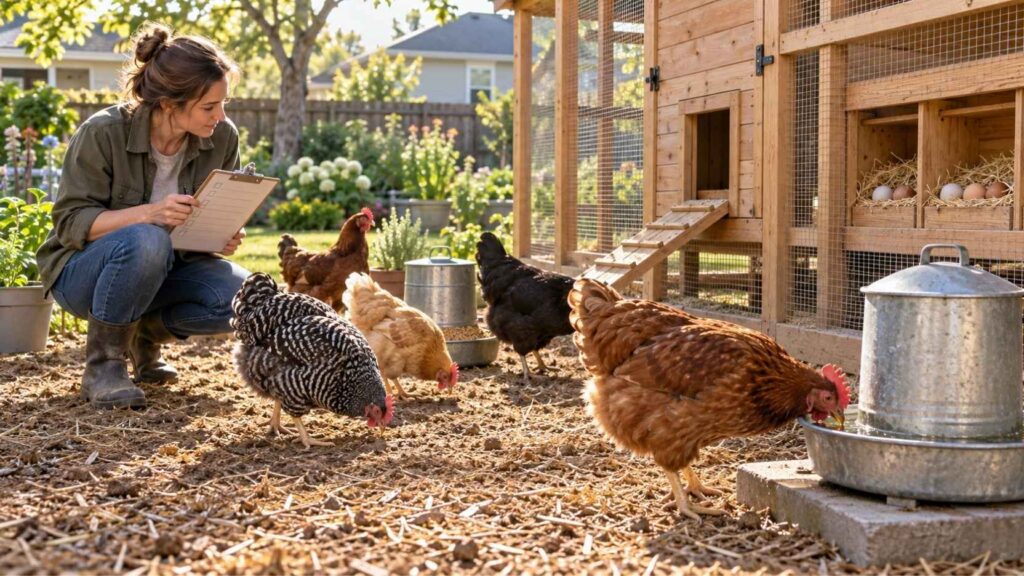
Keeping chickens healthy is not only about feed, water, eggs, and coop cleaning; observation is a daily chore too. A useful chicken health check can take about five minutes because the goal is not to diagnose disease, but to notice whether today looks different from your flock’s normal. 🐔 When you know how your birds usually move, eat, drink, socialize, and lay, small changes become easier to recognize without turning every unusual moment into an emergency.
That matters for beginners because normal chicken behavior can sometimes look strange when seen without context. Instead of beginning with “What disease is this?” ask, “What changed, how long has it lasted, and is the bird still functioning normally?” This baseline-first approach helps you respond to real changes without inventing ailments from every odd feather, dropping, or pose.
Start With the Flock—Not an Individual Symptom
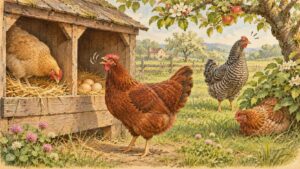
Begin your chicken daily check by standing back and counting heads while the birds come out, gather around feed, or move through the run. Ask whether everyone appeared, whether one bird is separated, and whether the flock seems alert. 👀 Healthy chickens generally interact, show interest in food, and follow familiar routines rather than staying persistently withdrawn.
A single quiet moment is not automatically a problem, so compare what you see with the time of day, weather, laying routine, molt, and that hen’s personality. Pay closer attention when several changes appear together, such as an active hen suddenly standing apart and ignoring feed. Birds can hide illness, which is why observing them before handling can reveal behavioral changes that are easy to miss.
Watch How They Walk
Next, watch the birds take several ordinary steps instead of immediately catching the chicken you are worried about. Look for even weight bearing, comfortable standing, and the ability to scratch, turn, and keep up without repeatedly stumbling. 🐾 A brief awkward step can happen, but a persistent limp, repeated loss of balance, or sudden reluctance to walk deserves a closer look.
If something seems off, inspect the legs and feet when the bird can be handled safely and calmly. Look for swelling, cuts, damaged nails, crusted scales, redness, or injuries on the footpad, but avoid naming the cause from appearance alone because different problems can look similar. Your check is meant to identify “this foot looks different,” document it, and decide whether it needs monitoring or professional evaluation.
Check Appetite and Drinking Behavior
Feed and water stations are excellent observation points because flock habits become obvious there. Notice whether birds approach food normally, whether one hen is repeatedly pushed away, and whether a bird visits the feeder but barely eats. 💧 Changes in food or water intake can accompany several problems, so treat the change as a clue rather than a diagnosis.
Check the equipment at the same time because what looks like a chicken problem can begin as an access problem. Confirm that clean water is available, feeders work, and timid birds can reach resources. If several chickens suddenly change together, inspect the shared environment first—feed, water, temperature, ventilation, and recent management changes.
Look at Feathers, Feet, and the Vent Area
A quick visual scan can reveal changes that are easy to miss when you focus only on behavior. Feathers need context because molt, mating wear, dust bathing, or pecking can change appearance, while persistent soiling or damaged skin deserves a closer look. 🪶 Occasionally part feathers in good light and look for visible parasites, wounds, scabs, or repeated pecking damage.
The vent area is another useful checkpoint, but it should be treated as an observation zone rather than a shortcut to diagnosis. Look for persistent fecal soiling, blood, swelling, protruding tissue, or obvious injury, then consider whether the bird is otherwise alert, eating, and walking normally. Feet and vents do not need an intense hands-on examination every morning, but periodic checks help establish what normal looks like for each bird.
Look Inside the Nesting Boxes
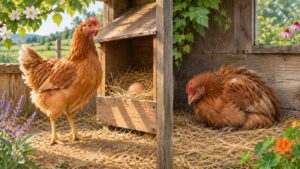
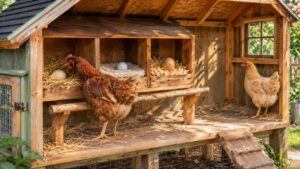
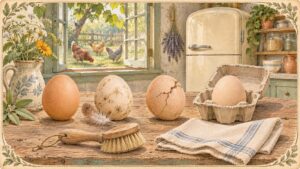
Egg collection is part of your chicken health check because the nest box can reveal changes in both hens and management. Notice whether production drops sharply, eggs are repeatedly broken, shells are consistently thin or misshapen, nests become unusually dirty, or hens start laying in hidden locations. 🥚 One strange egg is often less informative than a pattern because laying can change with age, molt, daylight, nutrition, stress, and heat.
That means an egg change should start an investigation rather than an instant conclusion. Check whether several hens are affected, whether daylight changed, whether the flock receives an appropriate complete ration, and whether another change happened at the same time. Readers can then move into focused guides such as Soft Shells, Weird Eggs, and Egg Eating or Why Did My Chickens Stop Laying? if the pattern continues.
Learn Your Flock’s Normal Before Diagnosing Abnormal
The most useful skill in learning how to tell if chickens are healthy is not memorizing a huge list of diseases; it is learning your flock’s baseline. One hen may sprint to the feeder, another may wait, and another may visit the nest box at nearly the same time each afternoon. 📋 Once those rhythms become familiar, “unusual” becomes a real comparison instead of a vague feeling that something must be wrong.
A notebook or phone note can help without turning chicken keeping into constant surveillance. Record meaningful changes such as “Hen A skipped breakfast,” “three soft-shelled eggs this week,” or “Hen B still limping,” plus the date. This creates a useful history if the problem persists and keeps your attention on patterns over time rather than isolated oddities.
When Should “Keep Watching” Become “Take Action”?
Use a simple sequence: observe first → recheck → identify persistent change → escalate when warranted. If a bird briefly acts differently but returns to normal, continued observation may be reasonable; if the change persists or worsens, move to a closer examination. 🚩 Act more quickly for obvious breathing difficulty, inability to stand, significant bleeding, protruding tissue, severe lethargy, refusal of food or water, sudden deaths, or similar signs appearing in multiple birds.
Avoid guessing treatments before you understand the problem because the same visible sign can have different causes. Separate an obviously ill or injured bird when appropriate, keep notes, and contact a poultry-experienced veterinarian or animal-health authority when serious or flock-wide disease is suspected. The five-minute check does not replace veterinary care; it helps you notice sooner, describe the change clearly, and respond proportionately.
5-Minute Flock Observation Card
Use the same order each day so the routine becomes automatic instead of stressful. A fast scan works best when you are checking for changes, not trying to prove that every bird is perfectly healthy. ✅ Keep this card near the coop or on your phone and record only something that differs meaningfully from normal.
| Time | Check | What to Look For |
|---|---|---|
| 0:00–1:00 | Headcount + flock behavior | Everyone present, alert, moving, interacting normally |
| 1:00–2:00 | Walking + posture | No persistent limp, imbalance, unusual sitting, or drooping posture |
| 2:00–3:00 | Feed + water | Normal interest, access, clean water, working equipment |
| 3:00–4:00 | Feathers + body scan | No new wounds, heavy soiling, swelling, or abnormal feather damage |
| 4:00–5:00 | Nests + eggs | Expected laying pattern, clean nests, no repeated breakage or shell changes |
Finish with one question: “Is anything clearly different from this bird’s or this flock’s normal?” If the answer is no, complete the regular chores and move on; if the answer is yes, write down what changed and recheck rather than immediately searching for the worst possible diagnosis. 🌿 Good chicken care is not constant worry—it is consistent attention, and five calm minutes of observation can become one of the most useful habits in backyard poultry keeping.