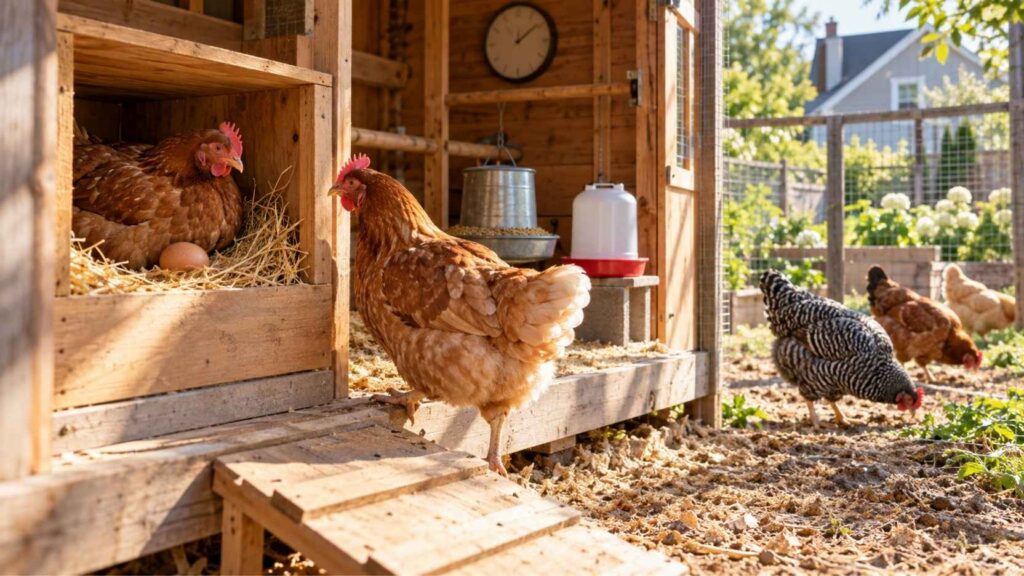
If you walk out to the coop at 8 a.m. and find three eggs, it is tempting to assume that morning is simply when chickens lay eggs. 🥚 In reality, one hen may already be finished while another is still hours away from settling into her favorite nest box, which is why the answer to “what time do chickens lay eggs?” is broader than a single hour. Backyard keepers commonly report eggs appearing from early morning through midday and well into the afternoon, which matches what we would expect when individual hens are moving through their own reproductive cycles.
The useful answer for a backyard keeper is therefore not “check the coop at exactly 9 a.m.” but learn the rhythm of your particular flock. ⏰ Most eggs in many flocks still tend to appear during the earlier portion of the day, but afternoon eggs can be completely normal, especially when several hens are at different points in their laying sequences. Understanding that variation makes egg collection easier and can also help you recognize hidden nests, skipped laying days, or a genuine change in a hen’s normal behavior.
The Short Answer: Chickens Can Lay Throughout the Day
Many laying hens produce their eggs during the morning or late morning, and poultry-extension guidance notes that a large proportion of chickens have finished laying by around noon. 🐔 That does not mean noon is a biological deadline, however, because perfectly normal hens may continue using the nest boxes later in the afternoon. A flock of eight hens can therefore behave less like eight workers arriving for the same shift and more like eight individual clocks running on slightly different schedules.
This explains why searching the nest boxes once at breakfast can give you an incomplete picture of daily production. An 8 a.m. collection might contain the eggs from your earliest layers, while another visit after lunch could reveal eggs from hens whose cycles started later. 🌤️ If your hens are healthy, eating normally, and producing reasonably consistent eggs for their breed, age, season, and individual history, afternoon laying by itself is usually not something that needs fixing.
Why Your Hens Don’t All Lay at the Same Time
Egg production is an individual biological process rather than a flock-wide appointment, and the complete formation of a chicken egg takes a little more than 24 hours. After a yolk is released, it passes through different sections of the reproductive tract while albumen, membranes, the shell, pigment, and protective coating are added. The shell-forming portion alone occupies roughly 20 hours of that process, which helps explain why producing an egg is not something a hen can simply repeat every morning at an identical clock time.
Individual hens also differ in genetics, age, production rate, lighting exposure, and where they are within a laying sequence. 🧬 One productive hen might lay on several consecutive days, another may regularly take breaks, and a third may produce fewer eggs because of her breed or age. Consequently, the time printed on your kitchen clock is less important than each hen’s individual cycle.
Why Today’s 9 AM Egg Might Become Tomorrow’s 11 AM Egg
A commonly cited figure for laying hens is approximately 24 to 26 hours to produce an egg, although individual cycles can vary. Because that interval can extend beyond a 24-hour calendar day, an egg produced at 9 a.m. today does not necessarily mean another egg will be waiting at 9 a.m. tomorrow. 🕘 The next egg may appear later, and eventually the hen may pause before beginning another sequence.
Imagine a hen whose cycle effectively shifts a little later from one egg to the next: an early egg might be followed by a later-morning egg and then another one closer to midday. Eventually her physiology and the daily light-dark rhythm may result in a break instead of an increasingly late egg. This is one reason tracking a hen across several days is far more informative than judging her from one morning’s nest-box check.
Morning Layers vs Afternoon Layers: What’s Normal?
An early-morning layer is normal, a hen that prefers late morning is normal, and an otherwise healthy hen laying during the afternoon can also be normal. 🌞 In the Reddit discussion that inspired this topic, backyard keepers described hens laying early in the morning, around midday, at roughly 2 p.m., and later in the afternoon rather than following one universal schedule. Those reports are anecdotes rather than controlled poultry research, but they illustrate the amount of real-world variation owners observe within backyard flocks.
Instead of comparing every bird with the earliest hen in the coop, establish a personal baseline for each bird whenever identification is practical. Egg color, shell shape, nest preference, leg bands, or a coop camera may help owners distinguish individual patterns without constantly disturbing nesting hens. 📋 Over time, a hen suddenly changing from a predictable pattern becomes more informative than the simple fact that she normally lays at 1 p.m. rather than 8 a.m.
Can Chickens Lay Eggs in the Evening?
Late-afternoon eggs certainly occur, while eggs appearing very late in the evening are less typical than morning or daytime laying. 🌇 If you discover an egg after dark, remember that finding it at 8 p.m. does not prove it was laid at 8 p.m.; it may simply have been hidden beneath bedding or missed during an earlier collection. Backyard reports occasionally describe surprisingly late eggs, but those observations should not be turned into a rule that hens commonly lay throughout the night.
Day length matters because light influences the reproductive system of laying hens, which is also why shorter seasonal daylight can reduce egg production. Many flock-management recommendations use roughly 14 hours of daily light when owners intentionally maintain winter production, although supplemental lighting should be introduced carefully rather than abruptly. 💡 A late egg from an otherwise normal hen is usually much less meaningful than a broader change in laying frequency, behavior, appetite, shell quality, or general condition.
Why a Hen Occasionally Skips a Day
A missing egg does not automatically mean something is wrong because even productive hens are not machines capable of depositing one egg every calendar day indefinitely. Since egg formation takes slightly longer than 24 hours, hens naturally produce eggs in sequences or clutches followed by occasional pauses, and the length of those sequences differs among birds. 🥚 Breed, age, nutrition, lighting, season, and individual production characteristics can all affect how frequently those pauses occur.
Longer-term reductions can also accompany shorter daylight, molting, aging, extreme weather, inadequate feed or water, environmental disruption, and other forms of stress. 🍂 For example, hens generally produce fewer eggs as they age, while free-ranging birds can create an entirely different mystery by depositing perfectly good eggs under shrubs or buildings. Before assuming a hen has stopped producing, check whether the egg has simply moved somewhere you are not collecting.
Should You Change Your Free-Range Schedule Around Laying?
You do not need to keep every backyard hen locked inside until a supposedly universal “egg hour” has passed, because no such hour exists. 🌿 However, when newly laying pullets or established hens start hiding eggs around the property, temporarily giving them access to the coop, secure run, and attractive nest boxes during their usual laying window can make legitimate nesting locations easier to establish. Releasing everybody at 10 a.m. will not solve every hidden-nest problem because some members of the flock may naturally lay much later.
Make the approved nest boxes quiet, accessible, clean, comfortably bedded, and available throughout the day rather than trying to force hens onto your preferred schedule. If free-ranging hens repeatedly disappear into shrubs, sheds, tall vegetation, or underneath structures, inspect those locations because hens allowed to roam may select them as nesting sites. 🔎 Your management schedule should adapt to the flock you actually own, not to a generic claim that all chickens finish laying before breakfast.
When an Unusual Laying Time Actually Deserves Attention
An unusual clock time alone usually tells you relatively little, but a sudden change combined with other abnormalities deserves closer observation. Watch for a hen repeatedly visiting the nest without producing an egg, obvious straining, marked lethargy, reduced eating or drinking, unusual posture, difficulty moving, persistent isolation, or abnormal eggs accompanied by a noticeable behavioral change. 🩺 Those signs do not identify a diagnosis on their own, so a bird that appears genuinely ill or distressed should be assessed by an appropriate poultry-experienced veterinarian rather than treated solely because her egg arrived late.
Also look at the flock-level picture when production suddenly changes: water availability, complete layer feed, extreme heat, predator disturbances, overcrowding, molting, daylight changes, and recent environmental changes can all matter. Heat stress, for example, can reduce feed intake and production, while inadequate access to water can affect laying beyond the day on which the problem occurred. 💧 In other words, investigate the hen and her environment, not merely the hour displayed on the clock.
A Simple 7-Day Egg-Time Tracking Method
You can understand your flock surprisingly well by recording eggs for only one week instead of checking randomly and relying on memory. 📝 Check the nest boxes at several consistent points—such as early morning, late morning, early afternoon, and late afternoon—and record the approximate discovery time, likely hen, nest location, and anything unusual about the egg. The goal is not to calculate an exact minute of laying but to identify repeatable windows and meaningful changes.
| Day | Hen / Egg ID | Approx. Time | Nest Location | Egg Notes | Behavior Notes |
|---|---|---|---|---|---|
| Day 1 | ______ | ______ | ______ | ______ | ______ |
| Day 2 | ______ | ______ | ______ | ______ | ______ |
| Day 3 | ______ | ______ | ______ | ______ | ______ |
| Day 4 | ______ | ______ | ______ | ______ | ______ |
| Day 5 | ______ | ______ | ______ | ______ | ______ |
| Day 6 | ______ | ______ | ______ | ______ | ______ |
| Day 7 | ______ | ______ | ______ | ______ | ______ |
By the end of seven days, you may discover that one hen is consistently early, two dominate the nest boxes around midday, and another regularly waits until afternoon. 🐓 That information can help you plan egg collections, identify hidden-nest risk, understand skipped days, and notice genuine changes without becoming anxious over normal variation. For readers who discover that eggs have disappeared altogether, the natural next guide is Why Did My Chickens Stop Laying?, while flock owners dealing with crowded or unpopular nests can continue with Nesting Boxes: How Many, How High, and What Bedding.