Introduction
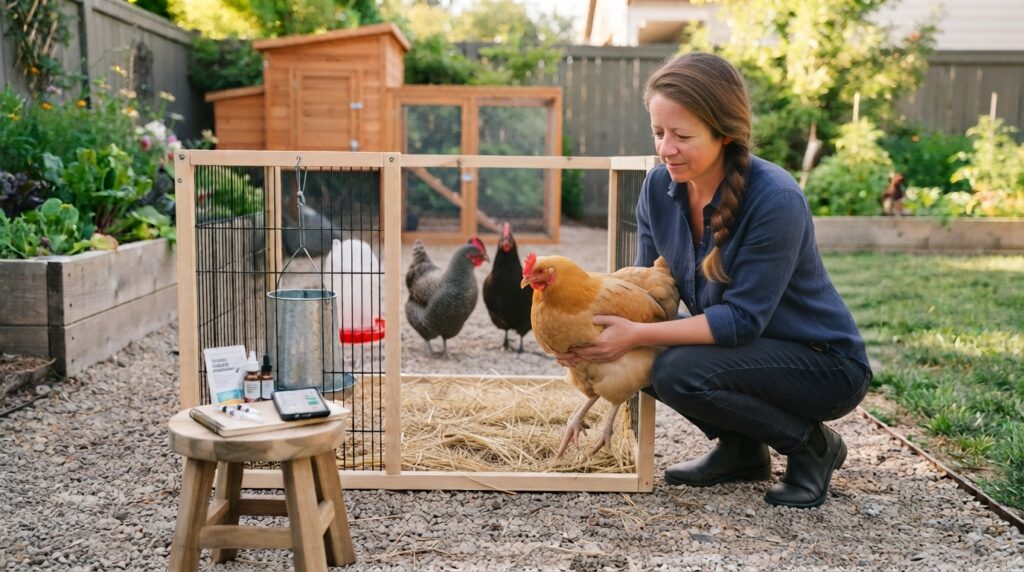
Finding a chicken that suddenly looks unwell can be stressful.
Maybe she is sitting by herself. Her feathers are fluffed up. She isn’t rushing toward the feeder. Perhaps her eyes look sleepy, her droppings look different, or she is walking strangely.
Your first instinct might be to pick her up and start checking everything.
But there’s a better approach.
Before handling a sick chicken, observe her from a distance. Chickens can hide illness, and even small changes in behavior, appetite, drinking, activity, breathing, posture, or appearance can provide useful clues.
A home check cannot tell you exactly what disease your chicken has. Many poultry illnesses share similar signs.
Instead, your goal is to answer four practical questions:
- What has changed?
- How sick does she appear?
- Could other chickens be affected?
- What information should I give the veterinarian?
Here’s a simple step-by-step check you can use before making that call. 🐔
1. Start by Watching, Not Touching 👀
Before catching the chicken, stand back and observe her for a few minutes.
This is one of the most useful parts of the examination because handling can change a bird’s behavior and breathing.
Compare her with the rest of the flock.
Look for:
- Alertness
- Activity level
- Appetite
- Drinking
- Posture
- Walking
- Interaction with other chickens
- Feather condition
- Breathing
A healthy chicken should generally be alert, active, eating normally, and interacting with the flock. A sick bird may become withdrawn, reduce food and water intake, and sit with a droopy or unusual posture.
Ask yourself:
“What is different from this chicken’s normal behavior?”
That question is often more useful than trying to match one symptom to one disease.
2. Check for Emergency Signs First 🚨
Before doing a detailed examination, make sure the chicken isn’t showing signs that require immediate professional attention.
Emergency warning signs include:
- Extreme difficulty breathing
- Severe weakness
- Seizures or other serious neurological signs
- An open fracture
- Significant head trauma
- Acute heavy bleeding
- Collapse or inability to stand
Merck Veterinary Manual recommends emergency care before a routine physical examination when these signs are present.
If the bird is struggling to breathe or extremely weak, don’t spend several minutes manipulating her body to complete a checklist.
Keep handling to a minimum and contact a veterinarian.
3. Watch Her Breathing 🫁
If she is stable enough to observe, watch her breathing while she is calm.
Look for:
- Open-mouth breathing
- Gasping
- Obvious breathing effort
- Tail bobbing associated with breathing
- Repeated coughing
- Sneezing
- Nasal discharge
- Unusual respiratory sounds
Increased respiratory effort and tail bobbing are abnormal findings in poultry.
A chicken that sneezes once isn’t automatically suffering from a serious respiratory disease.
The bigger concern is persistent or difficult breathing, especially when it occurs with weakness, discharge, swelling, or other abnormal signs.
If breathing looks difficult, stop the examination and seek veterinary help.
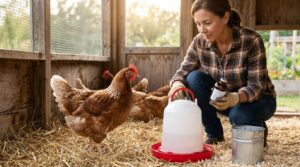
4. Check Her Appetite and Drinking 🍽️💧
Ask two simple questions:
Is she eating?
Is she drinking?
Don’t assume that food consumption is normal just because the feeder is full.
Watch the chicken herself.
Does she approach the feeder?
Does she actually peck and swallow?
Does she drink normally?
A decrease in food or water consumption can be an early sign of illness in poultry.
Also inspect the basics:
- Is the feeder accessible?
- Is the waterer clean?
- Is there enough water?
- Has the feed recently changed?
- Is another chicken preventing her from reaching the food?
Sometimes the problem is environmental or social rather than a disease, so these details matter.
5. Look at Her Eyes 👁️
Now observe the eyes.
A healthy adult chicken’s eyes should generally appear clear and bright.
Look for:
- Cloudiness
- Swelling
- Discharge
- Persistent closing of an eye
- Crusting around the eyelids
Merck’s poultry examination guidance specifically recommends checking the eyes for discharge, cloudiness, and swelling.
Don’t try to force an eye open if the bird is resisting or appears painful.
A photograph can sometimes be useful for showing a veterinarian what you observed.
6. Check the Nostrils and Face
Next, look at the area around the beak and nostrils.
Check for:
- Nasal discharge
- Crusting
- Swelling
- Scratches
- Other obvious abnormalities
You can also look at the beak for cracks or unusual changes.
Merck recommends examining the external nostrils and beak during a poultry physical examination.
Again, you’re documenting what you see, not trying to diagnose the cause.
7. Look at the Comb and Wattles 🐔
The comb and wattles are easy to see, making them useful parts of a quick visual check.
Look for:
- Swelling
- Scabs
- Lesions
- Major discoloration
- Changes that are clearly different from the bird’s normal appearance
Don’t diagnose illness from comb color alone.
However, unusual discoloration or swelling can become more important when it occurs together with other signs.
For example, USDA APHIS lists swelling or purple discoloration of the head, comb, wattles, or legs among signs that can occur with serious poultry diseases, along with respiratory, digestive, neurological, or production changes.
8. Look at Her Feathers and Skin 🪶
A sick chicken may have a noticeably unkempt appearance.
Check whether the feathers look:
- Clean
- Groomed
- Fluffed up
- Wet
- Soiled
- Broken
- Missing in unusual areas
Then look for obvious skin problems.
Check for:
- Wounds
- Blood
- Scabs
- Swelling
- Excessive irritation
- Signs of pecking
Merck recommends checking feather distribution and looking around the feather shafts for parasites such as lice, mites, and their eggs.
You don’t need to perform a full parasite investigation during an emergency.
The goal is simply to notice something that should be reported to your veterinarian.
9. Check Around the Vent 💩
The area around the vent can provide useful information.
Look for:
- Feces stuck to the feathers
- Blood
- Scabs
- Signs of pecking
- Excessive soiling
- Other obvious abnormalities
Soiling around the vent can occur with digestive problems, while blood or wounds may indicate pecking or injury.
If the area is heavily soiled, don’t assume that cleaning it will solve the underlying problem.
It may simply be a symptom of what’s happening internally.
10. Observe Her Droppings 💩
Droppings can be useful, especially when you can compare them with the chicken’s normal pattern.
Look for:
- Major changes in consistency
- Watery diarrhea
- Unusual color
- Blood
- Excessive mucus
- Reduced amount of droppings
One unusual dropping doesn’t necessarily mean your chicken is seriously ill.
A persistent change, especially alongside lethargy, poor appetite, respiratory problems, weakness, or other symptoms, deserves attention.
USDA APHIS lists greenish, watery diarrhea among signs that may occur with serious poultry disease.
Take a photograph if you’re unsure what you’re seeing.
11. Check How She Stands and Walks 🚶♀️
If the chicken is stable and willing to move, observe her walking.
Don’t force a weak chicken to walk around.
Look for:
- Limping
- Favoring one leg
- Stumbling
- Falling
- Weakness
- Loss of balance
- Head tilt
- Twisting of the head or neck
- Drooping wings
- Difficulty standing
Movement and balance changes can be important warning signs. USDA APHIS specifically identifies stumbling, falling, and twisting of the head or neck as signs requiring attention.
If she cannot stand, don’t keep testing her mobility.
That’s a reason to contact a veterinarian promptly.
12. Check Her Body Condition Carefully
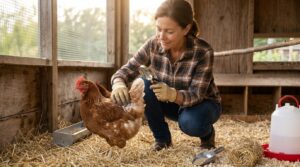
If you’re comfortable handling the chicken and she is stable, you can gently assess her breast muscles.
The keel bone runs down the center of the breast.
A veterinarian can use the breast muscles and keel to assess body condition. Significant loss of muscle can indicate poor nutritional status or chronic illness.
For a backyard keeper, the important question is simply:
Does she feel dramatically thinner than usual?
Don’t squeeze aggressively or repeatedly handle a weak bird just to perform a detailed body-condition assessment.
If you’re unsure, tell the veterinarian what you noticed.
13. Check Her Legs and Feet 🦶
Look at both legs and feet.
Check for:
- Swelling
- Cuts
- Scratches
- Crusty, raised scales
- Sores
- Swollen footpads
- Visible injuries
- Difficulty bearing weight
Merck recommends checking the scales of the legs and the footpads for abnormalities such as scaly-leg changes and footpad inflammation.
A chicken with a painful foot may become less active simply because walking hurts.
That is one reason not every lethargic chicken has a systemic illness.
14. Consider Her Egg Production 🥚
For a laying hen, note whether there has been a meaningful change in egg production.
Ask:
- Is she still laying?
- Has production suddenly decreased?
- Are eggs soft-shelled?
- Are eggs misshapen?
- Are several hens laying less?
Changes in egg production can have many causes, including normal reproductive changes, environmental factors, stress, and illness.
USDA APHIS lists decreased egg production and soft-shelled or misshapen eggs among signs that can accompany serious poultry disease.
So record the change, but don’t treat it as a diagnosis.
15. Think About What Changed Recently 🔎
Before calling the vet, make a quick timeline.
Ask:
Was a new chicken introduced?
Did the feed change?
Did the weather change dramatically?
Was there a predator incident?
Did the chicken have access to anything unusual?
Did another bird become sick?
Was there a recent injury?
Did the flock’s housing change?
These details can be extremely useful during a veterinary consultation.
Management-related problems can cause illness in backyard poultry, and early signs may be subtle.
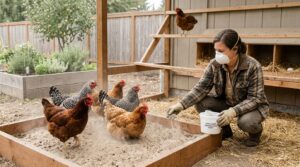
16. Check the Rest of the Flock 🐔🐔🐔
This is one of the most important steps.
Don’t only examine the individual chicken.
Stand back and watch the flock.
Look for:
- More than one lethargic bird
- Several birds eating less
- Respiratory signs in multiple chickens
- Several birds with abnormal droppings
- Multiple birds laying fewer eggs
- Sudden deaths
- Neurological signs in more than one bird
A single sick chicken and a group of suddenly sick chickens require different levels of concern.
USDA APHIS recommends acting quickly when sudden or significant changes occur in energy, appetite, breathing, egg production, or movement, particularly when illness affects the flock.
17. If You Must Handle Her, Keep It Gentle 👐
If the chicken is stable enough for handling, prepare everything before catching her.
Have nearby:
- A quiet examination area
- Clean towel if needed
- Notebook or phone
- Good lighting
- A clean temporary enclosure if isolation is appropriate
Catch her calmly.
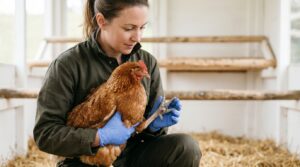
For chickens, Merck recommends holding the wings folded close to the body and supporting the breast while lifting.
Never squeeze the chest
Birds need normal chest movement to breathe.
Compressing the breast can interfere with breathing.
Don’t hold her upside down
Upside-down restraint can increase stress and the risk of regurgitation and injury.
And if the chicken is already having breathing difficulty, don’t perform a prolonged physical examination.
18. Separate Her if Appropriate 🏠
If a chicken is clearly sick, temporary separation can make monitoring much easier.
You can observe:
- Food intake
- Water intake
- Droppings
- Activity
- Breathing
- Ability to stand and walk
It can also prevent healthy flock members from bullying a weak bird.
Keep the area:
- Clean
- Quiet
- Appropriately ventilated
- Comfortable
- Easy to monitor
Isolation is not a diagnosis or treatment, though.
If a contagious disease is possible, additional biosecurity measures may be necessary. USDA APHIS recommends isolating sick birds and following veterinary or animal-health guidance when signs of disease occur.
19. Don’t Start Random Medications 💊
This is an important boundary for home care.
A chicken that is lethargic may have many possible problems.
Giving an antibiotic, dewormer, supplement, or other medication without knowing why it is needed can make the situation more complicated and may delay appropriate care.
Instead, focus on:
Observation → documentation → appropriate supportive conditions → veterinary advice.
If a veterinarian prescribes medication, follow the instructions carefully.
20. Know When to Stop Checking and Call the Vet 🚨
A home examination is useful only up to a point.
Call a veterinarian promptly when a chicken has persistent or worsening signs such as:
- Significant lethargy
- Loss of appetite
- Reduced drinking
- Abnormal droppings
- Eye or nasal discharge
- Lameness
- Progressive weakness
- Weight loss
- Unusual posture
- Reduced egg production
Seek urgent veterinary care for:
- Extreme breathing difficulty
- Severe weakness or collapse
- Seizures
- Serious neurological signs
- Open fractures
- Significant trauma
- Heavy active bleeding
These are not situations for prolonged home observation.
21. Take Your Vet a Useful “Chicken Report” 📱
Instead of saying:
“Something is wrong with my chicken.”
Give the veterinarian specific information.
Write down:
Chicken: Name or identifying description
Age: Approximate age
When symptoms started: Date/time
Activity: Normal / reduced
Appetite: Normal / reduced / none
Drinking: Normal / reduced / increased
Breathing: Normal / abnormal
Droppings: Normal / changed
Walking: Normal / abnormal
Eyes/nose: Normal / discharge
Comb/wattles: Normal / changed
Egg production: Normal / reduced / abnormal
Other birds affected: Yes / No
Recent changes: Feed, weather, new birds, housing, injury, possible exposure
Take photos or short videos when they can be obtained without stressing the chicken.
This gives your veterinarian a much clearer starting point.
A Simple 10-Minute Home Check 🕐🐔
If you need a quick routine, remember:
Minute 1–2: Observe
Watch the chicken and flock without touching her.
Minute 3: Breathing
Look for difficulty breathing, gasping, or abnormal respiratory effort.
Minute 4: Appetite and water
Confirm whether she is actually eating and drinking.
Minute 5: Eyes and nose
Check for swelling, discharge, or other obvious changes.
Minute 6: Comb and wattles
Look for swelling, lesions, or unusual discoloration.
Minute 7: Feathers and vent
Check for wounds, parasites, blood, or excessive soiling.
Minute 8: Droppings
Look for persistent or major changes.
Minute 9: Movement
Observe walking, balance, posture, and leg use if she is stable.
Minute 10: Flock check
Look at the other chickens and record what has changed.
Then make the call if the signs are concerning.
The goal isn’t to finish a perfect examination. The goal is to gather useful information without making the chicken more stressed.
Final Thoughts 🌿🐔
Checking a sick chicken at home can be useful, but it should never become a substitute for veterinary care.
The safest approach is surprisingly simple:
Observe first. Handle gently. Check the basics. Record changes. Watch the flock. Know the emergency signs.
Remember that chickens can hide illness, so subtle changes in behavior, appetite, drinking, posture, droppings, or appearance deserve attention.
And if several birds suddenly become sick, birds begin dying unexpectedly, or you see serious respiratory, neurological, or other emergency signs, don’t spend hours trying to identify the disease yourself.
Your home check has already done its job.
It has helped you recognize that something is wrong and given you useful information to pass to a professional.
You don’t need to be the veterinarian. You need to be the observant chicken keeper who knows when to call one. 🐔❤️