One of the first questions new backyard chicken keepers ask is simple: How big does a chicken coop need to be?
The answer depends on more than the number of chickens. You also need to consider whether the birds have access to an outdoor run, the size of the breed, your climate, ventilation, feeder and waterer placement, nesting boxes, roosting space, and how much room you want to leave for normal chicken behavior.
A coop that looks large enough on paper can become crowded once you add roosts, nesting boxes, feeders, waterers, and bedding.
For that reason, it is useful to think about coop space as a practical planning problem rather than simply choosing the smallest possible structure.
How Much Coop Space Does One Chicken Need?
A commonly cited starting point for backyard chickens is around 3 square feet of indoor coop space per standard-size chicken when the birds also have access to an outdoor run.
For example:
| Number of Chickens | Approximate Indoor Space |
|---|---|
| 4 chickens | 12 sq. ft. |
| 6 chickens | 18 sq. ft. |
| 8 chickens | 24 sq. ft. |
| 10 chickens | 30 sq. ft. |
These numbers should be treated as a planning reference rather than a universal rule.
Different extension services, poultry organizations, climates, breeds, and management systems can recommend different space allowances.
More space is generally easier to manage, particularly if your chickens spend significant time inside because of winter weather, predators, rain, or extreme heat.
A slightly larger coop can also make cleaning easier and reduce problems associated with overcrowding.
How Big Should a Coop Be for 4 Chickens?
Four chickens are a manageable starting flock for many backyard keepers.
Using a 3-square-foot-per-chicken reference gives you approximately 12 square feet of indoor space.
That could be a coop measuring:
- 3 ft × 4 ft = 12 sq. ft.
- 2 ft × 6 ft = 12 sq. ft.
- 4 ft × 4 ft = 16 sq. ft.
In practice, a 4 × 4-foot coop may be more comfortable than trying to build exactly 3 × 4 feet because the extra floor area gives you more flexibility for equipment and maintenance.
You also need outdoor space.
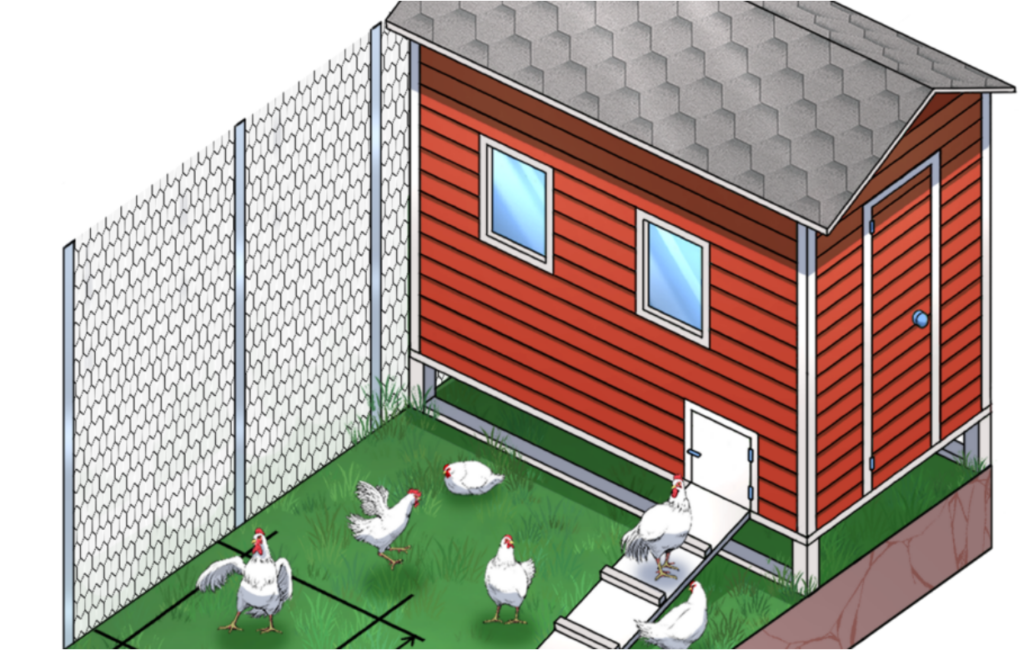
A coop and run should be considered as one system. If chickens spend most of their day outside, the indoor area has a different function than it would in a setup where they remain indoors for long periods.
How Big Should a Coop Be for 6 Chickens?
For six standard-size chickens, the same reference gives approximately 18 square feet of indoor space.
Possible dimensions include:
- 3 ft × 6 ft = 18 sq. ft.
- 4 ft × 5 ft = 20 sq. ft.
- 4 ft × 6 ft = 24 sq. ft.
A 4 × 6-foot coop gives you 24 square feet and may be easier to arrange.
Remember that six chickens need more than six bodies’ worth of floor space. You need room for:
- Roosting bars
- Nesting boxes
- Feeders
- Waterers
- Bedding
- Access doors
- Ventilation openings
The usable space can therefore be considerably different from the empty floor area shown on a building plan.
How Big Should a Coop Be for 10 Chickens?
Ten chickens require considerably more planning.
At approximately 3 square feet per bird, you would start with around 30 square feet of indoor floor space if they also have suitable outdoor access.
Possible dimensions include:
- 5 ft × 6 ft = 30 sq. ft.
- 5 ft × 8 ft = 40 sq. ft.
- 6 ft × 6 ft = 36 sq. ft.
For ten chickens, it is often worth building larger than the minimum reference if your property allows it.
A larger structure can be especially useful if your chickens spend considerable time indoors during bad weather.
What About Bantams?
Bantam chickens are smaller than standard-size breeds, so they generally require less physical space.
However, that does not mean you should simply divide standard chicken space by body weight.
Bantams are still active chickens. They need room to walk, perch, feed, dust-bathe, socialize, and escape aggressive flock members.
Some bantam breeds can also fly better than heavier standard breeds, which can influence how you design the run.
If you keep a mixed flock of bantams and standard-size chickens, designing around the needs of the larger birds is usually the simpler approach.
Indoor Coop Space vs. Outdoor Run Space
One of the biggest mistakes beginners make is treating the coop and run as the same thing.
They serve different purposes.
The coop provides a protected sleeping and nesting area. It should protect chickens from weather and predators while providing adequate ventilation.
The run provides additional space for movement, exploration, scratching, dust bathing, and social behavior.
If chickens are locked inside the coop for much of the day, the indoor space becomes much more important.
If they have reliable access to a spacious, secure run, the coop can function primarily as a sleeping and nesting structure.
But outdoor space does not excuse a cramped or poorly ventilated coop.
Don’t Forget the Roosting Space
Chickens naturally like to perch when sleeping.
Your floor-space calculation therefore does not tell you how much roosting space the flock needs.
Install sturdy roosting bars that are easy for chickens to access and clean.
The roost should also be positioned so that chickens are not sleeping directly over feeders, waterers, or nesting boxes.
The exact roost design can vary according to breed and chicken size.
Heavy breeds may require sturdier supports, while smaller breeds and bantams can use different arrangements.
How Many Nesting Boxes Do You Need?
You do not need one nesting box for every chicken.
A common planning guideline is approximately one nesting box for every four hens, although chickens may still insist on using the same favorite box.
For six hens, two nesting boxes can be a practical starting point.
For ten hens, two or three boxes may be appropriate depending on their design and flock behavior.
Place nesting boxes in a relatively quiet, darker area of the coop.
If the boxes are difficult to access, poorly positioned, or constantly disturbed, hens may choose other locations to lay eggs.
Where Should the Feeder and Waterer Go?
Feeders and waterers also consume valuable space.
They should be easy for every chicken to access without creating unnecessary crowding.
Avoid placing water where it can easily spill into bedding. Wet bedding contributes to moisture and odor problems.
Depending on the setup, raising feeders and waterers slightly can help reduce contamination from scratching and bedding.
However, equipment should remain accessible to all birds.
A dominant chicken should not be able to block the rest of the flock from food or water.
Why Bigger Can Be Better
There is a natural temptation to build the smallest possible chicken coop.
A smaller coop may cost less initially, but overcrowding can create management problems.
Too many chickens in too little space can contribute to:
- Increased competition
- Pecking and aggression
- Dirty bedding
- Moisture buildup
- Stronger ammonia odors
- Feather damage
- Difficulty cleaning
- Increased stress
Extra space also gives you more flexibility if you later add chickens.
However, building excessively large does not automatically solve every problem. A huge coop with poor ventilation, inadequate predator protection, or bad drainage can still be unsuitable.
The goal is usable space, not simply square footage.
A Simple Coop-Sizing Formula
For a beginner planning a standard backyard flock, you can start with:
Number of chickens × 3 square feet = approximate indoor floor-space starting point
For example:
6 chickens × 3 sq. ft. = 18 sq. ft.
Then ask whether you need additional space because:
- Your climate keeps chickens indoors for long periods
- You have large-bodied breeds
- Your run is small
- You plan to keep the flock for many years
- You want easier cleaning
- You may add birds later
If several of these apply, building larger than the basic calculation may make sense.
Final Thoughts
The right chicken coop size depends on more than a simple number.
For a starting point, around 3 square feet of indoor space per standard-size chicken with access to an outdoor run is a commonly used reference. Four chickens would therefore require roughly 12 square feet, six chickens about 18 square feet, and ten chickens about 30 square feet.
But those numbers should be viewed as a starting point rather than a target you must never exceed.
A good chicken coop needs enough room for chickens to move comfortably while also accommodating roosts, nesting boxes, feeders, waterers, bedding, ventilation, and maintenance access.
When in doubt, give your flock more usable space rather than designing right at the minimum.
A well-planned coop is not simply a box large enough to contain chickens. It is a dry, ventilated, predator-resistant environment where birds can sleep, lay eggs, move around, and behave naturally without unnecessary crowding.