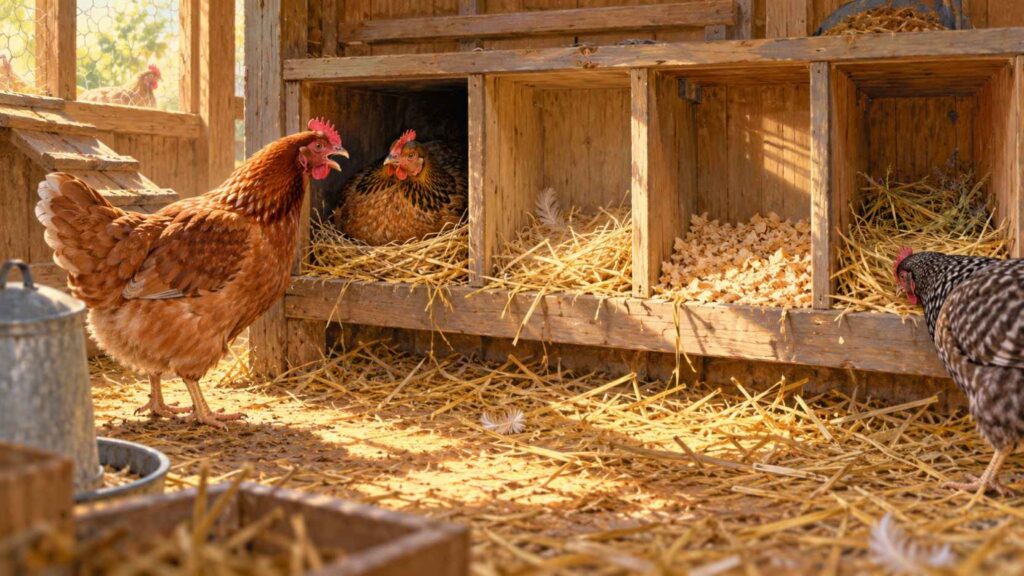
You walk into the coop and hear one hen making an astonishing amount of noise beside the nesting boxes, only to discover another hen peacefully occupying her favorite spot. 🐔 The strange part is that two or three perfectly empty boxes may be sitting only inches away, yet the waiting hen acts as though the flock has completely run out of places to lay. This behavior can look like bullying, panic, or a poorly designed coop, but it is often much simpler: your hen wants a particular nesting location, not merely any available box.
That makes chicken screaming at the nesting box less mysterious once you stop counting boxes and start watching which boxes the hens actually value. Laying hens can develop preferences based on location, privacy, substrate, familiarity, and what other hens are already using, so equal-looking boxes are not necessarily equal from a chicken’s perspective. Some waiting hens vocalize, pace, investigate alternatives, or attempt to squeeze into an occupied nest while they search for the situation they prefer.
Why Do Several Hens Want The Same Nesting Box?
Hens do not always spread themselves neatly across the nesting boxes you provide. Researchers describe gregarious nesting, in which hens choose to enter nests already occupied by another bird even though empty nests remain available, and studies have repeatedly found that particular nest positions receive disproportionate use. 🥚 This helps explain the classic backyard scene of three empty compartments beside one crowded box.
Location can become especially important because corner or end positions may receive heavier use, and young or inexperienced hens can be influenced by where other birds choose to lay. Once a particular box becomes established as a successful nesting site, familiarity and flock behavior may reinforce its popularity even though the neighboring boxes seem identical to you. More boxes are useful, but simply adding another identical compartment does not guarantee that hens will distribute themselves evenly.
Is The Chicken Singing An Egg Song Or Complaining?
Chicken keepers often use the informal phrase “egg song” for loud vocalizing around laying time, but sound alone does not tell you exactly what a hen is experiencing. 🎵 Research on laying-hen vocalizations has found that certain calls can occur during the pre-laying period and become more frequent when motivated hens are prevented from accessing a desired resource, including a nest. That means a noisy hen outside an occupied box may genuinely be expressing strong nesting motivation or frustration rather than simply celebrating somebody else’s egg.
Watch the behavior surrounding the noise instead of trying to diagnose the situation from the call itself. A hen walking between boxes, looking inside repeatedly, pacing near an occupied favorite, and eventually settling normally is behaving differently from a bird that remains distressed, weak, or repeatedly strains without laying. 👀 Treat vocalization as one clue in a larger behavioral picture rather than assuming every loud laying-area call means exactly the same thing.
Why Does My Hen Ignore The Empty Nesting Boxes?
Start by comparing the favorite box with the ignored boxes from a chicken’s point of view. Hens generally value nesting locations that feel secluded and comfortable, and loose nesting material can support normal nest-selection and nest-building behavior. 🌾 A brighter, exposed, unstable, dirty, difficult-to-enter, or poorly bedded box may therefore lose against a darker and more comfortable neighbor even when both have exactly the same dimensions.
Look for subtle differences such as sunlight entering one compartment, drafts, a loose floor, thinner bedding, another bird blocking the approach, or a box sitting beside a busy doorway. Accessibility also matters, particularly if a bird has to make an awkward jump or navigate a crowded perch to reach the nest. Rather than assuming the screaming hen is irrational, ask what makes the occupied box more attractive than every empty option beside it.
What Happens When A Hen Cannot Access Her Preferred Nest?
A highly motivated hen may wait near the preferred box, pace around the coop, inspect other locations, vocalize repeatedly, or attempt to join the hen already inside. 😤 Nest access matters strongly to laying hens, and behavioral research indicates that hens approaching egg laying are highly motivated to reach an acceptable nesting site. In many cases, the drama ends once the favorite box becomes free and the waiting bird enters normally.
If the preferred site remains unavailable, however, some hens may eventually choose another nest or search elsewhere for somewhere that feels acceptable. That can contribute to eggs appearing on the coop floor, behind equipment, beneath bushes, or in another hidden location rather than in the provided boxes. 🔎 When new floor eggs appear alongside heavy competition for one nest, examine nest attractiveness and access before assuming the flock simply needs a completely redesigned coop.
How To Reduce Nesting-Box Competition Without Rebuilding The Coop
First, make the ignored boxes more like the successful box rather than immediately installing additional ones. Match bedding depth and material, keep each nest clean and dry, reduce unnecessary brightness, check that boxes do not wobble, and make entrances similarly accessible. 🪹 If one preferred box sits in the darkest corner while the others are exposed, improving privacy elsewhere may be more effective than increasing the raw box count.
Also observe the flock during its busiest laying period because overcrowding may only occur for part of the morning. One commonly used backyard guideline is roughly one nest box for every four to five hens, but adequate numbers do not eliminate individual preferences or gregarious nesting. Avoid repeatedly moving established boxes unless necessary, because the goal is to create several attractive choices rather than continually changing the location hens have learned to use.
Nesting-Box Problem Worksheet
Use this quick check while the flock is actively laying rather than inspecting an empty coop later in the day. 📋 Watch which boxes hens approach, which ones they reject, and exactly what happens when the preferred nest becomes occupied. Patterns become much easier to understand when you separate availability problems from preference problems.
| What You See | Likely Question To Investigate | What To Check |
|---|---|---|
| Occupied 🥚 | Is one favorite simply in use? | Watch whether waiting hens settle normally once it becomes free |
| Ignored 👀 | Why are empty boxes unattractive? | Compare privacy, light, bedding, height, stability, and access |
| Overcrowded 🐔🐔 | Are several hens trying to use one site simultaneously? | Observe peak laying time and actual nest use |
| Uncomfortable ⚠️ | Is something physically wrong with a box? | Check damp bedding, dirt, drafts, sharp edges, wobbling, or difficult access |
| Alternative laying 🔎 | Has a hen selected somewhere else? | Search floor corners, sheltered coop areas, run structures, and hidden outdoor locations |
Use the worksheet over several laying mornings instead of changing everything after one noisy incident. A single argument may simply reflect two hens wanting the same nest at the same time, whereas the same three boxes being ignored every day points toward a consistent environmental preference. The goal is to discover why hens vote for one nest with their behavior, then make the alternatives more competitive.
When Nesting Distress Is More Than Ordinary Frustration
Ordinary nest competition should not be confused with a hen that appears physically unable to lay. 🚨 Warning signs that deserve closer attention include repeated or prolonged unsuccessful straining, excessive time spent attempting to lay, pronounced tail pumping, lethargy, weakness, or a sudden failure to produce an expected egg accompanied by obvious distress. Egg-binding and other reproductive problems can produce some of these signs, so persistent physical distress should not simply be dismissed as a hen throwing a tantrum over her favorite box.
The easiest distinction is to watch what happens after the nesting conflict resolves. If the occupied box becomes available, your hen settles inside, lays normally, and resumes ordinary flock behavior, nest preference was probably the important clue; if she continues straining or appears unwell regardless of which nests are available, the situation deserves prompt veterinary attention. ❤️ Several empty nesting boxes do not automatically mean your hen sees several equally good choices—sometimes the screaming really does mean, “Someone is in my spot.”