
Introduction
Choosing fencing for a chicken coop can seem simple: buy a roll of wire, attach it to the frame, and let your hens enjoy a safe outdoor space. But there’s an important difference between keeping chickens inside an enclosure and keeping predators outside it.
Chicken wire is lightweight, flexible, and often inexpensive. Hardware cloth is a more rigid metal mesh with smaller openings. Although both can look suitable for a backyard coop, they serve different purposes when raccoons, foxes, dogs, snakes, or other predators are nearby.
For backyard chicken keepers, especially beginners working with a limited budget, choosing the right material can help prevent avoidable security problems.
The short answer: Hardware cloth is generally the better choice for predator-resistant coop openings and run walls. Chicken wire is useful for containment, but it should not be your only predator barrier. <Cite refs={[“turn480757search4″,”turn480757search5”]}/>
What Is the Difference?
Chicken Wire: Affordable and Flexible
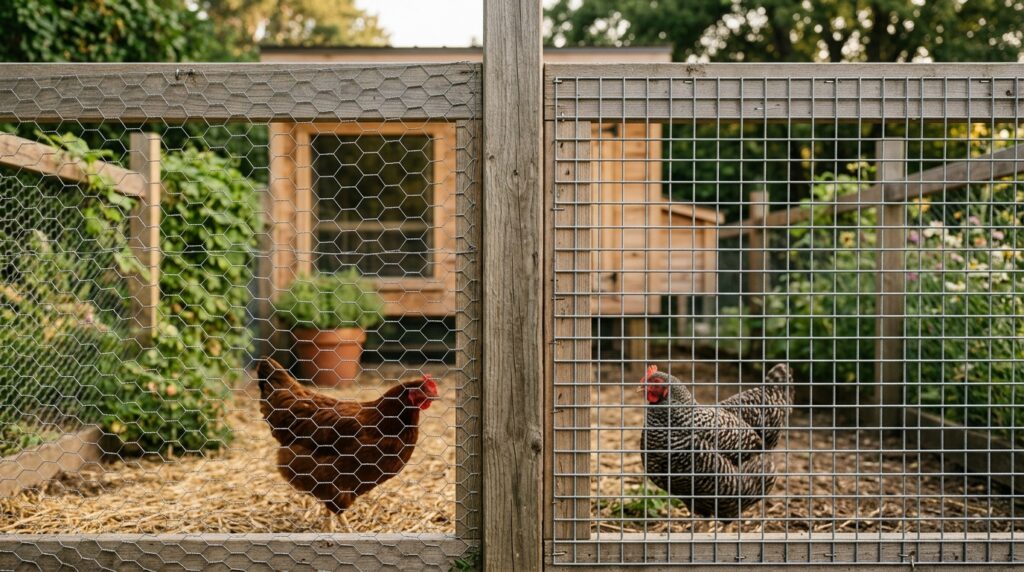
<text strong>Chicken wire</text> is typically made from thin wire twisted into a hexagonal pattern. It is easy to cut, bend, and attach, making it convenient for garden fencing, temporary dividers, and keeping chickens within a designated area.
However, its relatively large openings can allow predators to reach through, while the wire itself may be torn, bent, or pulled apart by a determined animal. Its low cost does not make it suitable for every part of a coop. <Cite refs={[“turn480757search4″,”turn480757search11”]}/>
Hardware Cloth: A Stronger Security Layer
<text strong>Hardware cloth</text> is a metal mesh commonly made with welded intersections and square openings. For many backyard chicken runs, ½-inch mesh is a practical starting point because the smaller openings reduce the chance that common predators can reach through to grab a bird.
Its effectiveness still depends on the wire thickness, material quality, framing, fasteners, and installation. A thin or poorly secured mesh can fail even if its openings are small. <Cite refs={[“turn480757search2″,”turn480757search6”]}/>
Hardware Cloth vs. Chicken Wire: Quick Comparison
| Feature | Chicken wire | Hardware cloth |
|---|---|---|
| Typical appearance | Hexagonal openings | Square grid |
| Construction | Twisted wire | Commonly welded wire |
| Flexibility | More flexible | More rigid |
| Upfront cost | Usually lower | Usually higher |
| Predator protection | Limited | Better when properly installed |
| Best use | Garden barriers and internal dividers | Coop vents, windows, and predator-facing run panels |
The exact strength, opening size, corrosion resistance, and price depend on the product. Always check the specifications rather than relying on the product name alone. <Cite refs={[“turn480757search4″,”turn480757search9”]}/>
Which Predators Are You Protecting Against? 🦊
Different predators create different risks, so the fencing material is only one part of your protection plan.
- Raccoons: Can reach through larger openings and may manipulate weak latches.
- Foxes and dogs: May dig under a run or damage a weak fence.
- Weasels and similar small predators: Can exploit surprisingly small gaps.
- Snakes and rodents: May enter through openings that seem insignificant during a quick inspection.
- Hawks and other aerial predators: Require protection from above, not just stronger side fencing.
Hardware cloth can reduce access through mesh, but it cannot guarantee a predator-proof enclosure on its own. Roof coverage, doors, gaps, ground-level protection, and regular maintenance matter too. <Cite refs={[“turn480757search5″,”turn480757search6”]}/>
Where Should You Use Each Material?
Use hardware cloth for security-critical areas
Prioritize hardware cloth on:
- Coop windows and ventilation openings accessible from outside.
- Permanent run walls exposed to predators.
- Gaps around doors and other openings.
- Ground-level areas where animals could reach or push through the enclosure.
For many backyard setups, ½-inch welded hardware cloth is a useful general-purpose choice. Where small predators or snakes are a known concern, a finer mesh may be appropriate. Consider the local risks and choose a product with suitable wire thickness. <Cite refs={[“turn480757search2″,”turn480757search6”]}/>
Use chicken wire for lower-risk tasks
Chicken wire can still be useful for:
- Separating sections inside an already secure enclosure.
- Temporary pens used under direct supervision.
- Protecting garden beds from chickens.
- Light-duty containment where predator exclusion is not the goal.
Avoid treating chicken wire as the sole barrier for a run where birds may remain unattended or overnight.
How to Make Your Coop More Secure
Even quality hardware cloth can fail if it is poorly attached. Use these practical steps when building or upgrading your enclosure.
1. Secure the mesh to a solid frame. Use suitable fencing staples or screws with washers, depending on the frame and mesh. Do not rely on a few weak fasteners or cable ties as the main security attachment.
2. Check every seam. Overlapping mesh should be securely fastened, with no loose edges a predator could pull away.
3. Protect against digging. Consider a securely attached mesh apron extending outward along the ground, or another appropriate dig barrier. The design should suit your soil and likely predators.
4. Secure doors and latches. A strong fence is not enough if an animal can open the door or squeeze through a gap.
5. Inspect regularly. Look for rust, broken welds, loose fasteners, bent mesh, and signs of digging. Repair weak points before they become entry routes.
6. Close birds inside a secure coop at night. A properly enclosed sleeping area adds another layer of protection, especially where nocturnal predators are active. <Cite refs={[“turn480757search5″,”turn480757search6”]}/>
Is Hardware Cloth Worth the Extra Cost?
Hardware cloth often costs more upfront than chicken wire. For a permanent coop or run exposed to predators, that extra investment may be worthwhile because the materials serve different purposes.
If your budget is limited, prioritize the areas where a predator could reach sleeping birds or enter the enclosure. You can use chicken wire for suitable low-risk tasks while investing in stronger mesh for the main security barrier.
Before buying, compare the price per square foot, mesh opening, wire thickness, coating, and roll dimensions. A cheaper roll is not necessarily a better deal if it is too flimsy for the job.
Final Thoughts 💚
Hardware cloth and chicken wire may look similar at a glance, but they are not interchangeable. Chicken wire is useful for containing chickens, while properly specified and securely installed hardware cloth is generally the better option for keeping predators away from your flock.
For most backyard keepers, the smart approach is to choose mesh based on the risk, secure it firmly to a sound frame, protect the ground-level perimeter, and check the entire enclosure regularly.
Build for the predator that might test your coop, not just for the chicken that lives inside it. A little extra planning can help you create a safer space without spending money on the wrong materials.




