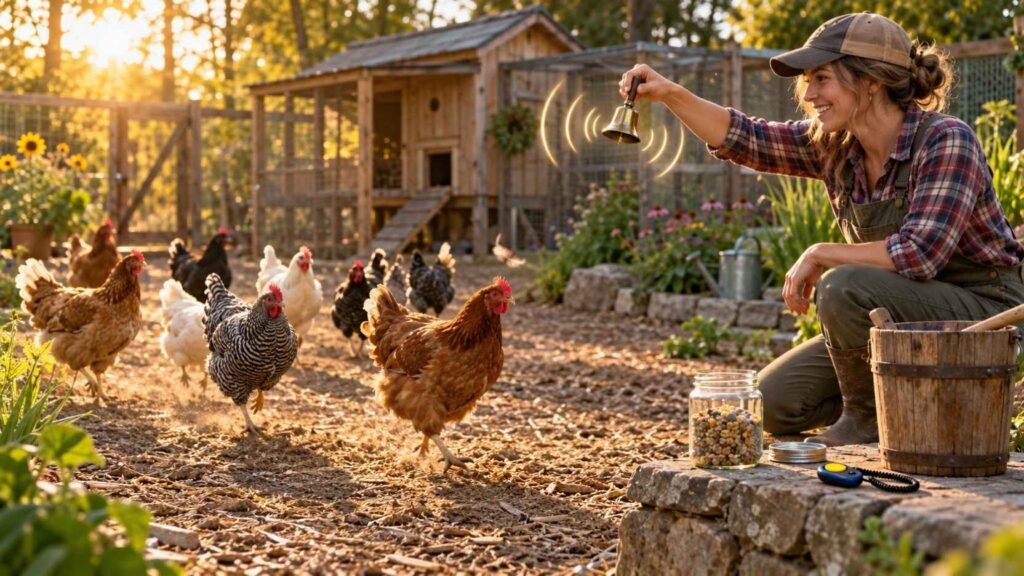
Whistling is often recommended for chicken recall, but it is a terrible household signal if only one person can actually make the same whistle. 🐔 A better recall cue is simply a distinct sound your chickens repeatedly hear immediately before something rewarding happens, such as receiving a small treat, entering a familiar feeding area, or returning to the run. That means learning how to call chickens without whistling is mostly about choosing a signal that is recognizable, repeatable, and practical.
You do not need a special chicken noise, perfect pitch, or complicated training routine. A spoken phrase, tongue click, small bell, rattling container, short melody, or repeated tapping sound can all become useful chicken recall sounds when consistently associated with the same outcome. 🔔 The best choice is usually not the cleverest sound—it is the one every caretaker can reproduce almost exactly the same way.
Can Chickens Learn To Recognize A Sound?
Chickens can learn associations between sensory cues and events, including sounds connected with food or other rewards. They are not necessarily understanding the literal meaning of “come here” in the human-language sense; instead, repeated experience teaches them that a particular sound predicts something worth approaching. 🧠 This basic associative learning is why the rattle of a feed scoop may eventually bring chickens running before you intentionally train anything.
Consistency is what turns ordinary noise into a meaningful cue. If you make the same sound and immediately provide a small reward over repeated sessions, the sound begins predicting what happens next. Once that association becomes strong, you can use the cue from farther away and eventually reward less frequently while still reinforcing the behavior occasionally.
6 Easy Sounds You Can Use Instead Of Whistling
You do not need a perfect whistle to teach chickens a reliable recall signal. 🐔 The important part is choosing a distinctive sound that you can repeat consistently and immediately connecting it with something positive. Here are six practical options that work well for different households and flock-management situations.
1. A Short Spoken Call 🗣️
A short verbal phrase is one of the easiest chicken recall sounds because you do not need any equipment. You might use “chick-chick,” “come on,” “girls,” or another distinctive phrase that you can repeat with roughly the same rhythm and tone. Keep it short so everyone caring for the flock can reproduce it easily.
This is especially useful if you want to train chickens with voice commands rather than carry a bell or container around the yard. Avoid using a phrase you constantly say during normal conversation because repeated accidental exposure can make the signal less meaningful. A slightly unusual two-word call often works better than an everyday phrase.
2. A Tongue Click Or Clicker Sound 👆
A tongue click or handheld training clicker provides a short, sharp, repeatable sound that is easy for chickens to notice. Because clicking is relatively distinctive, it can work especially well during short-distance training sessions around the coop or run. The cue should always be followed quickly by the expected reward while chickens are learning what it means.
The disadvantage is that not everyone can make exactly the same tongue click, so a mechanical clicker may be easier for households with several caretakers. Keep the device somewhere convenient rather than making recall depend on an object nobody can find when chickens need to return quickly. Once learned, the sound can become a useful part of routine flock handling.
3. Shake A Treat Container 🥜
Shaking a small container filled with treats may be one of the easiest signals for chickens to learn. The rattling sound is distinctive, carries reasonably well outdoors, and naturally predicts something the birds already want. Many chickens may even begin recognizing the container before you deliberately turn it into a recall cue.
Use one particular container and one consistent shaking pattern rather than rattling anything available. If similar containers are constantly shaken during unrelated chores, chickens may start responding to noises that have nothing to do with recall. A few deliberate shakes followed by a small reward creates a clearer signal.
4. Ring A Small Bell 🔔
A small hand bell gives you a consistent sound that children, adults, neighbors, and temporary caretakers can reproduce almost identically. It can also carry farther across a backyard than a quiet spoken call, making it useful if your chickens regularly free-range over a larger area. Ring it in the same short pattern every time rather than repeatedly ringing until birds eventually respond.
A bell is particularly useful for households where several people manage the chickens. Everyone can use the same physical signal without having to imitate one person’s voice or whistle. Store it near the coop or back door so it becomes a practical tool rather than another piece of equipment that disappears.
5. Hum Or Sing A Short Melody 🎵
A simple two- or three-note melody can become a surprisingly distinctive recall signal. You do not need to sing well because the chickens are learning the repeated sound pattern, not judging your musical ability. Choose something short enough that you can reproduce it almost automatically every time.
This option works particularly well for keepers who dislike shouting across the yard. Avoid using a melody you constantly hum while doing chores, however, because the chickens may hear it repeatedly without receiving the expected reward. Reserve your recall melody specifically for flock management whenever possible.
6. Use A Tap Or Clap Pattern 👏
Three taps on a bucket, two claps followed by a pause, or another short rhythmic pattern can work when you prefer a nonverbal recall signal. Rhythms are useful because the pattern itself can distinguish the cue from ordinary backyard noises. A simple pattern is also easier for another caretaker to copy than a complicated whistle.
Choose an object or action you can reliably access whenever you need to call the flock. Tapping the same coop post or designated bucket is usually better than striking random objects that all produce different sounds. Keep the volume reasonable because the goal is to attract chickens, not startle them into running.
Chicken Recall Sound Comparison
| Recall Sound | Easy For Children | Easy For Multiple Caretakers | Distinctive Outdoors | Accidental-Cue Risk | Best Use |
|---|---|---|---|---|---|
| Short spoken call 🗣️ | Excellent | Excellent | Good | Medium | Everyday family use |
| Tongue click / clicker | Good | Good | Good | Low | Short-distance training |
| Rattling container 🥜 | Excellent | Excellent | Excellent | Medium | Returning birds to run |
| Small bell 🔔 | Excellent | Excellent | Excellent | Low | Larger yards |
| Short melody / hum 🎵 | Good | Good | Good | Low | Calm flock routine |
| Tap or clap pattern 👏 | Good | Good | Very good | Medium | Hands-free-from-treat training |
The table highlights an important point: the “best” recall sound changes according to who needs to use it. A solo keeper may love a particular vocal call, whereas a household involving children, grandparents, neighbors, or pet sitters may benefit from a bell or designated rattle because those signals are easier to duplicate. Reproducibility matters more than originality.
You can also maintain one primary cue and one backup rather than teaching every sound imaginable. For example, your normal spoken call might work during daily chores while a bell becomes the stronger “everyone return to the run now” signal. 🚪 Too many interchangeable signals can make training unnecessarily complicated when one or two dependable cues accomplish the job.
How To Pick A Sound Your Chickens Won’t Hear By Accident
A good recall cue should stand out from normal backyard noise. If you constantly say “come on” while talking to your dog, children, or family members, chickens may hear the phrase many times without receiving reinforcement, gradually making it less informative. Instead, choose a short and relatively unusual combination of sound, rhythm, or words that you can deliberately reserve for the flock.
Think about practicality as well as distinctiveness. 📣 Your signal must be loud enough for birds to notice from the distance where you normally need recall, but it should not depend on shouting at maximum volume or carrying complicated equipment everywhere. A designated bell, container rattle, or unusual two-word call often provides a useful balance between consistency and convenience.
How To Introduce A New Sound Without Confusing Your Flock
Begin training when the chickens are relatively close and not intensely distracted. Make the chosen sound once or in its established pattern, then immediately provide a small desirable reward when the birds approach so the relationship between signal and outcome is obvious. 🐓 Short, successful repetitions are usually more useful than standing across the property continuously shouting a cue the chickens have not yet learned.
After the birds begin approaching reliably at close distance, gradually practice from farther away and in slightly more distracting situations. Do not jump immediately from five feet away inside the run to calling chickens that are exploring a large yard because you want each stage to remain easy enough for the flock to succeed. 🎯 Over time, you can reduce how often a substantial treat appears while still occasionally reinforcing recall so answering the cue continues to pay off.
Why Do Some Chickens Come While Others Ignore You?
Individual chickens can learn and respond differently, so do not assume the entire flock will perform identically after the same number of repetitions. A bold hen may race toward the reward immediately while a cautious bird watches first, and a chicken absorbed in scratching beneath a bush may simply be more distracted. 🌿 Flock dynamics can help because birds often notice companions moving toward something interesting and follow them.
Hierarchy can affect what happens after the flock arrives as well. A lower-ranking hen may understand the recall cue perfectly but hesitate to approach a reward surrounded by assertive flockmates, which can make her appear “untrained.” Providing enough space around the reward or scattering tiny portions across a controlled area can help you observe whether the issue is cue recognition or competition after arrival.
Keep Rewards Useful Without Turning Treats Into The Diet
Recall training does not require enormous handfuls of mealworms every time your chickens respond. A small reward can carry strong training value because the important part is the timing and association, not filling the birds with treats. 🥣 Their nutritionally complete feed should remain the foundation of the feeding system rather than being displaced by repeated training snacks.
You can also reinforce recall with events the chickens already value, such as access to a familiar feeding area or another positive part of their normal routine. This is particularly useful once the cue is established and you no longer need food rewards every single time. Think of treats as a training tool rather than the only reason your birds should ever listen.
What To Do When Your Chickens Stop Responding
When a previously reliable cue stops working, first ask whether the sound has lost its predictive value. Perhaps family members have been ringing the bell without rewarding the birds, someone rattles the same container during unrelated chores, or you have repeatedly called chickens when they were unlikely to respond. 🔄 In those situations, the problem may be cue dilution rather than stubborn chickens.
Run a simple reset by returning to close-distance practice for several sessions. Give the cue once, reward promptly when the chickens approach, and temporarily make successful responses easy before rebuilding distance and distractions. If the old cue has become part of constant background noise, selecting a fresh signal may be faster than trying to restore meaning to something the chickens now hear dozens of times without consequences.
Build A Recall Cue Everyone Can Actually Use
The most reliable signal is useless if nobody else knows it. Write down or demonstrate exactly what your household uses—perhaps three container shakes, one bell ring, or the same two-word verbal call—and ask other caretakers not to use the cue casually. 👨👩👧 This becomes especially valuable when someone else must put the flock away, move birds away from danger, or manage chickens while you are unavailable.
So, how do you call chickens without whistling? Pick one distinctive sound, immediately connect it with something positive, repeat the association at easy distances, and protect the cue from becoming meaningless background noise. 🐔 Whether your flock comes running to “chick-chick,” a bell, three taps, or the shake of a container matters far less than consistency, timing, and making the same sound mean the same thing every time.