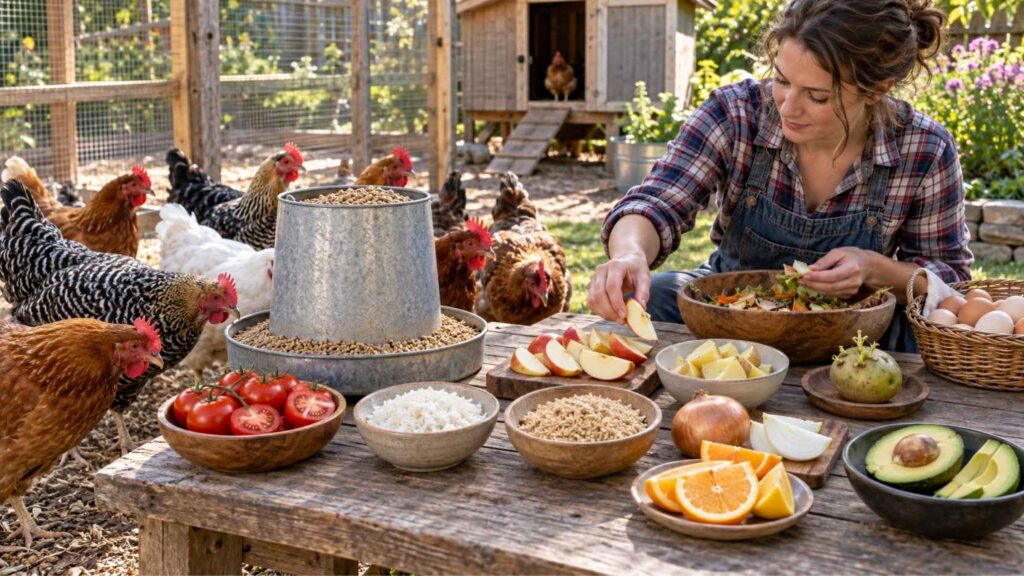
Search “Can chickens eat tomatoes?” and you may find one person saying absolutely yes while another warns that tomatoes are toxic, and surprisingly, both may be describing different parts of the same plant. 🍅 The same confusion happens with rice, potatoes, apples, onions, avocado, and citrus because simple yes-or-no answers often leave out the details that actually determine risk. For backyard keepers, the better question is usually not just “Can chickens eat this?” but “Which part, prepared how, in what amount, and how often?”
That distinction matters because chickens are curious eaters and may sample foods that should never become intentional treats. 🐔 A hen taking one accidental peck is also very different from a keeper putting a questionable food into the run every afternoon, so exposure and routine are not the same thing. These seven common myths can help you separate reasonable kitchen scraps from foods that deserve more caution.
Myth #1: Chickens Can’t Eat Tomatoes
Ripe tomato fruit can generally be offered to chickens as an occasional treat, which is why experienced keepers often report their birds happily eating garden tomatoes without problems. 🍅 The confusion comes from the tomato plant itself, because the leaves, stems, vines, and other green plant material contain higher concentrations of defensive glycoalkaloid compounds. This means “tomato” is too broad a word to answer the safety question accurately.
A soft, ripe tomato from the kitchen is not nutritionally equivalent to letting chickens strip foliage from tomato plants in the garden. Keep the plant parts away from the flock, avoid deliberately feeding unripe green tomatoes, and think of ripe tomato flesh as an extra rather than a substantial meal. 🌱 Most importantly, do not allow enthusiasm for tomatoes to displace the balanced poultry ration that should provide the majority of a laying hen’s nutrition.
Myth #2: Uncooked Rice Expands And Hurts Birds
The old story claims that birds eat dry rice, the grains expand dramatically inside them, and the digestive tract becomes dangerously overfilled. 🍚 That warning has circulated for decades, particularly around the tradition of throwing rice at weddings, but ordinary uncooked rice does not behave inside a bird like rice boiling inside a covered cooking pot. Birds naturally consume many kinds of dry grains and seeds, and rice is not uniquely capable of “exploding” inside them.
For chickens, the bigger issue with rice is much less dramatic: rice is not a complete poultry ration. Plain cooked or uncooked rice may be offered occasionally, but large portions can fill birds with predominantly carbohydrate-rich food while reducing how much nutritionally balanced feed they consume. Avoid heavily salted, buttered, seasoned, sauced, or spoiled leftover rice because the other ingredients may matter more than the rice itself.
Myth #3: One Apple Seed Means An Emergency
Apple flesh is generally suitable as an occasional chicken treat, and many flocks enthusiastically peck chopped apples or fallen fruit. 🍎 Apple seeds, however, contain cyanogenic compounds capable of releasing cyanide when the seeds are damaged and digested, which explains why reputable poultry guidance recommends removing them. That does not mean one overlooked seed should automatically cause panic.
Toxicity is influenced by dose, so accidentally swallowing a tiny amount is different from deliberately providing piles of crushed seeds or fruit pits. For routine feeding, the easiest practice is simply to remove the seeds and core before tossing apple pieces into the run. If a bird consumes a substantial quantity of questionable material or develops unusual weakness, breathing difficulty, neurological signs, or other concerning symptoms, contact a veterinarian rather than relying on internet calculations.
Myth #4: All Potatoes And Potato Peels Are The Same
The question “Can chickens eat potatoes?” becomes confusing because an ordinary cooked potato and a green, sprouting potato are not the same feeding situation. 🥔 Potatoes exposed to light or beginning to sprout can develop increased concentrations of glycoalkaloids, particularly around green tissue, sprouts, and skin. Those are exactly the portions backyard keepers should avoid putting into the flock’s scrap bucket.
Plain, properly prepared potato flesh from a sound, non-green potato is generally considered acceptable in moderation, but it still functions as a treat rather than complete feed. Do not assume that cooking makes heavily green or sprouted material suitable, because glycoalkaloid concerns cannot simply be solved by turning questionable potatoes into cooked scraps. A useful chicken-keeping rule is simple: if a potato is green, heavily sprouted, rotten, or questionable, keep it away from the flock.
Myth #5: Every Part Of An Avocado Carries Exactly The Same Risk
Avocado warnings are sometimes presented as though flesh, peel, pit, stem, and leaves all contain an identical amount of the same compounds. 🥑 In reality, concentrations and toxicity can vary among plant parts, and avocado leaves are particularly associated with the toxin persin. Birds are among the animals known to be susceptible to avocado toxicosis, although susceptibility also varies between bird species.
For backyard chicken management, there is little practical benefit in trying to calculate which avocado scrap might contain less persin. The safer and much easier routine is to leave avocado out of the chicken treat system, particularly the skin, pit, leaves, and plant material, instead of turning every leftover into an experiment. When dozens of other uncomplicated fruits and vegetables are available, avocado simply does not need to earn a place on the menu.
Myth #6: Citrus Is Automatically Toxic To Chickens
Oranges, lemons, grapefruit, and other citrus fruits are frequently placed on internet “never feed” lists, yet citrus itself is not automatically toxic to chickens. 🍊 Extension poultry guidance has specifically indicated that grapefruit can be offered, although birds may reject highly acidic foods because they find them less appealing. Some chickens enthusiastically peck citrus while others barely touch it.
That does not make citrus an unlimited feed ingredient, because it still lacks the nutritional balance of formulated poultry feed. Offer small amounts if you choose to use it, remove uneaten fruit before it spoils, and avoid turning citrus into a substantial portion of the diet simply because it happens to be available. The fact that chickens refuse a food also does not prove toxicity—sometimes they simply do not like it.
Myth #7: If A Chicken Eats Onions Once And Survives, Onions Must Be Safe
Onions show why accidental exposure and intentional feeding need to be separated. 🧅 Allium plants contain sulfur-containing compounds that can damage red blood cells when enough is consumed, and poultry research in other avian species has demonstrated anemia associated with substantial onion intake. Current poultry guidance therefore recommends avoiding large amounts and not making onions a routine treat.
A hen stealing one small onion fragment from a dropped dinner plate is not equivalent to feeding bowls of chopped onions every week. Likewise, saying “my chickens ate it and were fine” does not establish a safe feeding dose, because many food-related hazards depend on quantity, concentration, frequency, and the individual bird. When an ingredient has little nutritional reason to be deliberately provided and carries avoidable uncertainty, leaving it out is usually the easier management decision.
The Four Questions To Ask About Any New Scrap
Before giving chickens a food you have never offered before, start with which part of the plant or food you are actually holding. 🌿 Tomato flesh and tomato leaves illustrate why this matters perfectly, while potatoes show that color, sprouting, and condition can also change the answer. Saying “vegetables are safe” or “nightshades are toxic” is therefore far too broad to be useful.
Next ask whether the food is raw or cooked, how much will be offered, and how often the flock will receive it. Cooking may make some foods easier to consume, but it does not neutralize every naturally occurring toxin, while a tiny occasional treat can create a very different nutritional pattern from repeated large portions. Finally, check what else is mixed into leftovers because salt, sauces, seasonings, mold, spoilage, alcohol, chocolate, or other ingredients may turn an otherwise ordinary food into something you should not feed.
When To Stop Googling Individual Foods And Check The Whole Diet Instead
Once you have learned the major foods and plant parts worth avoiding, the bigger feeding question becomes what percentage of the flock’s appetite is being spent on extras. 🌾 Chickens can safely enjoy many fruits, vegetables, insects, grains, and garden foods, yet these individual ingredients do not reproduce the carefully balanced protein, amino acids, minerals, vitamins, and energy supplied by an appropriate complete feed. A treat can therefore be individually “safe” while the overall feeding routine is still poorly balanced.
Watch whether chickens actually eat their formulated ration instead of waiting for kitchen scraps, mealworms, rice, fruit, or scratch grain. 🥚 If treats are reducing regular feed consumption, the nutritional problem may not be tomatoes versus apples at all—it may simply be too many extras replacing the main ration. The best scrap system is one where complete feed remains boringly dependable and treats stay what their name suggests: small extras.
The Better Rule For Feeding Kitchen Scraps
The internet makes chicken feeding look more complicated than it needs to be because one forum post may describe a harmless accidental bite while another discusses repeated exposure to a concentrated toxin. 🐓 Do not judge food safety by whether one chicken ate something once without becoming sick, and do not assume every part of a plant has the same chemical composition. Instead, look at the specific food part, preparation, amount, frequency, and the rest of the diet.
Ripe tomato fruit, plain rice, seedless apple pieces, and properly prepared non-green potato can fit into a moderate treat routine, while green potato material, tomato foliage, avocado, and substantial onion feeding deserve much more caution. 🍎 Keep questionable or spoiled scraps out, maintain appropriate complete feed and fresh water as the foundation, and seek veterinary advice when significant ingestion or concerning symptoms occur. That approach is far more reliable than memorizing dozens of contradictory “yes/no” food lists—and much easier for a beginner to use every day.