One of the most important questions to ask before getting backyard chickens is not how much the coop costs or which breed lays the most eggs, but how much time chickens actually require every day. 🐔 Once a good system is established, routine care for a small flock can often be surprisingly quick, but describing chicken ownership as simply “10 minutes a day” leaves out cleaning, seasonal work, repairs, health problems, and unexpected events. The realistic commitment is a mixture of small daily jobs, larger periodic jobs, and occasional days when something goes wrong.
That distinction matters when people ask, “Are chickens high maintenance?” Compared with many pets, healthy adult chickens with an efficient coop can require relatively little hands-on work on an ordinary day, yet they cannot simply be ignored because feed, water, security, and flock condition still need regular attention. Extension guidance likewise emphasizes daily feed and fresh water, routine egg collection, predator protection, regular sanitation, and periodic deeper cleaning as basic parts of keeping laying hens.
How Much Time Do Chickens Take Each Day?
For many small backyard flocks, the essential chicken daily care routine may fit into roughly 5–15 minutes when feeders, waterers, nest boxes, and doors are conveniently arranged. ⏱️ That is not a guaranteed number because carrying water across a large property, manually opening a distant coop, cleaning a muddy waterer, or caring for 30 birds naturally takes longer than checking six hens beside the house. Think of the number as a planning range for an uncomplicated day rather than a promise that every chicken-owning day will be equally short.
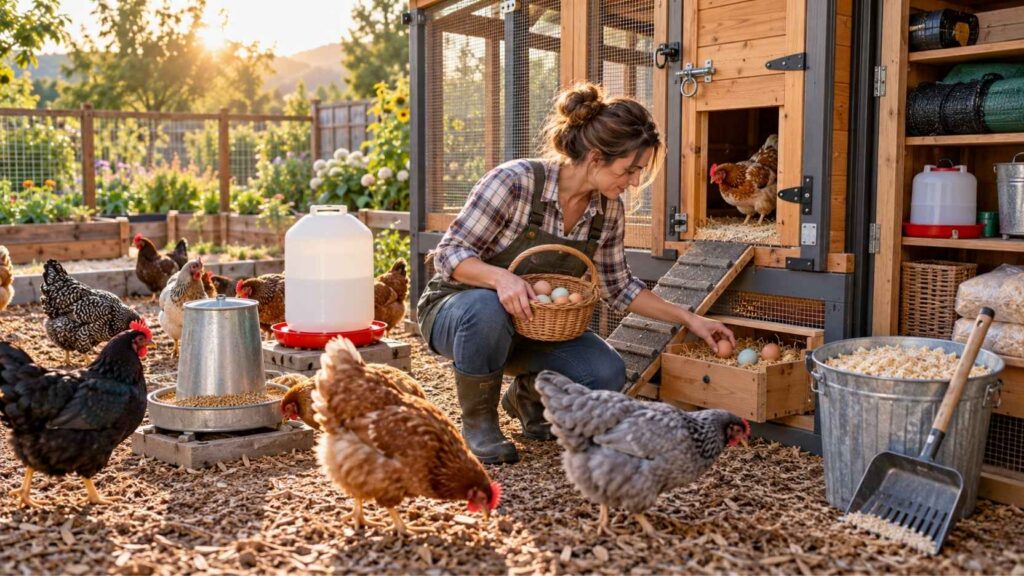
Daily work becomes faster when you stop thinking of it as several independent chores and turn it into one inspection loop. Walk to the coop, observe the flock, check feed and water, collect eggs, inspect the bedding briefly, and confirm that doors, fencing, and equipment are functioning before you leave. 👀 Most problems become time-consuming only after they have been missed for several days, which is why a short daily inspection can actually reduce the total workload.
The 5–15 Minute Essential Routine
Start with water because chickens should have continuous access to clean, fresh drinking water, and containers can empty through normal consumption, leaks, spills, freezing, or hot-weather demand. 💧 Then check the feeder, remove obviously spoiled or wet feed, and confirm that the hens are actually eating rather than assuming a full-looking feeder is functioning correctly. Water consumption and feed intake are closely connected, so reliable access to both is one of the most important parts of daily flock management.
Collect eggs, glance through nest boxes, and spend several seconds simply watching your chickens move. Healthy birds are generally alert and active, so a hen standing alone, limping, remaining unusually puffed up, or refusing food deserves a closer look even if the rest of the routine is normal. 🥚 If your chickens are manually released each morning and locked inside at night, include those trips in your true time estimate rather than counting only the midday chores.
What Has To Be Done Every Week?
Weekly chicken care is where your particular setup begins making a much bigger difference. 🧹 Inspect bedding for wet or heavily soiled areas, clean manure concentrations beneath roosts when necessary, inspect nest boxes, wash dirty drinkers, brush accumulated feed from feeders, and examine fencing or hardware for developing weaknesses. Some coops require substantial weekly cleaning, while deep-litter or carefully designed systems may rely more heavily on spot cleaning between larger bedding changes.
Use this time for a slightly closer flock inspection too, especially areas that are difficult to notice while chickens are moving quickly. Look at feet, feathers, vents, combs, general body condition, and behavior, and watch for evidence of mites, injuries, excessive feather damage, or persistent bullying. 🔍 Regular housing sanitation, removal of wet litter, and cleaning of watering equipment are standard poultry-management practices rather than cosmetic housekeeping.
What About Monthly Or Seasonal Cleaning?
A monthly checklist does not necessarily mean completely stripping the coop every 30 days. Instead, inspect the whole system: bedding depth and moisture, roosts, nest boxes, ventilation openings, feeder condition, water-system components, door latches, fencing, roofing, predator barriers, and places where rodents might be gaining access. 🛠️ Replace or clean what actually needs attention instead of creating unnecessary work simply because a calendar says it is cleaning day.
Seasonal work is usually larger because weather changes the weaknesses in your setup. Before summer, think about shade, ventilation, drinking-water capacity, and how rapidly water will become warm; before winter, check for frozen water problems, drafts versus necessary ventilation, roof leaks, and weather-related damage. ☀️❄️ A more thorough coop clean can also be scheduled periodically, with extension guidance recommending at least an annual deep cleaning and additional cleaning whenever manure, moisture, odor, or sanitation conditions require it.
Required Chicken Care Vs. Time You Choose To Spend With Them
One reason chicken-owner time estimates vary wildly is that people often mix required husbandry with enjoyable chicken time. Someone might finish feed, water, eggs, and security checks in ten minutes, then spend another 45 minutes sitting beside the run, hand-feeding treats, watching flock politics, gardening nearby, or talking to the hens. 😄 That does not mean the birds required nearly an hour of maintenance.
Separating those categories gives prospective owners a much more useful expectation. Required care includes food, water, sanitation, shelter, security, monitoring, and dealing with problems, while voluntary time includes bonding, training, enrichment projects, photography, free-range supervision, and simply enjoying your flock. ❤️ Many people discover that chickens require less compulsory daily labor than expected but inspire considerably more optional time because they are entertaining animals to watch.
What Suddenly Makes Chicken Care Take Longer?
The biggest time commitment rarely comes from an ordinary Tuesday morning; it comes from the unordinary Tuesday morning when something has changed. An injured hen may need separation and monitoring, a predator attempt may require emergency fencing work, a broody hen can change nest-box management, extreme heat may require additional water checks, and a leaking roof can suddenly turn clean bedding into a replacement project. 🚨 These events are not necessarily frequent, but prospective owners should budget for them mentally.
Weather deserves special attention because conditions can transform an otherwise automated setup. Waterers that comfortably last all day in moderate temperatures may need closer monitoring during heat, while freezing conditions can turn a normally effortless watering routine into repeated checks unless suitable equipment is available. Chickens are therefore low-routine rather than no-maintenance animals: most days may be simple, but someone still needs to be available when conditions change.
A Realistic Chicken-Care Calendar For Working Owners
Use this schedule as a starting framework rather than a rigid rule because flock size, climate, bedding method, predator pressure, coop design, and watering system all influence the workload. 📅 A six-hen suburban flock with an automatic door and large covered feeder will naturally operate differently from 25 free-ranging chickens using open bowls and manually operated housing. The objective is to make essential checks predictable enough that chicken care fits naturally before work, after work, or alongside other household routines.
| Schedule | Typical Chicken-Care Jobs |
|---|---|
| Daily | Check water, check feed, collect eggs, observe birds, inspect obvious contamination, confirm coop security |
| Weekly | Clean waterers thoroughly, inspect feeders, spot-clean bedding, remove wet manure areas, inspect birds and fencing |
| Monthly | Review bedding condition, inspect equipment, nest boxes, roof, ventilation, hardware, fencing and predator weaknesses |
| Seasonal | Prepare for heat or freezing weather, adjust water capacity, examine ventilation, inspect weatherproofing and perform larger cleaning when needed |
| As Needed | Treat injuries, isolate sick birds, repair equipment, manage broodiness, address predators, replace wet bedding or handle emergencies |
A screenshot of this table is more useful than trying to memorize a single daily-minute estimate. ✅ It shows why a chicken keeper can truthfully say, “My birds usually take ten minutes,” while still spending an hour cleaning the coop on another day or an afternoon repairing fencing once every few months. Average workload and maximum workload are two different questions, and responsible planning considers both.
When Your Routine Is Taking Too Long: Check The Setup
If basic chicken care takes an exhausting amount of time every single day, the birds may not be the real problem—the setup may be creating unnecessary labor. Carrying tiny amounts of water repeatedly, using undersized feeders, placing nest boxes where eggs are difficult to reach, crawling inside the coop to clean it, or manually dealing with a poorly designed door can turn simple husbandry into constant chores. 🔧 Infrastructure is effectively a labor-saving tool.
Before deciding chickens are too demanding, identify the chore consuming the most time and redesign that part first. A larger appropriate water reservoir, easier-clean feeder, removable manure board, accessible nest box, covered run, secure fencing, correctly positioned waterer, or properly installed automatic coop door can remove repeated friction without compromising animal care. The best chicken setup is not necessarily the fanciest one—it is the one that makes correct daily care easy enough to perform consistently.
So, Are Chickens High Maintenance?
For a healthy adult flock in a practical setup, chickens usually do not require hours of mandatory attention every day. 🐓 Expect a short daily routine, somewhat longer weekly maintenance, occasional larger cleaning and seasonal jobs, plus unpredictable extra work when weather, illness, predators, or equipment problems appear. Chicks, newly integrated birds, sick chickens, and complicated setups can require considerably more supervision than an established flock of healthy adult hens.
The better question is therefore not simply, “How many minutes do chickens take?” Ask whether you can reliably check them every day, keep water and feed available, maintain sanitary housing, secure them from predators, and respond when an ordinary ten-minute morning unexpectedly becomes a much longer job. If the answer is yes, chicken keeping can fit comfortably into many working households—and much of the extra time you eventually spend outside may be because you want to watch the chickens, not because the chickens require it. 🥚🌿