Finding one thin-shelled egg can immediately make a backyard chicken keeper think “calcium deficiency,” but the number of affected hens matters almost as much as the shell itself. 🥚 If several laying hens suddenly produce weak shells, the first suspects naturally include things they share—feed, water, heat, environmental stress, or another flock-level problem. When one hen repeatedly lays thin-shelled eggs while everybody else’s shells remain normal, however, the investigation should increasingly focus on that individual bird.
That does not prove the hen has a particular disease, nor does it completely rule out nutrition, because individual chickens do not necessarily consume identical amounts of the same ration. What it does give you is a useful diagnostic starting point instead of immediately changing the diet for every bird in the coop. The goal is to compare the affected hen’s age, laying history, food access, recent stress, behavior, and pattern of abnormal eggs before deciding that the entire flock needs more calcium.
Start Here: One Hen Vs Whole-Flock Problems
Think of eggshell quality as the finished product of several systems working together: the hen needs appropriate nutrition, adequate calcium and phosphorus availability, vitamin D3 for normal calcium metabolism, and a functioning reproductive tract capable of depositing the shell. 🐔 The shell itself is formed mainly from calcium carbonate, with much of the shell-building process occurring in the shell gland over many hours. A disruption anywhere along that chain can occasionally produce a thin, soft, misshapen, or shell-less egg.
The fastest first question is therefore not “What supplement should I buy?” but “How many hens are affected?” If you have eight established layers eating the same complete layer feed and seven continue producing sturdy eggs, a major deficiency affecting the entire ration becomes less convincing than it would be if all eight suddenly developed weak shells. That observation does not diagnose the eighth hen, but it tells you where to concentrate your attention first.
If Every Hen Has Weak Shells, Inspect The Shared Environment First
When shell quality deteriorates across several birds around the same time, investigate the things the flock shares. Check whether the hens are receiving a nutritionally complete ration intended for laying birds, whether treats or scratch grains are displacing too much of that ration, whether drinking water is constantly available, and whether severe heat or another environmental change has occurred. ☀️ Calcium, phosphorus, vitamin D3, and overall dietary balance all contribute to normal shell production.
Hot weather deserves particular attention because high temperatures can reduce feed consumption while laying hens still need substantial nutrients for egg production. If multiple birds begin producing weak eggs during the same hot period, that pattern means something different from one older hen producing occasional thin shells while everyone else remains normal. 🔎 Likewise, a sudden flock-wide change in egg production or shell appearance deserves more attention than a single isolated abnormal egg.
If Only One Hen Is Affected, Look At The Individual Bird
Suppose five hens share the same coop, feeder, waterer, and commercial layer ration, but only one repeatedly produces fragile shells. Instead of automatically increasing calcium for every bird, determine whether that specific hen is actually eating normally, whether dominant flockmates are interfering with feeder access, and whether she spends unusual amounts of time away from the primary ration. 🍽️ A shared feeder does not guarantee identical nutrient intake.
Watch the bird rather than only watching the eggs, because body condition, activity, appetite, mobility, droppings, and general behavior provide important context. A hen that remains bright, active, eating normally, and laying normally except for one unusual shell presents a very different picture from a bird becoming lethargic, losing condition, reducing production, or showing respiratory or other signs of illness. Persistent abnormalities accompanied by changes in the bird’s health deserve professional veterinary or poultry-health evaluation rather than repeated experiments with supplements.
New Layer Vs Established Layer
Young pullets beginning their first laying cycle can produce some strange eggs while their reproductive systems settle into regular production. 🐣 The shell gland is responsible for depositing shell material, and an immature shell gland can be associated with shell-less or poorly formed eggs. An occasional abnormal first egg therefore carries less diagnostic weight than the same defect appearing repeatedly in an established hen that previously produced normal shells.
This is where knowing whose egg belongs to whom becomes surprisingly valuable in a backyard flock. If the suspicious egg started appearing immediately after a pullet began laying, record it and watch the next several eggs before assuming the flock’s nutrition has suddenly failed. If a mature hen with months or years of normal shell production abruptly starts laying consistently thin eggs, her change in history provides a stronger reason to investigate further.
Age And Laying History Matter
Older hens also deserve their own category because eggshell characteristics can change as birds age. 🐔 Soft-shelled eggs and cracked eggs are reported more commonly in older hens, so the same ration can sometimes produce excellent shells in younger layers while an older bird begins showing declining shell quality. That makes age an important part of your one-hen thin-shell investigation, especially when the flock contains birds from several generations.
Do not interpret age as an automatic diagnosis, however, because an older hen can still develop nutritional or health problems just like a younger bird. Instead, compare her current eggs with her own previous eggs: Are they gradually becoming larger and thinner, did the change happen suddenly, or does she alternate between completely normal and very weak shells? A hen’s individual laying history often tells you more than simply comparing her egg with the strongest egg in the nest box.
Is She Actually Eating The Same Ration?
A bag of quality layer feed cannot help a hen sufficiently if she is not eating enough of it. Chickens establish social hierarchies, and a timid bird may spend less time at a crowded feeder while another hen dominates the most convenient feeding position. 🌾 Excessive treats, kitchen scraps, scratch grain, or free-ranging foods can also reduce how much balanced ration an individual bird consumes.
Before changing the whole flock’s feed, spend several feeding periods watching the affected hen and consider adding another properly positioned feeder if competition exists. If laying hens are offered supplemental calcium such as appropriately sized oyster shell, it is commonly provided free-choice rather than used as a substitute for a complete layer ration. More calcium is not automatically better, and repeatedly adding supplements without identifying the pattern can hide the real management problem.
Stress And Temporary Shell Abnormalities
Egg formation is a biological process rather than an assembly line, so an occasional imperfect egg does not automatically mean something is seriously wrong. Disturbances during egg formation, premature laying, environmental stress, or disruptions involving the shell gland can result in abnormal eggs, including soft, misshapen, wrinkled, or otherwise defective shells. ⚡ A single odd egg should therefore be treated as information to observe rather than an emergency diagnosis by itself.
Think about what happened during the previous day or two: Was the flock moved, chased by a predator, introduced to new birds, exposed to extreme weather, or otherwise significantly disrupted? Those observations become more useful when recorded instead of relying on memory several weeks later. If subsequent eggs immediately return to normal, the isolated defect carries a different meaning from abnormalities appearing again and again.
Why One Bad Egg Is Different From A Repeating Pattern
Imagine Hen A produces one thin egg on Monday followed by six normal eggs, while Hen B produces four thin or soft eggs during the same seven-day period. 🥚 Both technically produced an abnormal egg, but Hen B has the stronger pattern, and patterns are what should drive your next step. One-off shell defects occur; repeated defects tell you that something deserves investigation.
Also record exactly what “bad shell” means because thin, soft, shell-less, wrinkled, cracked, rough, and misshapen eggs are not identical abnormalities. A paper-like soft shell indicates something different visually from a fully calcified shell with one unusually thin area, while a wrinkled egg can involve disturbances of the shell gland rather than simply “not enough calcium.” 📋 Photographing unusual eggs beside a normal egg from the same flock can make changes much easier to compare.
One Hen Vs Whole Flock Diagnostic Table
| What You Observe | Look At First | Why It Matters |
|---|---|---|
| One abnormal egg, then normal eggs | Record and monitor | An isolated abnormal egg may be temporary |
| One hen repeatedly lays thin shells | Her age, diet intake, laying history and health | Individual factors become more important |
| Several hens develop thin shells together | Complete ration, supplements, heat, water and environment | Shared causes become more plausible |
| New pullet lays unusual eggs | Age and first-lay pattern | Reproductive maturity can affect early eggs |
| Older hen develops weaker shells | Age plus previous laying history | Shell problems can become more common with age |
| Hen seems unable to access feed | Feeder competition and ration intake | Sharing a coop does not guarantee equal intake |
| Thin shells continue with other health changes | Veterinary or poultry-health evaluation | Persistent shell changes should not automatically be labeled “calcium deficiency” |
Use the table as a direction finder rather than a diagnosis chart. 🔍 Its most important job is preventing two common mistakes: ignoring a repeating problem because only one hen has it, and changing the diet of an entire healthy flock because one unusual egg appeared. The flock-versus-individual distinction simply tells you which branch of the investigation deserves attention first.
Keep A 7-Day Egg Record
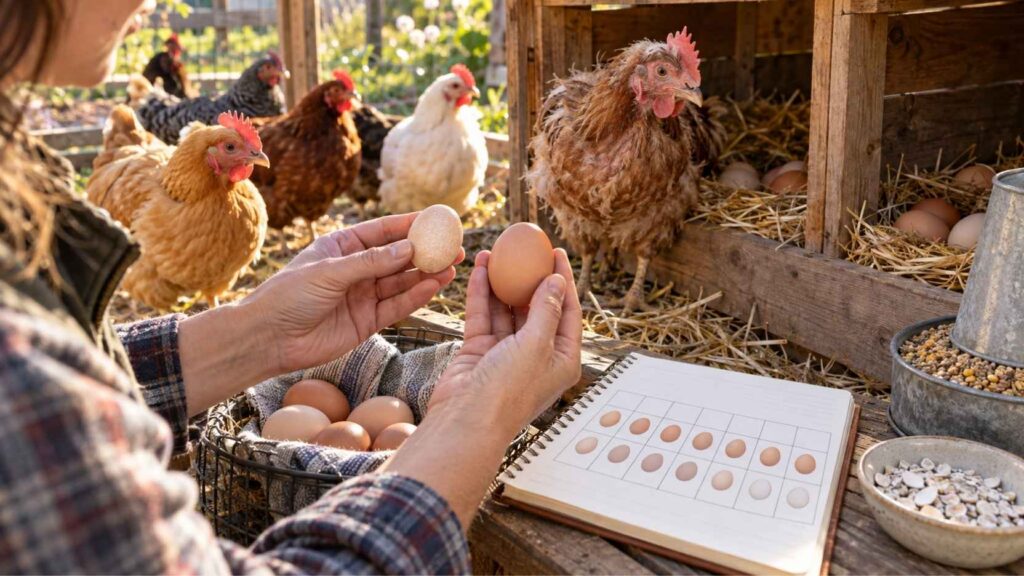
For the next seven days, record the hen, shell condition, approximate egg size, laying time if known, appetite, treats, weather, and anything unusual about the flock. 📅 You do not need laboratory-level notes; a simple notebook with “normal,” “thin,” “soft,” “shell-less,” or “misshapen” is enough to reveal a useful pattern. Marking or photographing eggs can help if several hens lay similar colors.
Seven days will not diagnose every reproductive problem, but it can quickly separate a random event from a repeating trend. If Monday’s strange egg is followed by normal shells all week, continued observation may be reasonable, whereas five abnormal eggs from the same hen create a much clearer case for closer investigation. The record also gives a veterinarian or poultry specialist far better information than simply saying, “Sometimes her eggs look weird.”
When Persistent Abnormalities Shouldn’t Be Treated As “Just Calcium”
Calcium is essential to shell formation, but thin shells are not a calcium test. Nutritional imbalance can involve calcium, phosphorus, vitamin D3, overall diet quality, or actual feed intake, while shell abnormalities may also be associated with age, shell-gland problems, heat stress, toxins, and infectious diseases. 🩺 That is why repeatedly adding calcium without examining the bird and flock pattern can lead you in the wrong direction.
Pay particular attention when persistent shell abnormalities occur alongside reduced egg production, decreased appetite, weakness, respiratory signs, noticeable behavioral changes, or abnormalities spreading to additional hens. Those combinations deserve advice from a veterinarian, poultry Extension specialist, or qualified poultry-health professional rather than assuming that another scoop of oyster shell will solve everything. One hen laying thin-shelled eggs while the others remain normal is a clue—not a diagnosis—and careful observation is what turns that clue into a useful next step.