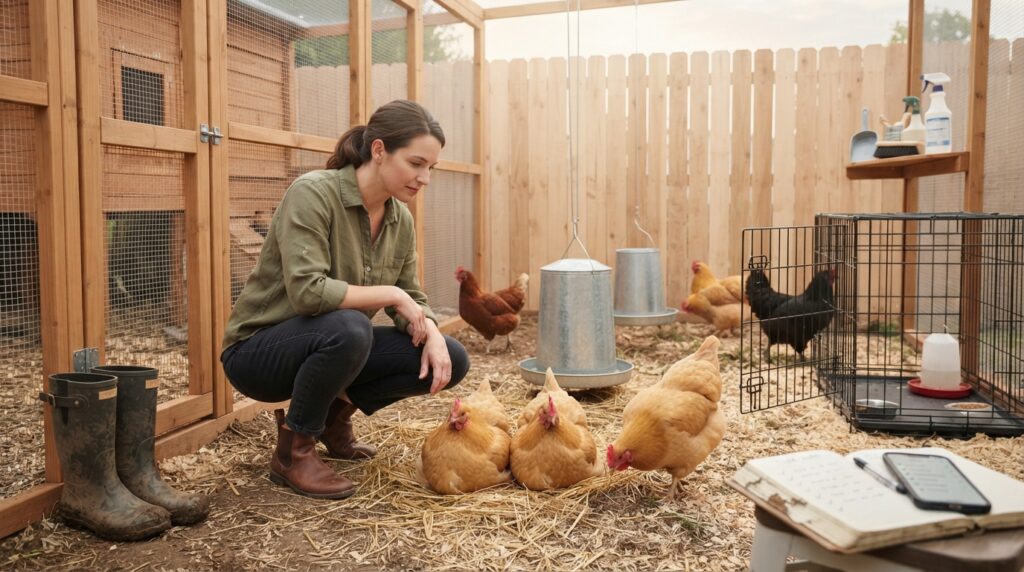
One sick chicken can be worrying.
Two or three sick chickens at the same time is different.
When several birds start showing changes in appetite, energy, breathing, droppings, egg production, or behavior, it’s time to stop thinking only about “What is wrong with this chicken?”
Start asking:
“What is happening to my flock?”
Multiple chickens becoming sick can happen for many reasons. Some causes are infectious and can spread between birds. Others may involve feed, water, parasites, toxins, ventilation, temperature, sanitation, or another shared environmental problem.
That means the safest first response is not to guess a disease from a photo or immediately start treating every chicken.
It’s to slow down, separate where appropriate, protect the healthy birds, document what changed, and get veterinary or animal-health guidance when the situation warrants it.
Here’s a practical flock-level approach. 🌿
🚨 First: Treat Multiple Sick Birds as a Warning
Chickens naturally hide illness because they are prey animals. Early signs can be subtle, including reduced activity, changes in eating or drinking, dull feathers, or changes around the eyes, nostrils, or vent.
When one bird looks slightly off, it can be difficult to know what it means.
When several birds show similar changes, the pattern itself becomes important.
Look for:
- Several birds becoming unusually quiet
- Multiple birds eating less
- Reduced water consumption
- A sudden decrease in egg production
- Several birds developing respiratory signs
- Changes in droppings across the flock
- Multiple birds losing weight
- Swelling or discoloration
- Neurological signs
- Unexpected deaths
USDA specifically identifies sudden deaths, increased mortality, lack of energy or appetite, reduced egg production, abnormal eggs, swelling, discoloration, and respiratory difficulty as signs that deserve prompt attention.
Don’t wait until every chicken is visibly sick before taking action.
🛑 Stop Moving Birds Around
When you see several sick chickens, your first instinct may be to rearrange the flock.
Try not to create unnecessary movement.
Moving birds between coops, pens, cages, or properties can potentially spread disease through birds, people, equipment, clothing, footwear, and other materials. USDA emphasizes controlling what enters and leaves bird areas and maintaining clean routines.
For now:
Pause new introductions.
Don’t sell or give away birds.
Don’t take birds to shows or gatherings.
Don’t move potentially affected birds to another property unless instructed by a veterinarian or animal-health authority.
This is particularly important when a contagious disease is possible.
🐔 Separate the Sickest Birds When Appropriate
Isolation can be useful, but there’s an important distinction:
Separating a visibly sick bird for care is not the same thing as pretending the rest of the flock is unaffected.
If one bird is weak and being pecked, place it somewhere safe where you can monitor it.
If several birds are sick, think about how your entire flock is managed rather than simply creating several little “hospital cages.”
Disease-control guidance commonly emphasizes quarantine or separation of affected groups, traffic control, and sanitation.
The exact setup depends on your property and the suspected problem.
If you have multiple poultry species or separate groups, avoid unnecessary contact between them.
🧼 Create a Clean-to-Dirty Routine
When more than one chicken is sick, how you move around the property matters.
If possible, care for apparently healthy or high-priority groups first and sick or affected birds last.
Then:
- Wash your hands
- Clean footwear appropriately
- Clean equipment
- Avoid sharing feeders and drinkers between groups
- Change or clean contaminated clothing when necessary
- Don’t carry dirty equipment into another flock area
Biosecurity is not about creating a complicated laboratory environment.
It’s about controlling the ways germs can travel.
USDA notes that pathogens can move through wild birds, animals, visitors, clothing, shoes, equipment, vehicles, feed, and other materials.
Even simple routines can reduce unnecessary movement of contamination.
💧 Check the Water Before Assuming It’s a Disease
When several chickens become sick, don’t look only at the birds.
Look at their environment.
Start with water.
Ask:
Is the water clean?
Is the drinker functioning?
Has anything fallen into it?
Has the water source changed recently?
Are multiple birds avoiding the drinker?
A dirty or contaminated water source can affect multiple birds because the entire flock shares it.
Clean and refill the water system while investigating the underlying problem.
If you suspect contamination, tell your veterinarian exactly what the birds have been exposed to rather than guessing at a treatment.
🌾 Check the Feed and Recent Feed Changes
The same logic applies to feed.
Look for:
- A recently opened bag
- A new brand or formulation
- Wet or moldy feed
- Unusual smell or appearance
- Feed contamination
- Rodent access
- Spoiled scraps
- Access to something they normally cannot reach
Don’t automatically assume the feed caused the illness.
But when several chickens become sick around the same time, shared exposures deserve investigation.
If poisoning or feed contamination is suspected, preserve useful information about the feed, supplements, pesticides, rodenticides, disinfectants, and other chemicals used around the birds. Veterinary diagnostic guidance notes that these records can be important when investigating suspected toxicosis.
☀️ Look at the Coop, Not Just the Chickens
Walk through the entire chicken area slowly.
Check:
Ventilation
Is the coop adequately ventilated?
Bedding
Is it wet, heavily soiled, or unusually contaminated?
Temperature
Have there been significant heat or cold conditions?
Crowding
Do the chickens have adequate space?
Wildlife access
Can wild birds or other animals enter?
Pests
Are rodents or insects accessing feed or water?
Chemicals
Have cleaning products, pesticides, rodenticides, or other substances been used nearby?
New birds
Did you recently introduce chickens from another source?
New equipment
Did you bring in used cages, feeders, crates, boots, or other equipment?
These questions don’t diagnose a disease.
They help you identify shared exposures and recent changes that a veterinarian may need to know about.
📋 Make a Flock Health List
Don’t rely on memory.
Write down every bird that looks abnormal.
For example:
| Chicken | Appetite | Activity | Breathing | Droppings | Other |
|---|---|---|---|---|---|
| Hen 1 | Reduced | Low | Normal | Changed | Fluffed |
| Hen 2 | Normal | Low | Abnormal | Normal | Sneezing |
| Hen 3 | Reduced | Low | Normal | Changed | Weight loss |
| Hen 4 | Normal | Normal | Normal | Normal | None |
You don’t need complicated medical terminology.
You need patterns.
If five chickens developed signs within two days, that’s important.
If one chicken became sick three weeks ago and another developed unrelated signs yesterday, that is a different pattern.
⏰ Write Down When the Problem Started
Timing can be extremely useful.
Record:
First sick bird: Monday morning
Second bird: Tuesday evening
Third bird: Wednesday morning
Feed changed: Sunday
New chicken introduced: Two weeks ago
Heavy rain: Monday
Egg production dropped: Tuesday
This doesn’t prove cause and effect.
But it gives a veterinarian a timeline to work with.
A flock-health investigation becomes much easier when you can describe what changed and when it changed.
🥚 Watch Egg Production
For laying hens, eggs can provide another useful clue.
Keep track of:
- Number of eggs
- Sudden decrease in production
- Soft-shelled eggs
- Misshapen eggs
- Changes in egg quality
A decrease in production doesn’t identify a particular disease by itself.
Stress, nutrition, environmental conditions, age, reproductive issues, and illness can all affect laying.
But when an unusual drop happens alongside other flock symptoms, document it.
USDA lists decreased egg production and soft-shelled or misshapen eggs among signs that can accompany significant poultry illness.
🫁 Pay Special Attention to Respiratory Signs
Multiple birds coughing, sneezing, showing nasal discharge, or having difficulty breathing deserves particular attention.
Respiratory symptoms can occur with several different poultry diseases, so you cannot reliably identify the cause from the symptom alone.
Watch for:
- Sneezing
- Coughing
- Nasal discharge
- Gasping
- Open-mouth breathing
- Increased respiratory effort
- Swelling around the face or eyes
Difficulty breathing is not something to casually monitor for several days.
Seek veterinary or animal-health guidance promptly, especially if multiple birds are affected.
☠️ Sudden Death Changes the Situation
One unexpected death is upsetting.
Several unexpected deaths or a rapidly increasing death rate should be treated as a serious flock-health event.
Some important poultry diseases can spread rapidly, and highly pathogenic avian influenza is one example that requires particular attention. Clinical signs can include respiratory, digestive, neurological, and other abnormalities, and sudden increases in mortality are important warning signs.
If multiple birds suddenly die or several birds become seriously ill over a short period:
Don’t move the flock to another location.
Don’t sell or give away birds.
Contact a veterinarian or the appropriate local animal-health authority for guidance.
In the United States, USDA specifically advises owners to report sick birds and contact animal-health officials when concerning signs occur. Local reporting procedures differ by country, so backyard keepers elsewhere should follow their own veterinary or government animal-health system.
🚫 Don’t Start Treating the Whole Flock With Random Medication
This is one of the most important rules.
When several chickens become sick, it can be tempting to reach for leftover antibiotics, dewormers, supplements, or another medication.
Don’t treat the flock based solely on a social-media diagnosis.
Different diseases can produce overlapping signs.
And medications used in food-producing poultry have additional considerations involving species, approved uses, withdrawal periods, and food safety. Merck specifically notes that antimicrobial products have different labeled uses and that some drugs are prohibited in food animals.
Instead:
Document → isolate where appropriate → identify possible exposures → contact a veterinarian.
If medication is prescribed, follow the veterinarian’s instructions precisely.
🧤 Be Careful With Dead Birds
If a chicken dies while several others are sick, don’t immediately dispose of the carcass without considering whether diagnostic testing might be useful.
A veterinarian or diagnostic laboratory may need a recently deceased bird for examination.
If toxicosis is suspected, veterinary guidance may also involve preserving feed or water samples and information about chemicals used around the property.
Ask your veterinarian or local animal-health authority what samples should be collected and how they should be stored.
Don’t improvise sample collection if it could create a biosecurity or safety problem.
📞 Know When to Call for Help
You don’t have to know the disease before contacting a professional.
Call a veterinarian or appropriate animal-health authority when:
🔴 Multiple birds are becoming sick
🔴 Several birds have respiratory signs
🔴 Birds are dying unexpectedly
🔴 Deaths are increasing rapidly
🔴 Birds show severe weakness or neurological abnormalities
🔴 There is significant swelling or discoloration
🔴 You suspect poisoning or contaminated feed
🔴 You suspect a serious contagious disease
🔴 You cannot determine whether the flock is stable
The purpose of professional help is not simply to obtain a name for the disease.
It can help determine what to do next and how to protect the remaining birds.
🧭 Think in Terms of “Flock-Level Questions”
Instead of asking only:
“What’s wrong with my hen?”
ask:
What changed?
Feed? Water? Weather? New bird? New equipment? Bedding? Wildlife exposure?
Who is sick?
One age group? One breed? Birds sharing a particular enclosure?
When did it begin?
Hours? Days? Weeks?
Are the signs similar?
Respiratory? Digestive? Neurological? General weakness?
Is the situation spreading?
More birds every day?
Is mortality increasing?
Any unexpected deaths?
Could there be a shared exposure?
Feed, water, chemicals, environment, parasites, or infectious disease?
These questions don’t replace diagnosis.
They help you respond intelligently instead of guessing.
🐔 Protect the Chickens That Still Look Healthy
Healthy-looking chickens are not necessarily guaranteed to remain healthy.
Some infections can spread before every bird shows obvious signs, and apparently healthy birds may have been exposed already.
That’s why biosecurity matters even after you notice the first sick bird.
Avoid unnecessary mixing.
Limit visitors.
Keep equipment from traveling between groups.
Protect feed and water from contamination.
Keep wild birds away from poultry and poultry supplies where possible.
USDA describes these everyday measures as core components of flock biosecurity.
📱 Create a “Flock Emergency Note”
A simple phone note can save time when you’re stressed.
Keep these details together:
Veterinarian: __________
Local animal-health contact: __________
Number of chickens: __________
Number currently sick: __________
First symptoms noticed: __________
First date noticed: __________
Recent feed change: __________
Recent new birds: __________
Recent medications: __________
Recent chemical exposure: __________
Recent contact with other poultry: __________
Deaths: __________
You may never need it.
But if several birds suddenly become sick, you’ll be glad you prepared it.
❤️ Don’t Blame Yourself Too Quickly
When multiple chickens become sick, it’s easy to immediately think:
“What did I do wrong?”
Don’t jump there.
Flock illness can have many possible causes, including infectious disease, parasites, management problems, environmental factors, and toxic exposures.
Your job in the first few hours isn’t to assign blame.
It’s to reduce unnecessary spread, protect the birds, collect useful information, and get appropriate help.
🌿 Final Thoughts
When more than one chicken starts getting sick, think flock first, individual bird second.
Don’t panic and don’t guess.
Slow down.
Separate birds when appropriate. Limit movement. Check food, water, housing, ventilation, wildlife exposure, and recent changes. Start documenting symptoms and timing. Strengthen your biosecurity routine. And contact a veterinarian or appropriate animal-health authority when multiple birds are affected, especially when respiratory signs, severe illness, or sudden deaths are involved.
The goal isn’t to become an overnight poultry diagnostician.
It’s to recognize that a pattern of illness is information. 🐔
The sooner you notice that pattern and respond appropriately, the more useful your observations can be to the people who can actually diagnose the problem and guide treatment.
A good flock-health response is not about having every answer.
It’s about knowing what to do before you have the answer.