Automation Should Reduce Chores, Not Replace Observation
An automatic chicken coop works best when it removes repetitive timing pressure without removing you from the flock. A good setup can open the coop, keep feed available, supply water, and simplify cleaning while you are at work or away for part of the day. 🐔 The goal is not “set it and forget it,” but less routine labor with the same daily awareness.
Equipment can fail quietly, and chickens cannot tell you that a door jammed, a nipple stopped flowing, or bedding became wet overnight. Poultry guidance still emphasizes fresh water, secure housing, dry litter, and regular flock monitoring even when labor-saving equipment is used. Automation should therefore buy back time, not eliminate observation.
Task 1: Opening and Closing the Coop
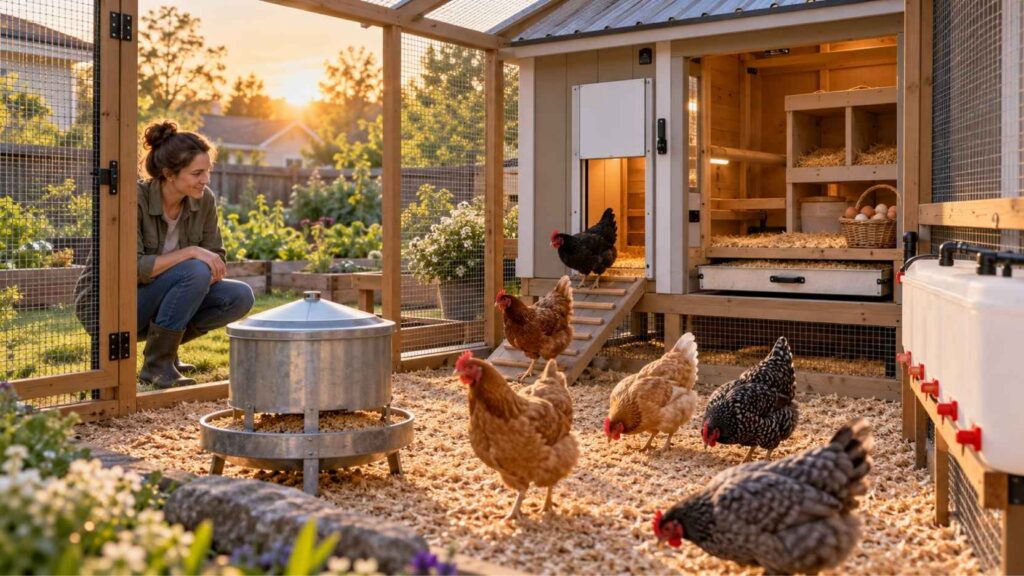
Opening the coop every morning and securing birds at night is one of the easiest chores to automate because it follows a predictable rhythm. An automatic chicken door can use a timer or light sensor, which helps keepers who leave early, work late, or cannot always be home at dusk. 🌅 Backyard keepers with full-time schedules frequently describe automatic doors as one of their biggest reductions in daily timing pressure.
The door is only one layer of predator protection, because it cannot compensate for weak wire, damaged fencing, gaps, or poor latches. Keep a manual way to operate the door if its motor, battery, sensor, or track fails, and remember that secure, covered housing remains central to predator protection. Occasionally watch closing time too, because a reliable door still needs to close after every bird is safely inside.
Task 2: Feeding Without Creating a Pest Buffet
Feeding can be simplified with a large-capacity automatic chicken feeder, gravity hopper, or treadle-style feeder holding several days of complete poultry ration. The main benefit is flexibility: you do not have to carry feed out at the same time every morning, and larger feeders are commonly used by working backyard keepers for exactly this reason. 🌾 Keep the system centered on an age-appropriate complete ration rather than treating scratch grains, table scraps, or treats as the flock’s main food.
A feeder can remain “full” while the feed becomes damp, clumped, spoiled, contaminated, or accessible to rodents and wild birds. Keep reserve feed dry and secure, clean spills, and position the feeder where rain and wild birds are less likely to reach it because feed sanitation is part of backyard-flock biosecurity. Your job remains simple but important: check the feed itself, confirm that it is flowing, and make sure all birds can reach it.
Task 3: Building a Dependable Chicken Water System
Water is another strong candidate for automation, using gravity waterers, poultry nipples, drinking cups, or reservoir-fed systems. A five-gallon nipple setup can reduce refill frequency for a small flock while making it harder for birds to kick litter directly into an open water pan, and backyard keepers commonly use this arrangement for lower-maintenance routines. 💧 Extension guidance specifically notes that automatic waterers can save labor even in small flocks, while chickens must still have continuous access to fresh, clean water.
Water deserves extra caution because one blocked nipple, empty reservoir, leak, frozen line, or tipped container can affect the whole flock. Larger capacity should never become an excuse to ignore cleanliness, since small-flock guidance recommends maintaining clean waterers and removing wet bedding around watering areas. When practical, provide redundancy and physically test nipples or cups instead of deciding everything is fine simply because the reservoir still looks full.
Task 4: Egg Collection Is Only Partly Automatable
Egg collection remains mostly a human task because gathering eggs also lets you notice dirty nests, cracked shells, broody behavior, or a sudden change in production. Roll-away-style nest designs can reduce how long eggs remain directly under active hens, but even a well-designed nesting system does not remove the need to inspect and collect eggs. 🥚 Think of nest-box improvements as partial assistance, not full automation.
Frequent collection reduces the time eggs remain exposed to breakage, dirt, extreme temperatures, and egg-eating behavior, and Penn State Extension advises collecting eggs at least twice daily, particularly during temperature extremes. A change in egg numbers may have ordinary explanations such as molt, age, season, or breed, but it is still useful information about your flock. Automation can protect eggs after laying, but it cannot interpret what the nest boxes are telling you.
Task 5: Cleaning Can Be Designed Down, Not Automated Away
Cleaning is less about buying a machine and more about designing the coop so manure and wet bedding are easy to remove. Removable trays, easy-access panels, well-placed roosts, and droppings boards or trays beneath roosts can concentrate manure where it is quicker to remove. 🧹 Extension guidance specifically notes that trays beneath roosting areas can make manure cleanup easier, while deeper bedding systems can reduce how frequently bedding is completely replaced when they are managed correctly.
No bedding system can automate away spilled water, ammonia, compacted litter, excessive moisture, or a leaking roof. Poultry guidance recommends removing wet or caked litter and providing enough ventilation to prevent persistent moisture and ammonia buildup. The best cleaning “automation” is therefore a coop that takes only a few minutes to inspect and spot-clean before small problems become large ones.
What You Cannot Automate
The most important chicken-keeping jobs are judgment calls, and those still belong to you. A camera may show that the flock is moving around, but it can miss a hen standing slightly apart, limping, losing condition, or being pushed away from food and water. 👀 Backyard-flock guidance continues to treat daily monitoring as a basic responsibility even when equipment makes routine husbandry easier.
You also cannot fully automate assessment of predator damage, wet bedding, poor ventilation, unusual droppings, broken fencing, jammed equipment, or unexplained changes in laying. Cameras, sensors, automatic doors, and large reservoirs can extend your awareness, especially when work schedules keep you away from home, but they are backups rather than replacements for inspection. A useful rule is simple: anything capable of failing needs a human check often enough that failure does not become an emergency.
Low-, Medium-, and High-Budget Automation Setups
A low-budget automatic chicken coop can begin with a secure enclosure, larger gravity feeder, appropriately sized waterer, convenient nest boxes, and a cleaning layout that reduces wasted motion. Add an automatic door when the coop and run themselves are already predator-resistant, because automating an insecure structure simply closes an insecure structure on schedule. 💵 This approach works well for beginners who need schedule flexibility but do not want numerous batteries, sensors, motors, and plumbing connections to maintain.
A medium-budget setup can add an automatic door, covered high-capacity feeder, nipple or cup chicken water system, droppings board, and simple camera, while a higher-budget system might include larger reservoirs, remote monitoring, backup power, alerts, and redundant water sources. More equipment does not automatically mean more reliability because every valve, hose, battery, connection, sensor, and motor introduces another possible failure point. Spend first on predator security, reliable water, weather protection, good ventilation, and easy maintenance, then layer convenience technology around those fundamentals.
Automate It / Check It Yourself Comparison Chart
The easiest way to plan your coop is to separate jobs that are repetitive from jobs requiring observation or judgment. Doors, feed storage, water capacity, nest design, and manure collection can all be made easier through equipment, while the condition of the birds and equipment must still be checked by a person. 🔎 This keeps automation focused on its real purpose: removing unnecessary labor without removing responsible flock care.
Use the chart below when deciding whether a new coop upgrade actually saves meaningful work or merely adds another gadget to maintain. Beginners usually gain more from one dependable door, one reliable water setup, and an easy-to-clean coop than from trying to automate everything at once. Build the simple systems first, watch how your flock uses them, and upgrade only when you understand the problem the next piece of equipment is supposed to solve.
| Coop Task | Automate It | Still Check Yourself |
|---|---|---|
| Morning opening | ✅ Automatic chicken door | Bird count, obstruction, door operation |
| Night closing | ✅ Timer or light-sensor door | Confirm every bird returned |
| Feeding | ✅ Large-capacity or treadle feeder | Feed condition, flow, pest activity |
| Watering | ✅ Nipples, cups, or reservoir | Actual water flow, cleanliness, leaks |
| Egg handling | ⚠️ Roll-away nest can assist | Collect and inspect eggs |
| Manure management | ⚠️ Trays and poop boards assist | Remove buildup and wet material |
| Bedding | ⚠️ Deep bedding can reduce labor | Moisture, odor, compaction |
| Predator security | ❌ Not fully automatable | Fence, wire, locks, digging, damage |
| Flock health | ❌ Human observation required | Behavior, mobility, appetite, appearance |
| Equipment failure | ❌ Human verification required | Batteries, valves, motors, sensors |
The Daily Two-Minute Automation Check
A good automated setup should make the daily inspection shorter, not optional. Walk the enclosure, confirm the automatic chicken door is working, scan the perimeter for digging or damage, glance at flock behavior, and verify that feed is dry and flowing. ⏱️ Then activate or touch several water nipples or cups yourself so you know water is actually reaching bird level instead of trusting the reservoir gauge alone.
Finish by collecting eggs, checking nests, scanning bedding for wet spots, and making a quick head count when the flock settles in the evening. If something looks different—one bird lagging behind, a damp corner, unusually high feed leftovers, fewer eggs, or an unfamiliar sound—slow down and investigate rather than letting automation reassure you falsely. The best automatic chicken coop is not the one you never visit; it is the one that makes two attentive minutes more valuable than twenty minutes of repetitive chores. 🐓