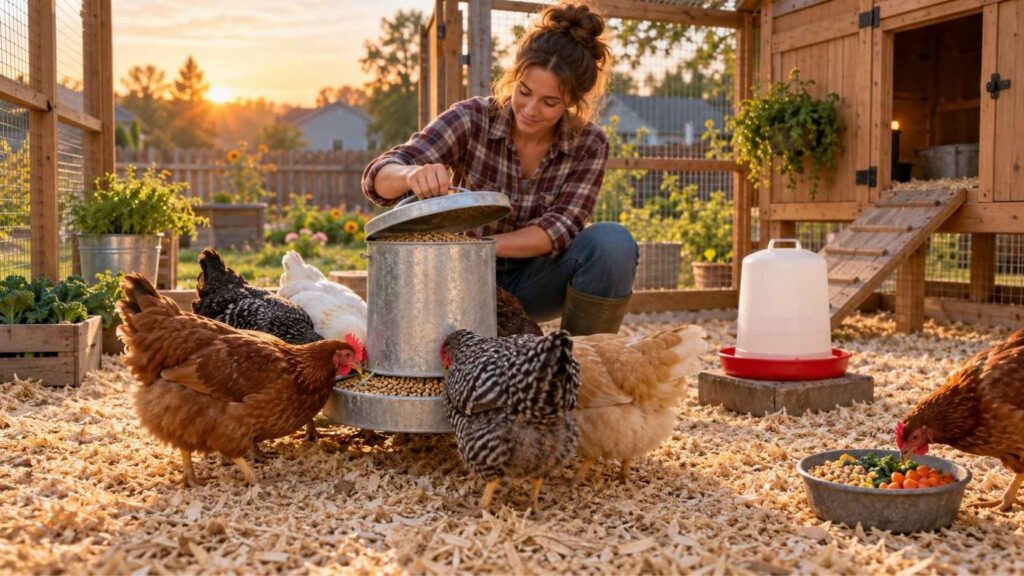
Giving chickens mealworms, scratch, fruit, or vegetables when the coop opens can feel like a harmless and enjoyable morning ritual. The birds rush over, the keeper gets an enthusiastic greeting, and those favorite foods disappear much faster than ordinary feed. 🐔 But the better question is not whether a particular treat is good or bad; it is what chickens should fill up on first.
For most backyard flocks, complete poultry feed and clean water should be the foundation, while treats remain optional extras. Complete poultry feeds are formulated to provide the protein, energy, vitamins, minerals, and other nutrients birds need, while adding too much grain or other food can upset that nutritional balance. A small morning treat is not automatically a problem, but hungry birds should not regularly replace their balanced breakfast with favorite snacks.
The morning question chicken keepers answer differently
Backyard keepers use many routines because flock size, yard space, weather, work schedules, and free-range time vary from home to home. Some scatter scratch immediately, others offer vegetables later, and some save mealworms for free-ranging or calling birds back into the run. 🌅 The visible routine may look different, yet the underlying diet structure matters more than the exact minute when treats appear.
A flock with reliable access to complete feed can handle occasional extras very differently from one receiving a large bucket of scraps before regular feed. Chickens readily consume attractive supplemental foods, so generous portions can reduce how much of their carefully formulated ration they eat. Oregon State University Extension specifically warns that excessive scraps and greens can dilute the diet when birds fill up on them instead of their normal feed.
Start with a complete chicken feed
When readers ask what to feed chickens, the answer begins with a complete ration made for the birds’ age and production stage. Chicks, growing pullets, and actively laying hens have different nutritional requirements, which is why the label on the feed bag matters more than whether the mixture simply looks wholesome or grain-rich. For laying birds, a layer ration is formulated differently from feeds designed for younger chickens.
A mixed-age flock may require a different strategy because younger birds should not simply be treated like laying hens. Oregon State notes that an appropriate all-purpose ration can serve chickens of different ages, but laying hens eating such a feed may need free-choice supplemental calcium such as oyster shell because their calcium requirements are higher. 🥚 This is another reason a feeding system should start with the flock’s life stages rather than with whichever treat happens to be available in the kitchen.
Why free-ranging all day does not automatically replace feed
Free-ranging can provide insects, seeds, plants, exercise, and valuable opportunities for natural scratching and exploring. However, one green spring yard may offer much more edible material than the same space during winter, drought, heavy rain, or after several hens have already picked it over. 🌿 Yard size, flock size, vegetation, season, soil, and time outside all change what free-ranging actually contributes.
Seeing chickens pecking and scratching throughout the day therefore does not prove they have assembled a nutritionally complete diet for themselves. Pastured birds can find insects and seeds, but their availability varies throughout the year, making forage an unreliable substitute for a properly formulated ration in an ordinary backyard setup. Keeping complete feed available gives the flock a consistent nutritional anchor when insects disappear, plants mature, or the run simply stops providing much food.
A simple morning feeding order
A practical chicken morning feed routine starts with the boring essentials before anything exciting appears. Confirm that the correct complete feed is available, check that every bird can reach it, and make sure the waterer contains clean, fresh water. Penn State recommends free-choice feed and a constant supply of fresh water for small laying flocks, while Oregon State stresses that water intake is substantial and increases during warm weather.
Morning feed → treats decision diagram: Complete feed available? → Fresh water available? → Birds can eat normally? → Optional small treat later. If feed or water is missing, correct that first; if both are ready, treats can wait or be skipped entirely. ✅ This simple order removes much of the confusion because treats are not a required daily feeding step, even when your chickens have trained you to believe otherwise.
Where scratch grains fit
Scratch grains for chickens commonly contain grains such as corn, wheat, oats, or barley and are especially attractive when scattered across litter or soil. Their most useful role is often enrichment because scattering them encourages scratching, searching, movement, and other natural foraging behaviors. 🌾 Scratch is not a complete poultry ration, however, so a feeder filled with scratch should not become a substitute for formulated feed.
Oregon State University Extension gives a general guideline of keeping scratch to about 10–15% of total daily food consumption, noting that larger amounts can dilute nutrients in the prepared diet. If chickens eat whole grains and cannot find suitable small stones outdoors, provide insoluble poultry grit separately so their gizzards can grind those foods properly. Oyster shell is different: it supplies calcium and is too soft to perform the same grinding function as grit.
Where fruits, vegetables, and kitchen scraps fit
Suitable fruits, vegetables, garden trimmings, and kitchen scraps for chickens can add variety, but variety is not the same thing as nutritional completeness. Watery produce may fill a chicken’s digestive tract while providing a different nutrient profile from formulated feed, and generous servings of leftovers can reduce consumption of the balanced ration. 🍎 Extension guidance therefore consistently treats scraps and greens as supplements rather than the foundation of the diet.
Timing offers a simple way to protect that diet structure without banning enjoyable extras. Offer appropriate scraps after the flock has had access to its normal feed instead of making fruit, vegetables, or leftovers the first large meal of the morning. That distinction should guide any Kitchen Scraps for Chickens system too: “safe to offer” does not mean “suitable to replace complete feed.”
Treats have one extremely useful job: training
Chicken treats become especially useful when they help you manage the flock instead of simply adding calories. Pair a small reward with a consistent call, whistle, bell, or shaken container, and chickens can learn that the signal predicts something desirable. 📣 That routine can make it much easier to gather birds when free-range time ends, bad weather approaches, you need to close the run, or everyone must be secured before you leave home.
For clearer training, give the reward where you want the chickens to finish rather than scattering it far from the enclosure. Use the same cue, encourage the flock through the gate, and provide the reward once the birds are where you need them to be. This turns chicken treats into a management tool, allowing a very small serving to provide more practical value than routinely dumping a large quantity into the yard.
Feed first does not mean treats are forbidden
A feed-first system is not meant to turn backyard chicken keeping into a joyless nutrition spreadsheet. Mealworms, scratch, greens, fruit, and suitable leftovers can all have useful roles when the complete ration remains the dietary center, and scratch in particular can encourage activity when used appropriately. 🐓 Extension recommendations differ somewhat in how strictly they limit particular extras, but they consistently agree that treats should not replace a balanced ration.
So, should chickens get treats first thing in the morning? A small amount may fit a well-managed flock’s routine, but beginners will usually find it simpler to make complete feed and fresh water the first priorities and offer treats afterward. Once that structure is established, questions about scratch grains, mealworms, vegetables, and kitchen scraps become much easier because every extra is judged against the same practical rule: feed first, treats second.